
All articles · Published 2026-10-03
TOEIC Part 5 grammar rules: 26 you can apply from the shape of a question, and the six-sevenths where they stay quiet
Some TOEIC Part 5 grammar questions don't require you to understand the sentence at all: "the" before the blank, "of" after it, and four forms of the same word — the answer is the noun, whatever the sentence is about. Yuko Koishi, a Japanese TOEIC instructor with a perfect 990, built a method around exactly this kind of judgment: a short list of numbered rules, keyed to what you can see around the blank, reread before the test. Handy 990 has turned the same idea into two features. "Grammar Rules" names the rule that decided a question the moment you see the answer, and "Final Five Days of Grammar" walks you through one family of rules a day before the exam. This article explains how we got from her method to these designs, which parts we added ourselves, and why the rules speak up on only one question in seven.
Where this started: a mistake notebook and a Japanese instructor
These features didn't start with a paper. They started with a YouTube video. In October 2026 the Chinese-language channel "brain 學霸" described Koishi's mistake-notebook method, and one idea in it stuck with us: don't copy your mistakes in date order, copy them grouped by the kind of error. Put responsible ___, apologize ___ and perfect ___ side by side, and you notice they are the same mistake three times.
We built that first, as "Your blind spots" in the mistake notebook: whenever two or more of your misses break the same rule, their gapped sentences are stacked on one card. Once it existed, the next question was obvious — which rule, exactly? The card could say "Prepositions". It couldn't name the rule itself.
So we went back to Koishi's book. Her TOEIC L&R テスト 英文法 出るとこだけ! (ALC, 2022) is a five-day Part 5/6 crash course built around 33 numbered rules. The full list isn't public; the only two examples we could find online are "after an intransitive verb, choose the adverb" and "if an object comes straight after the blank, choose the gerund, not the noun."
Two rules are not many. But they are enough to see the shape of the method.
Can TOEIC grammar questions really be solved by rules?
Look at what those two examples have in common: neither needs the meaning of the sentence. "Sales rose ___ in May." Rise is intransitive, it takes no object, so the blank is an adverb: sharply. You don't need to know what was sold or how much it rose.
That is a property of Part 5. As our post on Part 5 difficulty shows, almost all of a Part 5 question's difficulty lives in how its four options are arranged. If the options are implement, implementing, implementation and implemented, the question tests word forms, and the words around the blank decide it. If they are notify, announce, inform and declare, it tests meaning, and shape can't help you.
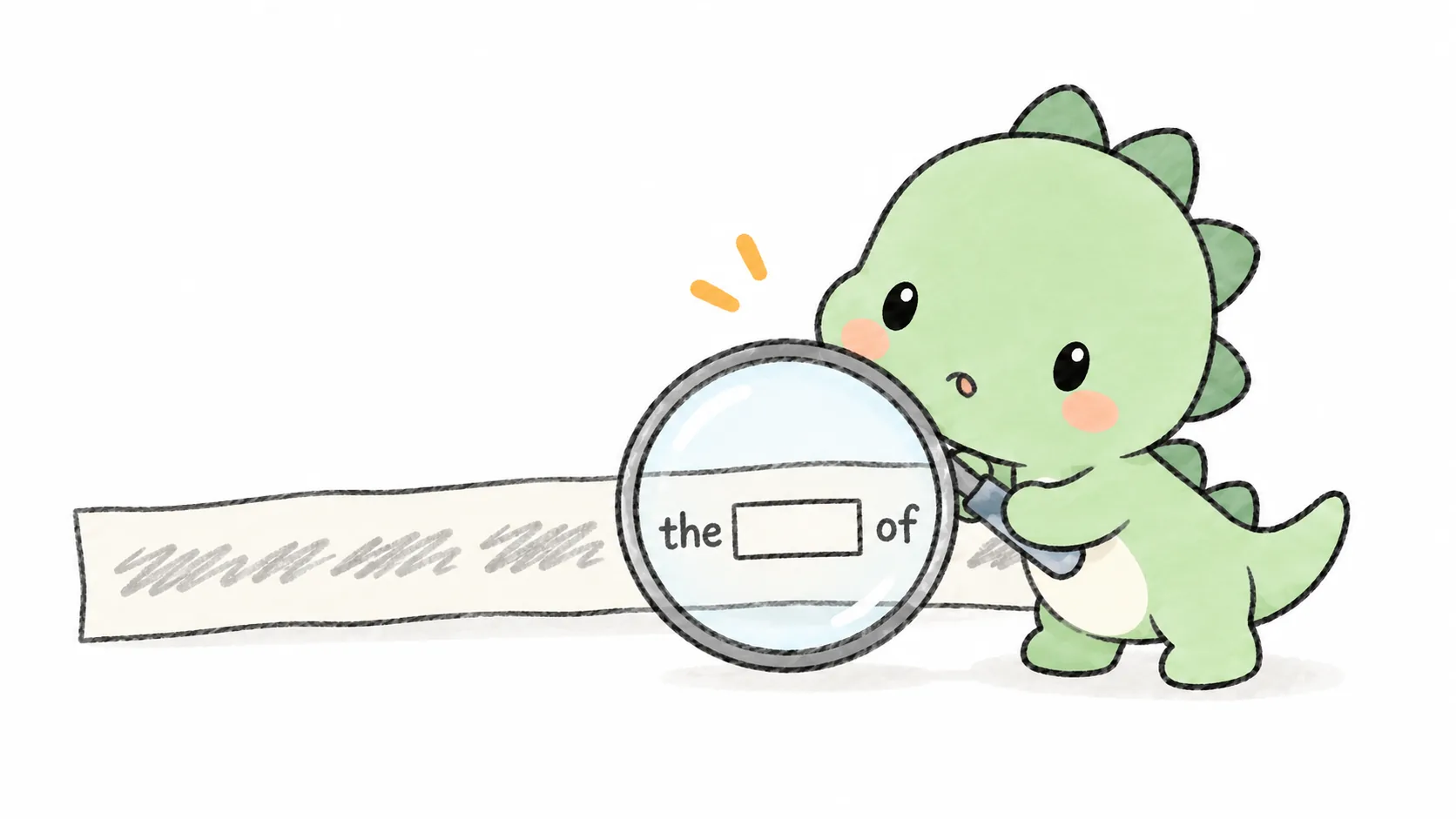
So the first thing we did was admit that rules can only handle the first kind of question — and then organize that kind properly. We ended up with 26 rules, grouped in the order of Koishi's five-day course:
| Family | Rules | Example |
|---|---|---|
| Parts of speech | 6 | determiner or adjective + blank + preposition: a noun |
| Verbs | 11 | since, so far, recently: the present perfect |
| Conjunctions | 2 | a clause follows: although; only a noun phrase: despite |
| Prepositions | 2 | in + month, on + day, at + clock time |
| Pronouns and relatives | 5 | a noun, then a verb, right after the blank: whose |
The wording of every rule is ours, written from our own question bank; none of it is copied from her book. What we borrowed is the form: numbered, read from the shape of the question, reread before the test, walked through in five days.
Why name the rule instead of writing a longer explanation?
Every question in the app already had an explanation, and they weren't bad. The trouble is that each one is written for that one question. Miss "the ___ of the new system" on Monday and "the candidate's ___ of the industry" on Thursday, and you read two different explanations. They look like two unrelated mistakes.
Cognitive psychology has a direct study of this. Gentner, Loewenstein and Thompson (2003, Journal of Educational Psychology) taught undergraduates a negotiation strategy using two worked cases. One group was asked to compare the cases and describe what they had in common; the other read the same two cases separately. Faced with a new negotiation afterwards, 48% of the comparison group used the strategy, against 19% of those who read the cases separately. Same material; the only difference was putting the two side by side.
So "Grammar Rules" does three simple things:
- It names the rule when the answer is revealed. After a Part 5 question or a Part 6 word blank is revealed, if a rule decided it, one line appears above the explanation: "Rule 1: A determiner (a, the, its) or an adjective before the blank, and a preposition, verb or full stop after it: the blank is a noun."
- The rule list counts your mistakes. Tap that line to open the list of rules, each with an example. If any of your pending mistakes are decided by a rule, it says "3 of your pending mistakes" with a button to redo them.
- Blind-spot cards get a real heading. In the mistake notebook, when every sentence in a "Your blind spots" group breaks the same rule, the card is headed by that rule rather than just "Word forms".
Monday's question and Thursday's now sit on the same card, under the same number. That is the gap between Gentner's 48% and 19%, turned into an interface.
How does the app tell which rule decides a question?
People read shapes quickly. A machine first has to be told what "reading a shape" means. Ours looks at only the few words either side of the blank, plus how the four options relate to each other.
Take Rule 1. It checks two things. First the position: before the blank is "the", "its", someone's, or an adjective; after it, a preposition, a verb or a full stop — a place where a noun goes. Then the options: they must be one word family (sharing a stem of at least five letters), and exactly one of them must be a noun.
The second step is the hard part. Implementation is obviously a noun — but design, offer, increase? Each is both a noun and a verb, and the spelling won't tell you. So we built a part-of-speech table for the 4,930 words that appear in the question bank, from the dictionary data the app already ships. Words outside the table fall back to their suffixes; if the suffix doesn't settle it either, the rule stays silent.
The most important design decision is this: a rule is shown only when it picks the correct answer. Rules applied by a machine will sometimes be wrong. A printed book doesn't have that problem; an app does. So for every question, each rule "answers" independently, and only a rule that picks the key is ever named.
Across the whole bank, 7 questions lead a rule to the wrong option. We list each one in our tests, with the reason. The best of them is a Part 6 sentence, "free and open to the ___". Rule 1 dutifully decides the slot needs a noun and picks publication. The answer is public — an adjective wearing a noun's coat. English does that. Learners see no rule on those seven questions, and if an eighth ever appears, the test fails and someone has to decide whether the rule or the question is the odd one out.

The last five days: why one family a day?
Koishi's book is a five-day course: day 1 parts of speech, day 2 verbs, day 3 conjunctions, day 4 prepositions and noun modifiers, day 5 pronouns and relatives. The order itself is a map of what Part 5 tests.
Our last week before the exam used to be driven by your weakest areas. That makes sense, but it has a blind spot of its own: no day guaranteed that you had walked through everything Part 5 tests at least once.
So "Final Five Days of Grammar" follows her order, and deliberately doesn't switch to weakest-first: parts of speech five days out, then verbs, conjunctions and prepositions, and pronouns and relatives the day before the exam. Each day adds one line to the daily plan at the top of the home screen, and it opens three things:
- that family's rules, with examples;
- the matching lessons in the interactive grammar book;
- 10 Part 5 questions.
How those 10 are chosen matters. Questions you still have wrong come first, then ones you haven't seen, and only then ones you already answered correctly; very hard questions are left out, because the last five days are for consolidating, not for the bank's trickiest corners. Answer all 10 and the day is ticked off.
Why put mistakes first? Because answering a question again is one of the most effective forms of review there is. Roediger and Karpicke (2006, Psychological Science) had students read a passage, then either read it again or take a recall test on it. A week later, the rereading group remembered 42% and the tested group 56% — the same time spent, a third more remembered. It is also why, when you redo a mistake in the notebook, we hide the options until you have an answer in mind.
If a mock test lands on one of those five days, the line still appears so the five days stay consecutive; it replaces that day's grammar catch-up instead of stacking a second grammar task on top. In the Last-minute review deck, the grammar section also becomes a checklist of the five families for those days, with today's in bold.
What these rules can't do
Last, the limits.
They speak up on one Part 5 question in seven. Of 1,216 Part 5 questions in the bank, 163 are decided by a rule, plus 31 Part 6 blanks. Most of the rest are vocabulary questions or questions that turn on meaning — there is no shape to read, and forcing a rule onto them would only mislead you. That is what "stay quiet" in the title means.
One family a day is blocked practice. Kornell and Bjork (2008, Psychological Science) had people learn to recognize painters' styles, seeing each painter's works either back to back (blocked) or mixed in with other painters' (interleaved). The interleaved group scored 61%, the blocked group 35% — and while 78% of participants did better with interleaving, 78% also believed blocking was as good or better. Our five days are blocked on purpose: what the last five days need is "every family seen at least once", not maximum discrimination. Smart Practice in the daily plan keeps mixing question types throughout those days; the blocked pass is one line among several.
These are not her rules. We borrowed Yuko Koishi's form and order; the rules are our own. If you want her original 33, read her book.
"Grammar Rules" appears in the answer to every Part 5 and Part 6 question that a rule decides, and the rule list opens from the Part 5 and Part 6 strategy guides; "Your blind spots" sits at the top of "To Review" in the mistake notebook. "Final Five Days of Grammar" appears automatically in the daily plan on Handy 990's home screen during the last five days before the exam date you set, free of charge; the Last-minute review deck is a Pro feature. For how the daily plan decides everything else, read TOEIC study plans that plan themselves; for why answering questions again works, read In Defense of Drilling.