
All articles · Published 2026-09-25
A unique or an unique? A vs. an depends on the sound, not the letter: why it's a university but an hour
A learner reported that "a unique code" in one of our questions was a mistake: unique starts with u, so it should take an. In fact, a unique is correct. A and an never look at the first letter, only at the first sound. This post sets out the rule in one table, then looks at a question in the official TOEIC sample test where a used and an invoice sit side by side, sorts out the abbreviations that trip people up most (an MBA, an HR manager, a NASA engineer), and ends with some history: an is actually the original form, and English once misheard a nadder as an adder.
What was "wrong" with that question?
The report was about this Part 5 item:
Each parcel is given a unique ___ so customers can locate it online.
The note said only: "unique needs an in front of it."
That instinct is perfectly reasonable. The version of the rule many people carry away from school is "use an before a, e, i, o, u". It is easy to remember, and it rarely lets you down in a test. Until you meet unique.
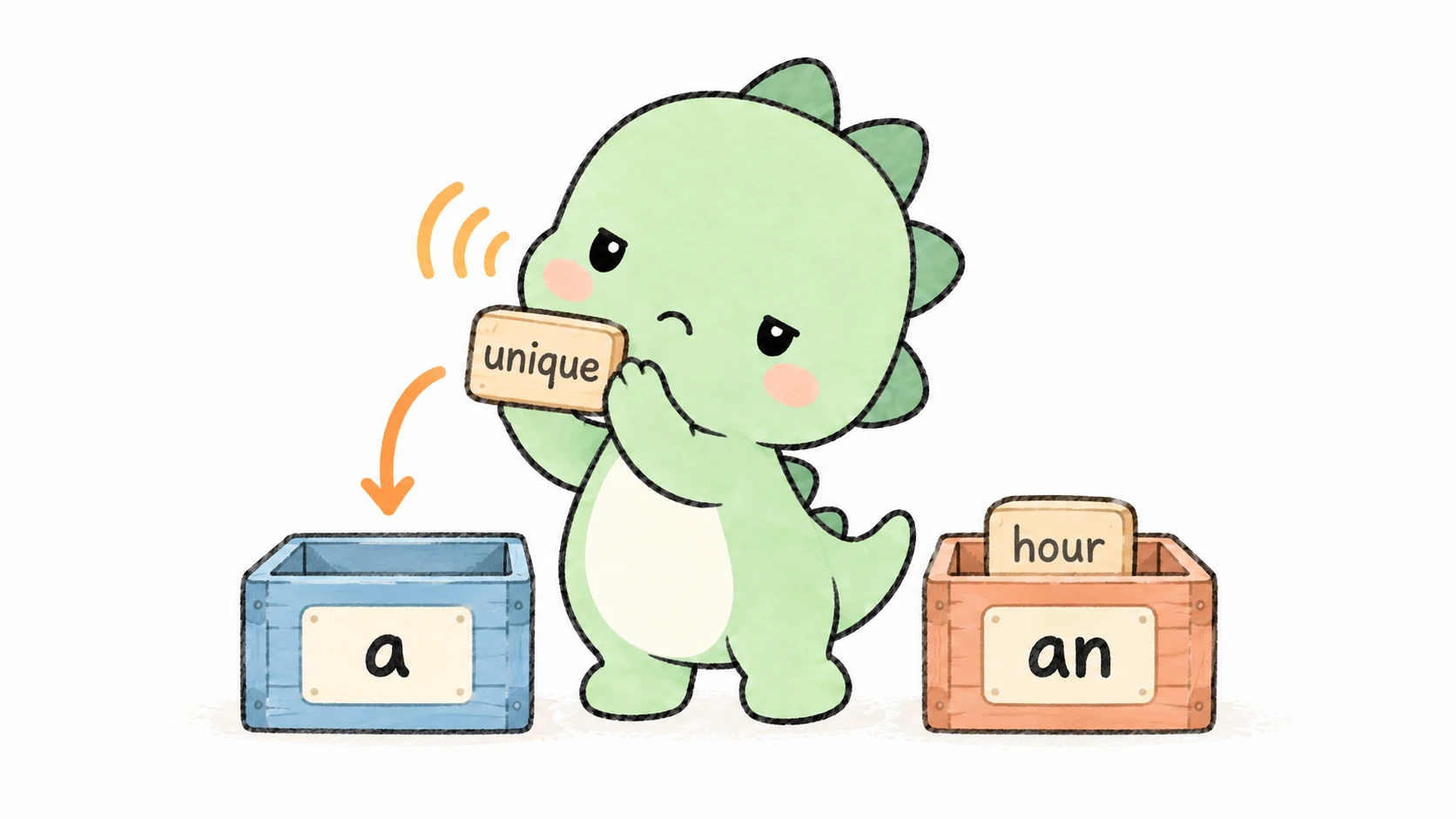
Say unique out loud: /juˈniːk/. It starts with "you". That /j/ is a consonant sound, the same one that starts yes and young. So it is a unique code, just as you would say a young man and never an young man.
The whole rule: look at the first sound
A and an have never divided the work by letters. They go by the first sound you say:
- The first sound is a consonant → a
- The first sound is a vowel → an
The trouble is that English spelling and English pronunciation often disagree, so "starts with a vowel letter" and "starts with a vowel sound" part ways:
| Word | First sound | Article | Why |
|---|---|---|---|
| unique | /j/ | a unique code | the u is said "you" |
| university | /j/ | a university | same |
| used | /j/ | a used car | same |
| European | /j/ | a European branch | eu is also said "you" |
| one-time | /w/ | a one-time fee | one is said "won" |
| hour | /aʊ/ | an hour | the h is silent |
| honest | /ɑ/ | an honest mistake | the h is silent |
| umbrella | /ʌ/ | an umbrella | the u is said as in "up" |
| uninsured | /ʌ/ | an uninsured driver | the un- prefix is said as in "under" |
The last row deserves a second look. Unique and uninsured share their first three letters, yet they take different articles. Looking at the letters, you cannot get this right. Saying the words, you get it in a second.
The official TOEIC sample test: a used and an invoice in one question
Question 73 of the official TOEIC Listening and Reading sample test published by ETS has the rule hidden in its options:
(A) Look for a used part
(C) Send an invoice
Used starts with u and takes a; invoice starts with i and takes an. Under the "look at the letter" rule, (A) would have to read an used part. But the writer was saying /juːzd/, so the writer wrote a.
Abbreviations cause the most mistakes: say the letter names
Abbreviations are where this rule goes wrong most often, because first you have to decide how the abbreviation is said.
For abbreviations read letter by letter, what counts is how the first letter's name is pronounced. M is /ɛm/, H is /eɪtʃ/, S is /ɛs/. All of them start with a vowel sound, so:
- an MBA (em-bee-ay)
- an HR manager (aitch-ar)
- an SUV (ess-you-vee)
- an IT department
- an ATM card (ay-tee-em)
Twelve letters have names that start with a vowel sound: A E F H I L M N O R S X. The other way round, the name of U is /juː/, so it is a U.S. company and a UK office.
For abbreviations read as a word, the ordinary rule applies. NASA is said /ˈnæsə/, which starts with a consonant, so it is a NASA engineer. But NBA is read letter by letter (en-bee-ay), so it is an NBA player. Both start with N, and they take different articles.
Why does English work this way? An is the original
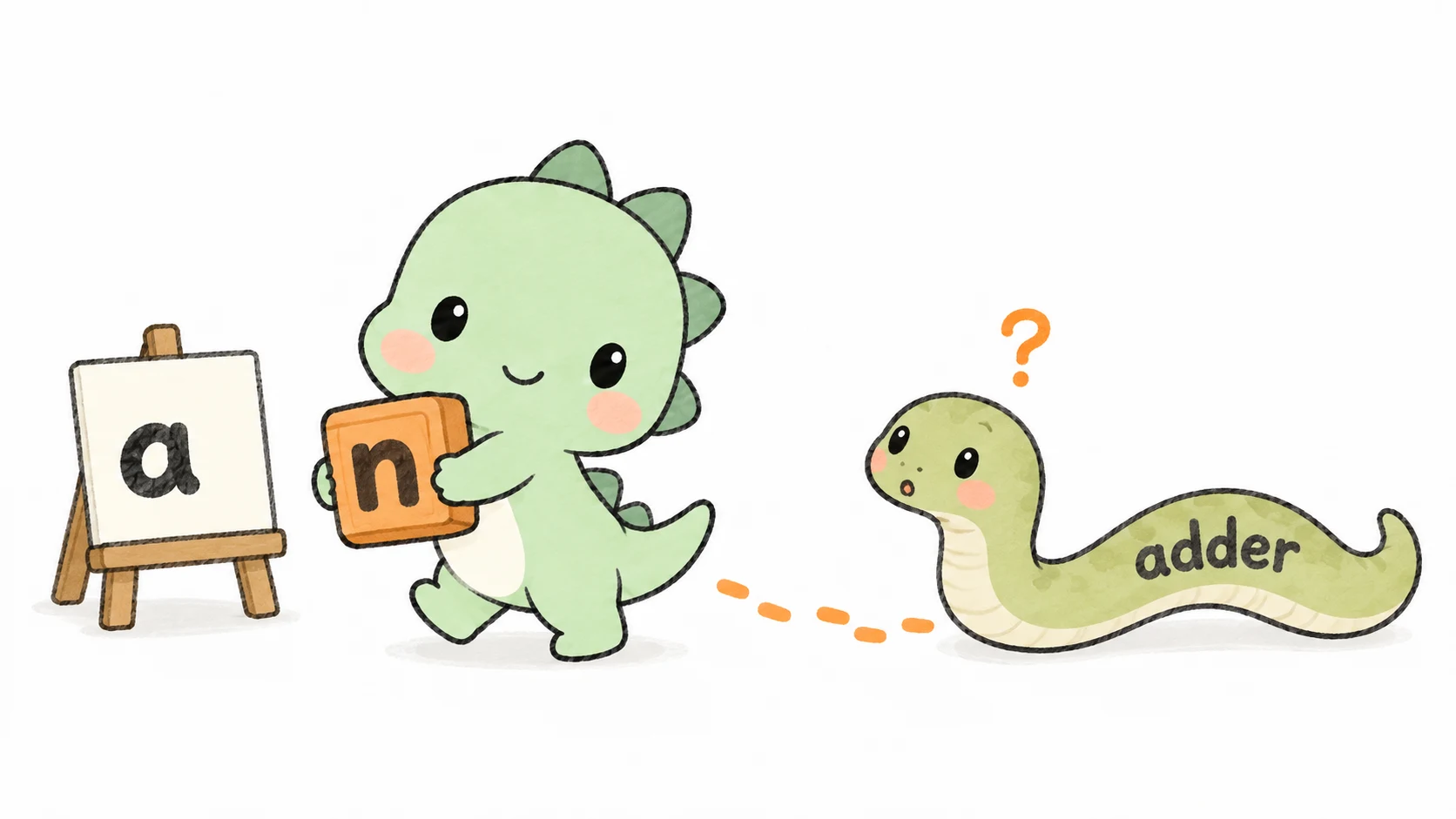
According to the Online Etymology Dictionary, an comes from the Old English ān, which simply meant "one". At first it was an before everything. From about the middle of the 12th century, the n started to drop away before consonants, a change that was mostly complete by the middle of the 14th century. That is where today's a comes from.
In other words, a is the shortened form of an. The usual explanation is ease of speech: before a consonant the n does no work, but before a vowel it earns its place. In a apple the two vowels bump into each other and you have to pause; the n bridges the gap.
The best part: because a and an differ by one n, listeners could not always tell whether the n belonged to the article or to the noun, and several English words ended up cut in the wrong place:
- adder (the snake) was originally a nadder. Between the 14th and 16th centuries it was re-divided as an adder, and the snake lost its n.
- apron and umpire took the same route. Both once began with n.
- newt went the other way. It was originally an ewte, heard in the early 15th century as a newte, and it gained an n it never had.
So a and an have been a rule for the ear from the start. The ear has even rewritten a few of the words.
This is English, so there are exceptions
Words starting with h where the stress is not on the first syllable. The Online Etymology Dictionary notes that after about 1600 the n also began to vanish before a sounded h, but that many writers still keep an before h- words whose first syllable is unstressed. So you may come across an historic event or an hotel in British writing. It is not wrong, just old-fashioned. When you write, a historic and a hotel are the safe choice.
One abbreviation, two pronunciations. URL can be read letter by letter (you-are-el), and some people say it as "earl", so you will find both a URL and an URL. The rule has not changed; what differs is how the writer says the word. When this happens, go with whichever form you see most often in the documents you read.
Conclusion: a and an are written for the ear
Back to the report: Each parcel is given a unique code is correct.
The next time you see a before u, e or o, or an before h, M or S, don't reach for the red pen yet. Say it quietly first. English spelling often lies to you, but the sound does not.
The "Articles: A, An, The" topic in Handy 990's grammar practice has 50 short stories in which you put a, an and the back where they belong, and long-pressing a word in a question to look it up also shows its pronunciation. In the same series, theatre is not a typo covers another "that must be a typo" misunderstanding, and wind and wind covers words spelled the same but said differently.