
All articles · Published 2026-10-09
English words from Asian languages: ketchup had no tomatoes, and tea and chai are one word that took two roads
ketchup, tea, typhoon, tycoon, emoji, pho — all of these English words have an East or Southeast Asian connection, though not always a simple or settled one, and many of their histories are far more tangled than the versions that circulate online. This post runs from a Hokkien fish brine to Dutch trading ships, and from the shogun's diplomatic title to the 26 Korea-related words the Oxford English Dictionary added in a single update in 2021, debunking a few popular folk etymologies along the way. Fair warning: this one is purely for fun. It will not add a single point to your TOEIC score.
What was ketchup originally made of?
The English for tomato sauce is ketchup. But the word ketchup is more than a century older than tomato ketchup.
According to the Oxford English Dictionary, ketchup first appears in English in 1682, naming a sauce that British traders and sailors had met in Southeast Asia. The spelling wandered: catchup turns up in 1690, catsup in 1730, and catsup can still be found in the United States today.
For a long time, ketchup had nothing to do with tomatoes:
| When | What ketchup was made from |
|---|---|
| 1682 | The word first appears in English, for a salty Asian sauce |
| 18th century | Anchovies, mushrooms, walnuts, oysters — recipes varied widely |
| 1812 | The earliest known recipe for tomato ketchup (James Mease) |
| Late 19th century | Tomato becomes the dominant kind; later recipes add more and more sugar and vinegar |
Stanford linguist Dan Jurafsky followed the word back in The Language of Food (2014). His conclusion: the first ketchup was a fish sauce, and its name comes from Hokkien (Southern Min) 膎汁, also written 鮭汁 — kê-chiap in the Zhangzhou accent, kôe-chiap in the Quanzhou accent — meaning the brine that seeps out of pickled fish or shellfish. Carstairs Douglas's Chinese-English Dictionary of the Vernacular or Spoken Language of Amoy (1873) already lists it, defined as "brine of pickled fish or shell-fish".
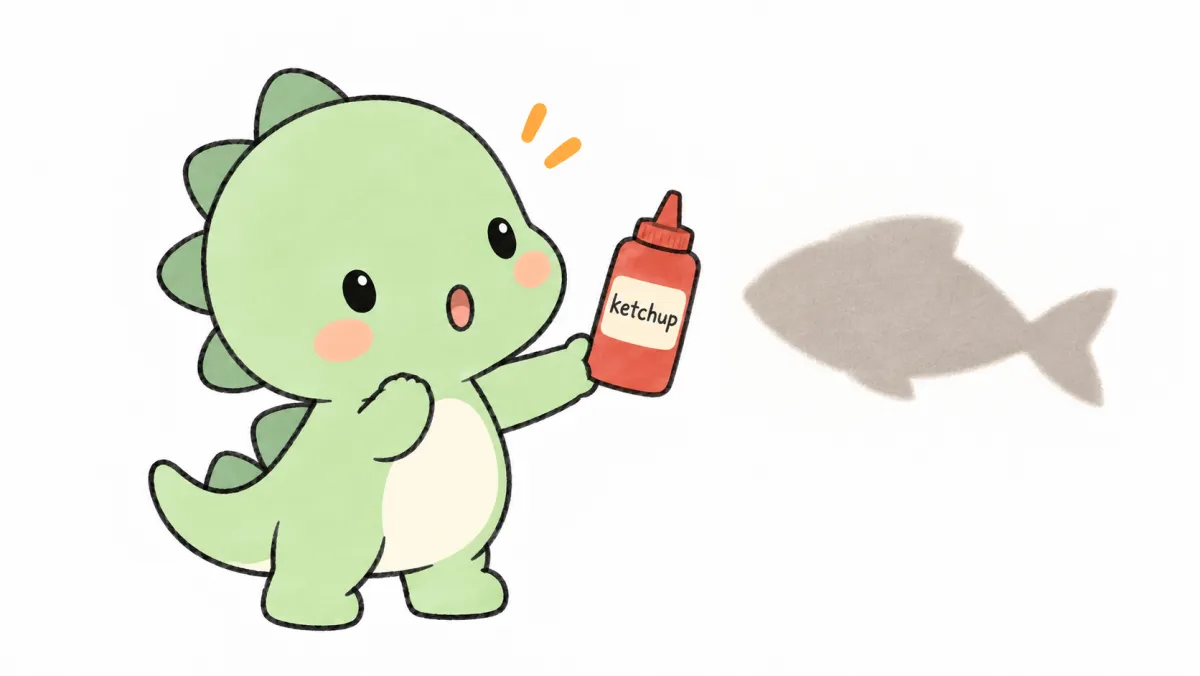
How the word got from Fujian to England is still unsettled. One view is that English borrowed it straight from Hokkien; another is that it passed through Malay kicap first (also spelled kecap; Indonesian and Malay still use the word for soy sauce and similar sauces). The American food historian Andrew F. Smith, in Pure Ketchup (2001), puts it bluntly: the word's origin is "a matter of confusion".
One theory can be safely ruled out: that ketchup comes from Cantonese 茄汁, "tomato sauce". As Jurafsky points out, the sauce and its name came into English long before anyone put tomatoes in it — the tomatoes arrived more than a century later.
Why do some languages say tea and others say chai?
This is the best story in the whole post, and it can be drawn on a world map — the online WALS actually does it (Map 138A).
In chapter 138 of the World Atlas of Language Structures (WALS), "Tea", the linguist Östen Dahl sorted the words for tea in 230 languages:
| Where the word for tea comes from | Languages |
|---|---|
| Sinitic cha type | 110 |
| Min Nan Chinese te type | 84 |
| Others (a word of their own) | 36 |
The split starts inside China. Most Sinitic languages have something like Mandarin chá, but Min Nan — Dahl names Fujian and Taiwan — says tê.
After that, it is a story about trade routes. The Dutch were the main importers of tea into Europe, where tea drinking became common in the 17th century, and Dutch traders did most of their business in Amoy (Xiamen) in Fujian, among Min Nan speakers. So Dutch wrote it thee, and from the Netherlands that form spread across much of Europe: English tea, French thé, German Tee. Former Dutch colonies show it too: Indonesian and Malay say teh.
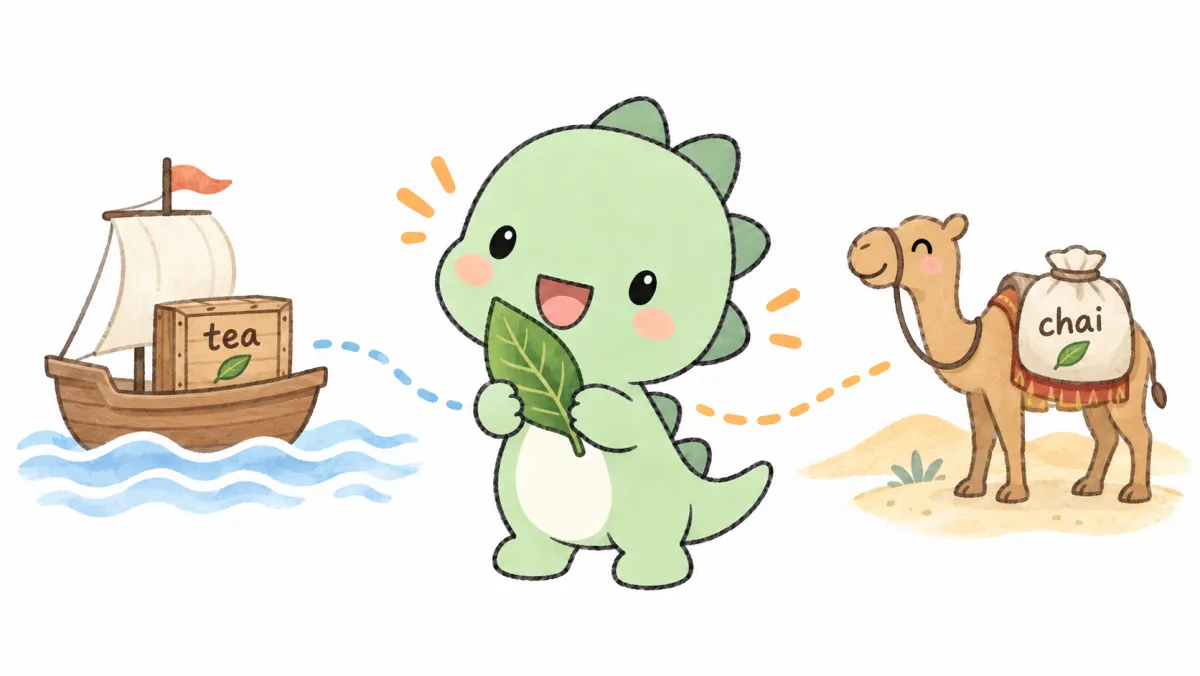
Overland was different. Dahl notes that the countries of eastern Europe and Asia that got their tea overland, rather than from the Dutch, tend to use forms like chai — Russian and Persian, for example, and Hindi belongs to this group too. English chai was borrowed from Hindustani, and is used almost only for Indian-style spiced milk tea.
Hence the popular rule of thumb: "by sea, tea; by land, chai." But one group breaks it: the Portuguese. The first Europeans to import tea were in fact the Portuguese, in the 16th century. They came by sea too, but they traded through Macao and heard the Cantonese cha, so Portuguese still says chá today. At least for the seafaring Europeans, what decided between tea and cha was not sea or land, but which port you bought your tea in.
One more twist: English met cha first. According to Victor Mair and Erling Hoh's The True History of Tea (2009), cha entered English via the Portuguese in the 1590s; tea arrived with the Dutch only in the 17th century, and overtook it. British slang still keeps a trace of it in char.
Typhoon: one word, three possible ancestors
Typhoon is often held up as an English borrowing from Chinese 大風, "big wind" — daai fung in Cantonese, which really does sound close. The full story is messier.
English has at least three threads, and they ended up knotted together:
- Greek. Greek myth has a storm monster called Typhon, and Greek typhōn also means "whirlwind". An English translation from 1555 already says that the Greeks call such tempests Tiphones.
- Arabic, by way of the Portuguese. English first uses the word for the giant storms of the Pacific in 1588, spelled Touffon. It comes from Portuguese tufão, which Portuguese sailors most likely picked up from Arabic ṭūfān ("storm, flood") — Persian and Hindi have the word as well.
- Chinese. Later English spellings such as tyfoong and tyfung clearly carry the shadow of Chinese "big wind".
Scholars weigh the three threads differently. The Oxford Dictionary of English Etymology (1966), edited by C. T. Onions, treats today's typhoon as Chinese tai fung merged with the earlier touffon and the Greek typhon; Tai Whan Kim (1976) argues that Portuguese tufão came from Arabic, not from Chinese. What is less disputed is this: the spelling we use now, ty- at the front and -phoon at the back, was pulled toward the Greek Typhon.
From shogun to business mogul: tycoon and honcho
Tycoon comes from Japanese 大君, taikun, "great lord". In the Edo period, the shogunate used the title 日本国大君 for the shogun in diplomatic documents — first in its letters to Joseon Korea, and, after the 1854 treaty with the United States, in its treaties with Western countries too.
That is how the title travelled, through treaties and diplomatic paperwork, into British and American ears. Merriam-Webster dates the word's first known use in English to 1857, and in 1863 Rutherford Alcock, Britain's first minister to Japan, published his account of the country under the title The Capital of the Tycoon.
Then it became a joke. According to the historian Adam Goodheart, writing in The New York Times (2010), Abraham Lincoln's two secretaries, John Hay and John Nicolay, called their boss "the Tycoon" behind his back. From there the word spread into business, giving us today's oil tycoon and media tycoon.
Honcho has a military backstory: it comes from Japanese 班長, hanchō, "squad leader". Many people assume it is Spanish (it does sound a bit like muchacho), but it isn't. NPR's Code Switch (Lakshmi Gandhi, 2013) found the earliest published use in 1947, in a memoir by the New Zealand journalist James Bertram: "But here comes the hancho". An earlier one sits in the prisoner-of-war diary of a US Army medic, Ernest Norquist, who in 1945, in a camp run by the Japanese, wrote about the "honcho" in charge of the galley. Today's head honcho is simply "the boss".
Chinese words from the barracks, the Cold War and ceremony: gung-ho, brainwashing, kowtow
Gung-ho (enthusiastic and energetic, often overly so) comes from 工合 — but 工合 was never a slogan. It is short for 工業合作社, "industrial cooperative", the Chinese Industrial Cooperatives set up during the Second Sino-Japanese War. The US Marine officer Evans Carlson had seen the movement in China, and in a 1943 interview he said he had told his men that it meant "Work Together — Work in Harmony". He made gung ho the motto of the unit he commanded, the 2nd Marine Raider Battalion; in 1943 Hollywood released a film about the battalion's 1942 raid on Makin Island, titled Gung Ho!.
An organisation's name became a slogan, and the slogan became an adjective. The linguist Albert Moe summed it up exactly: in Chinese it is "neither a slogan nor a battle cry; it is only a name for an organization".
Brainwashing is a word-for-word translation of Chinese 洗腦, "wash brain". The earliest English use the OED has found is in an article by the journalist Edward Hunter in the Miami News on 7 October 1950. During the Korean War, the word was used to explain why some American prisoners of war cooperated with their Chinese captors, and it quickly became a fixture of Cold War headlines.
Kowtow, from 叩頭, "knock head", entered English in the early 19th century, first naming the ritual bow itself. Its meaning then drifted a long way, to "grovel": kowtow to the boss means to fawn on your boss, and nobody's forehead touches the floor.
The new wave: from tsunami to mukbang
More recently, the routes into English have increasingly run through news, restaurants and the internet.
- Tsunami comes from Japanese 津波, literally "harbour wave". Scientists prefer it because the older English tidal wave suggests a link with tides, and there is none. Most native speakers drop the first t and say "soo-NAH-mee", because English words don't normally start with /ts/.
- Karaoke is Japanese 空 kara, "empty", plus オケ oke — short for オーケストラ, borrowed from English orchestra. So the back half of karaoke is English orchestra coming home from a trip to Japan.
- Emoji is Japanese 絵 e, "picture", plus 文字 moji, "character". Its resemblance to English emotion and emoticon is pure coincidence.
- Korean. In September 2021 the Oxford English Dictionary added 26 Korea-related words and revised 11 (NPR, 2021). Jieun Kiaer, a Korean linguist at the University of Oxford, said there was no precedent for 26 words from one language entering the OED in a single year. New entries included hallyu, K-drama, mukbang, banchan and kimbap. Interestingly, the batch also contains words like skinship and fighting, made in Korea from English parts — as NPR pointed out, not every new entry is a Korean word.
- Vietnamese. One of the earliest English records of pho is in Recipes of All Nations, edited by Countess Morphy in 1935. Bánh mì was added to the Oxford English Dictionary on 24 March 2011.
- Hong Kong English. Add oil, a word-for-word rendering of 加油, was added to the Oxford English Dictionary in October 2018, labelled as chiefly Hong Kong English.
Hallyu has a backstory of its own. The earliest recorded "Korean wave" was not coined by Koreans at all: it appeared in Chinese, as 韩流, in Beijing's Beijing Youth Daily on 19 November 1999, to describe Chinese audiences' craze for Korean dramas and pop songs. A word coined in Chinese, pronounced in Korean, then taken in by English.
Not what they seem: mandarin, long time no see and Siamese twins
Some words look as if they came from one particular Asian language, and turn out to have a different story.
Mandarin. English calls the officials of imperial China mandarins, and the standard Chinese language Mandarin, and the word looks like a transliteration of something Chinese. In fact it isn't Chinese at all: it comes from Portuguese mandarim, before that from Malay menteri ("minister"), and ultimately from Sanskrit mantrin ("counsellor, minister", built from mantra, "counsel"). Chinese officials ended up being named by the Portuguese with a word that had travelled from India by way of the Malay world.
Long time no see. Its word order is so close to Chinese 好久不見 that it is easy to take it as proof of a calque. It may well be one, but the origin is not settled: Eric Partridge's A Dictionary of Slang and Unconventional English (1984 edition) gives two possibilities — a translation of Chinese, perhaps from a US Chinatown or the British Far East such as Hong Kong; or a pidgin coinage in English itself, familiar from old films' stereotyped portrayals of Native Americans. Which one is right can't currently be traced.
Siamese twins. This one is about Thailand, but it isn't Thai. It comes from two real people: Chang and Eng Bunker (1811–1874), born in Siam (today's Thailand) and joined at the chest, who were brought to the United States in 1829 and exhibited on tour, soon billed as "the Siamese twins". They became so famous that Siamese twins turned into a general name for conjoined twins. The twist: the brothers were of Chinese descent, and at home they were known as the "Chinese twins".
Your language is on this map
If you speak an Asian language, some of these words live closer to you than you might think.
- Taiwanese Hokkien says 茶 tê, the very sound the Dutch carried to Europe, while Mandarin chá stands with Portuguese, Persian and Russian — both routes on one island. It also still uses 膎 (kê or kôe) for pickled seafood: ketchup's distant cousin.
- Japanese gave English tycoon, honcho, tsunami, karaoke and emoji, and its own 茶 cha sits on the cha side of the map.
- Korean 재벌 (財閥) became English chaebol, written with the same two characters as Japanese zaibatsu, which English borrowed too.
- Vietnamese gave English pho and bánh mì; at home, tea is trà or chè, both linked to Chinese 茶.
- Thai has given English food words such as pad thai and sriracha — the sauce takes its name from the town of Si Racha.
Will the TOEIC test any of these words?
Honestly, hardly at all. We searched the official TOEIC Listening and Reading sample test from ETS, and not one of the words in this post appears (coffee does, though).
The ones you might actually meet in business English are probably limited to tycoon (a real estate tycoon), typhoon (a flight cancelled because of one), the figurative kowtow, and everyday nouns like tea and ketchup. The value of this post is not the exam. It's that next time you see these words, you'll remember the road they travelled.
Etymology is where good stories fool us most
A few things to be clear about:
- Dates are the earliest record found so far, not the day a word was born. 1682, 1588, 1857 — each is just a book or document that happened to survive; people may have been saying the word long before. Honcho shows it: the first published record is from 1947, but a prisoner-of-war diary has it in 1945.
- Ketchup, typhoon and pho all have competing explanations. We've given the main explanations and laid out the disputes. Pho especially: some trace it to French pot-au-feu, a slow-cooked beef stew, others to Chinese 牛肉粉, "beef noodles", and the question is still open.
- "By sea, tea; by land, chai" is a simplification. The Portuguese are the counterexample, and 36 languages on the map belong to neither side.
- History can turn into folklore too. The often-told story that the British envoy Macartney refused to kowtow in 1793 and that this is why his mission failed has been questioned by recent research, for example by the historian Stephen Platt.
- The best stories are often the most suspect. "Ketchup is 茄汁" and "bánh mì comes from French pain de mie" are both widely repeated, and both fail: the Vietnamese word bánh has been used for rice cakes and other pastries since as early as the 13th century, long before the French arrived.
Conclusion: one bottle, a long line of ports
Next time you squeeze a bottle of ketchup, think about it: the name very likely set out as the brine from a jar of pickled fish on the Fujian coast, perhaps passed through the Malay world, sailed to England on British ships, swapped its fish for mushrooms and walnuts there, swapped those for tomatoes in America, and finally filled up with sugar.
The sauce changed several times. The name only changed its spelling.
Handy 990's Vocabulary Flashcards have an Etymology button that tells you where a word came from. In the same series, "Why does English have silent letters?" covers the s that scholars wrongly pushed into island — another case of a good story fooling everyone — and "British vs. American English vocabulary" looks at how the same English word went separate ways on either side of the Atlantic.