
All articles · Published 2026-10-19
"The staff is" or "the staff are"? Why British and American English disagree about collective nouns
A TOEIC grammar question — The IT department ___ currently migrating all files — wants is. Put the same sentence in a British newspaper and are would pass too. Nouns for a group of people, like team, committee, family and government, almost always take a singular verb in American English, while British English can treat them as a group of individuals and use the plural. Using a corpus grammar and a usage guide, this post sorts out where the two sides differ, why a singular verb can end up with they, why staff and police break the pattern, and how to choose between a number of and the number of.
A TOEIC grammar question a British reader might answer "are"
Here is a Part 5 question from Handy 990's question bank:
The IT department ___ currently migrating all files to a secure cloud server.
(A) are (B) to be (C) is (D) am
The answer is (C) is, for a plain reason: the department is one department, so the verb is singular.
But if you read British newspapers, you will meet sentences like these. Both are news examples that Biber and colleagues use to illustrate British usage on page 188 of the Longman Grammar of Spoken and Written English (1999; "the Longman grammar" from here on):
The family are absolutely devastated. They are coping as well as possible, but they are desperately upset.
The Government have decreed that we will have to rebid for our betting licence in 1992.
Family is a singular noun, and it takes are. So is Government, and it takes have. These are not typos. British English lets a noun for a group of people take a plural verb; American English hardly ever does. Show the question above to a British speaker, and (A) are may not look wrong at all. ETS, which writes the TOEIC, is an American organization, and the test follows American habits.
What is a collective noun?
A noun like team or family — singular in form, but naming a group of people or things — is a collective noun. The common ones include:
- organizations of people: team, staff, committee, board, management, government, company, department, firm
- people gathered together: family, audience, crew, jury, public
One misunderstanding first: collective nouns have plurals. Two teams are two teams, three committees are three committees, and those take plural verbs like any plural. The question only arises with the singular form: is the team one thing or many?
That depends on how you look at it:
- as one unit: the verb follows the noun's form and is singular. Grammars call this grammatical concord.
- as its individual members: the verb follows the meaning and is plural. This is notional concord.
What's easy to miss is that Americans and Britons choose between the two views differently.
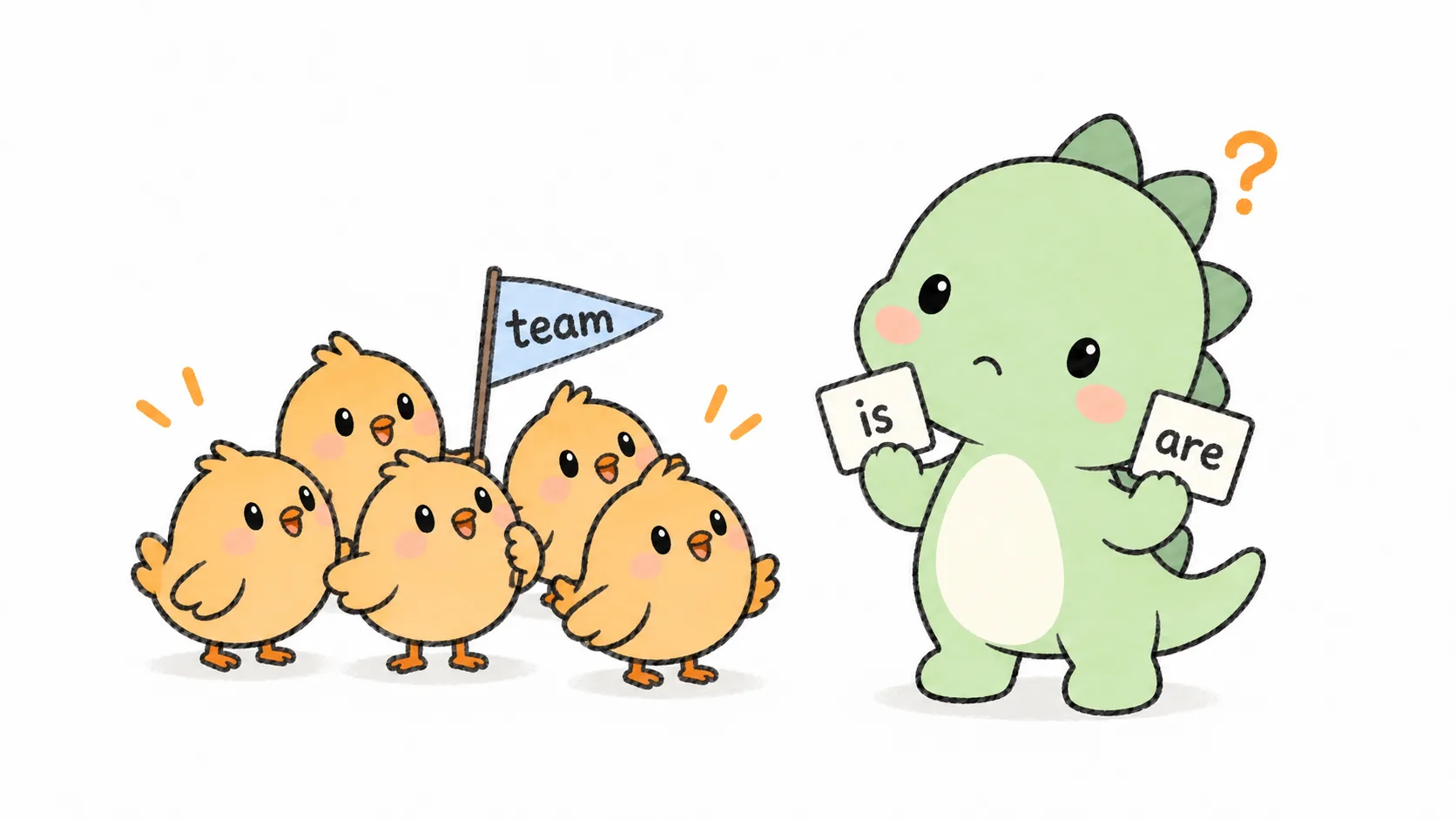
Why do the British say "the team are"?
Michael Swan's Practical English Usage (3rd edition, 2005, section 526) puts it clearly: in British English, singular words like family, team and government that refer to groups of people can take singular or plural verbs and pronouns. His rule of thumb:
- when the group is seen as a collection of people doing personal things — deciding, hoping, wanting — the plural is common;
- when it is seen as an impersonal unit, the singular is more common.
Swan's contrasting examples:
| Seen as people (plural) | Seen as a unit (singular) |
|---|---|
| My family have decided to move to York. | The average family has 3.6 members. |
| My firm are wonderful. | My firm was founded in the 16th century. |
The same family: the people deciding to move get have; the household with an average of 3.6 members gets has.
Even the relative pronoun follows along. Swan notes that British English prefers who with the plural (The committee, who are hoping to announce important changes...) and which with the singular (The committee, which is elected at the annual meeting...). The first is a group of people with hopes; the second is a body that gets elected.
The clearest case is sports teams. The Longman grammar (page 189) points out that British news regularly uses a place name for a team and gives it a plural verb:
England have been here almost a week, practising every day...
That England is not the country but the England team — a group of players. The same page says this pattern is regularly found in British news but does not occur in American English, unless the team's name is itself plural, as with the New York Giants.
Don't conclude that the British put every collective noun in the plural. The corpus behind the Longman grammar — British and American, spoken and written, over 40 million words — shows that in actual use, the singular is still the more common choice. In that corpus, audience, board, committee, government, jury and public take singular agreement more than 80% of the time; family and crew are common with both; and only staff goes the other way, with plural agreement more than 80% of the time (more on staff below).
What do Americans say?
American English is simpler. Swan, in the same section, says that in American English singular verbs are normal with most of these nouns in all cases, adding one exception: family can have a plural verb. The Longman grammar agrees that family and crew regularly take both in British English, while American English prefers the singular.
So Americans say:
- The committee is meeting on Friday.
- The team has won three games in a row.
- Management has approved the budget.
They don't normally say The committee are meeting on Friday — to most American ears, that sentence has a British accent.
A singular verb, then they?
American English isn't as singular as it looks, though. Swan's American example:
The team is in Detroit this weekend. They expect to win.
The first sentence uses is; the second uses they. Singular verb, plural pronoun — and Swan says American English can do this.
The Longman grammar (page 192) sees the same thing in its corpus: verbs and pronouns normally agree, and collective nouns are one of the places where they often don't. Its example comes from British news: Her own family has suffered the anguish of repossession, and her personal story of how her local Liberal Democrat-controlled council helped them... — has first, them later. The book draws three conclusions: pronouns drift more than verbs do; the drift typically happens when the pronoun is far from the noun; and it is generally motivated by meaning rather than form.
The linguist Magnus Levin found the same distance effect in his 2001 doctoral thesis at Lund University in Sweden, Agreement with Collective Nouns in English, which compared American, British and Australian newspapers and speech: the further a word is from the collective noun, the more likely it is to be plural. A verb usually sits right after its subject, so it tends to stay singular; a pronoun may come several words later, or in the next sentence, where the pull of meaning is stronger.
The official TOEIC sample test has a ready-made example. In the conversation for Questions 41–43, a man says You know our vendor has raised their prices, right? — has is singular, their is plural, in a single sentence. (We met this line in Can you end a sentence with a preposition?, in the section on singular they.)
Questions 38–40 are even better. In that conversation a man says the company must be making good money if they're adding that space!, using they for the company. Then Question 40, printed in the test book, asks What do the men imply about the company?, and the correct answer, (C), is It is in a good financial situation. Same company: they in speech, it on the page.

Written text is tidier generally. The reading passage for Questions 161–164 of the same sample test begins Mooringtown Library is pleased to invite local community groups to use the free advertising space on its new notice board: the library takes is, and its pronoun is its. Handy 990's Part 5 has Each department is responsible for monitoring ___ own energy usage., where the answer is its and their is the trap.
In short: in listening, they may well be a company; in a reading fill-in-the-blank, the pronoun for an organization is usually its.
Staff and police: two words that lean plural
Two collective nouns are odd ones out.
Staff is the exception the Longman grammar singles out: in its corpus, staff takes a plural verb more than 80% of the time (The staff carry messages from guest to guest; When staff are absent, a class is split between other teachers). The book says staff behaves much like police and people: it combines with numbers (Swan's examples are four staff and six crew), it can go without a determiner, and it takes all and some. For one employee you need a staff member or a member of staff; a staff means a whole group of employees (a staff of 200), not one person.
But staff isn't always plural. The Longman grammar also quotes academic prose with the staff is disrupted, where the reference is to the staff as a body.
We ran a small count on our own question bank. In the reading and listening text of Handy 990, counting only sentences where the noun is directly the subject in the pattern "the/our (or another determiner) + noun + a form of be or have", and counting each repeated sentence once: team takes a singular verb in 60 sentences and a plural one in only 2; company is 31 to 0; staff is the other way round, with 10 plural and just 1 singular (The lobby staff is still setting up...). The bank also has the question The staff ___ the tables while the chef finished plating the desserts., whose answer is were setting.
Police is even more settled. The Longman grammar (page 289) says that police, though it doesn't look plural, takes a plural verb: Police are appealing for help from anyone who witnessed the incident. Swan makes a point of it too: The police are looking for..., not The police is looking for.... One officer is a police officer, not a police. The Longman grammar does note the occasional singular, as in The Royal Canadian Mounted Police was searching the airliner — where the reference is to the institution, the Mounties as a body, not to a group of officers.
People works the same way when it means a group of persons: People are.... Only when it means a nation or an ethnic group (a people, plural peoples) is it singular — a different meaning.
A number of or the number of?
These two look alike and work in opposite directions:
| Form | Meaning | Verb | Example |
|---|---|---|---|
| a number of + plural noun | several, quite a few | plural | A number of Arab countries have condemned the UN resolution. |
| the number of + plural noun | how many there are | singular | The number of instances was surprisingly large. |
Both examples come from page 185 of the Longman grammar. Swan, in the same section 526 of Practical English Usage, says A number of people have tried... is more natural than A number of people has tried....
An easy way to remember it: a number of means "several" — it only says there are quite a few, and the real subject is the noun after it. The number of is the number itself, and a number is one thing, so the verb is singular.
A group of and a series of are similar. The Longman grammar notes that with a plural noun after them the verb is sometimes plural (its news example is A series of profit downgradings were shrugged off), but when the focus is on the unit, the singular is the regular choice. Series itself has the same form in singular and plural, which we covered in What is the plural of fish?.
One last common trap is news. It ends in s, but in modern English it always takes a singular verb: The news is good.
Your language doesn't make you choose
For readers whose first language is Chinese, Japanese, Korean, Vietnamese or Thai, this whole question can feel strange, because in those languages a verb has no singular or plural form that must match its subject. "The team is playing" and "the players are playing" use exactly the same verb. Nobody has to decide whether a team is one or many, so there is no native feel for the difference between the team is and the team are.
Interestingly, the pronoun half is familiar. In Chinese it is perfectly natural to say that a company was very decent and that "they" refunded you the next day — one company, a plural pronoun, because you are thinking of the people there. That is the same notional concord as our vendor has raised their prices.
So the hard part for these learners isn't the pronoun; it's the verb. English makes you commit to a number on the verb, and the American answer is almost always singular.
How does the TOEIC test this?
ETS, which writes the TOEIC, is American, and its tests use American English. We went through the official TOEIC Listening and Reading sample test: every noun for an organization that we found with a verb showing number had a singular verb — the hotel hires (Questions 35–37), our vendor has (Questions 41–43), the restaurant is a bit understaffed tonight (Questions 74–76), Mooringtown Library is pleased (Questions 161–164), and the business overall benefits in the passage for Questions 131–134. Plurals turned up only in pronouns, and only in the listening section: besides the vendor and the company above, Questions 38–40 say they have the most people about a research department, and in Questions 77–79, about the agency Torland Advertising, even the printed options for Question 77 read Their focus on cost cutting.
No question in the sample test tests collective-noun agreement directly. If you meet one on test day, here is what to go by:
- team, committee, board, company, department, management + verb: choose the singular (is, has, a verb with -s).
- A pronoun blank for one of these organizations: choose its, especially after each or every. (Question 77's options use Their, so the printed test doesn't always use it or its; but in a grammar blank, its is the safe answer.)
- In listening, they may be a company, not necessarily several people.
- police and people take the plural; one officer is a police officer.
- staff goes both ways. A question that turned only on whether staff takes is or are would have two right answers. In the were setting question above, the answer comes from the tense clues while and finished, not from the number of staff.
- a number of takes the plural, the number of the singular; news takes the singular.
The fine print, on which even the British are divided
A few things to be clear about:
- The British plural is an option, not a requirement. Swan says both are possible, and the Longman grammar says the singular is more common in actual use. A British article with The committee is... is nothing unusual.
- The "80%" figures are for the Longman grammar's whole corpus. That corpus mixes British and American English, conversation, fiction, news and academic prose; they are not country-by-country figures. We didn't find per-country percentages we could cite with confidence, so this post gives none.
- American English isn't 100% singular either. Family can take a plural verb, the pronoun can be they, and teams with plural names (the New York Giants) take plural verbs.
- Some verbs only take the singular, in Britain too. The Longman grammar notes that for the plural to work, the verb's meaning must apply to the individual members; so The committee consists of eight members can only be singular — having eight members is true of the committee as a whole, not of each member. Levin's thesis likewise found that consist, be set up and increase require the singular.
- Our question-bank count is narrow. It covers one pattern — determiner + noun + be/have — and leaves out ordinary verbs and pronouns. It shows a direction, nothing more.
Conclusion: one team, or a group of people?
When an American sees the team, they see one team; a Briton sometimes sees a group of people. Both views make sense; English just forces you to pick one on the verb.
On the TOEIC, be American: one team, one is.
As for staff and police — they were never one person to begin with.
In Handy 990, Grammar Practice → Structure → Subject-Verb Agreement has fifty levels, with sentences like The safety committee meets..., A number of passengers are... and The number of complaints has...; Chapter 19 of the Grammar book, Subject-Verb Agreement, walks through matching subjects and verbs from the start, with a short quiz at the end of every section. In the same series, What is the plural of fish? covers nouns with the same singular and plural, Can you end a sentence with a preposition? covers singular they, and British and American English vocabulary differences lists the words the two sides say differently.