
All articles · Published 2026-10-11
What is an eggcorn? For all intensive purposes, should of, and the phrases native speakers mishear and then "fix"
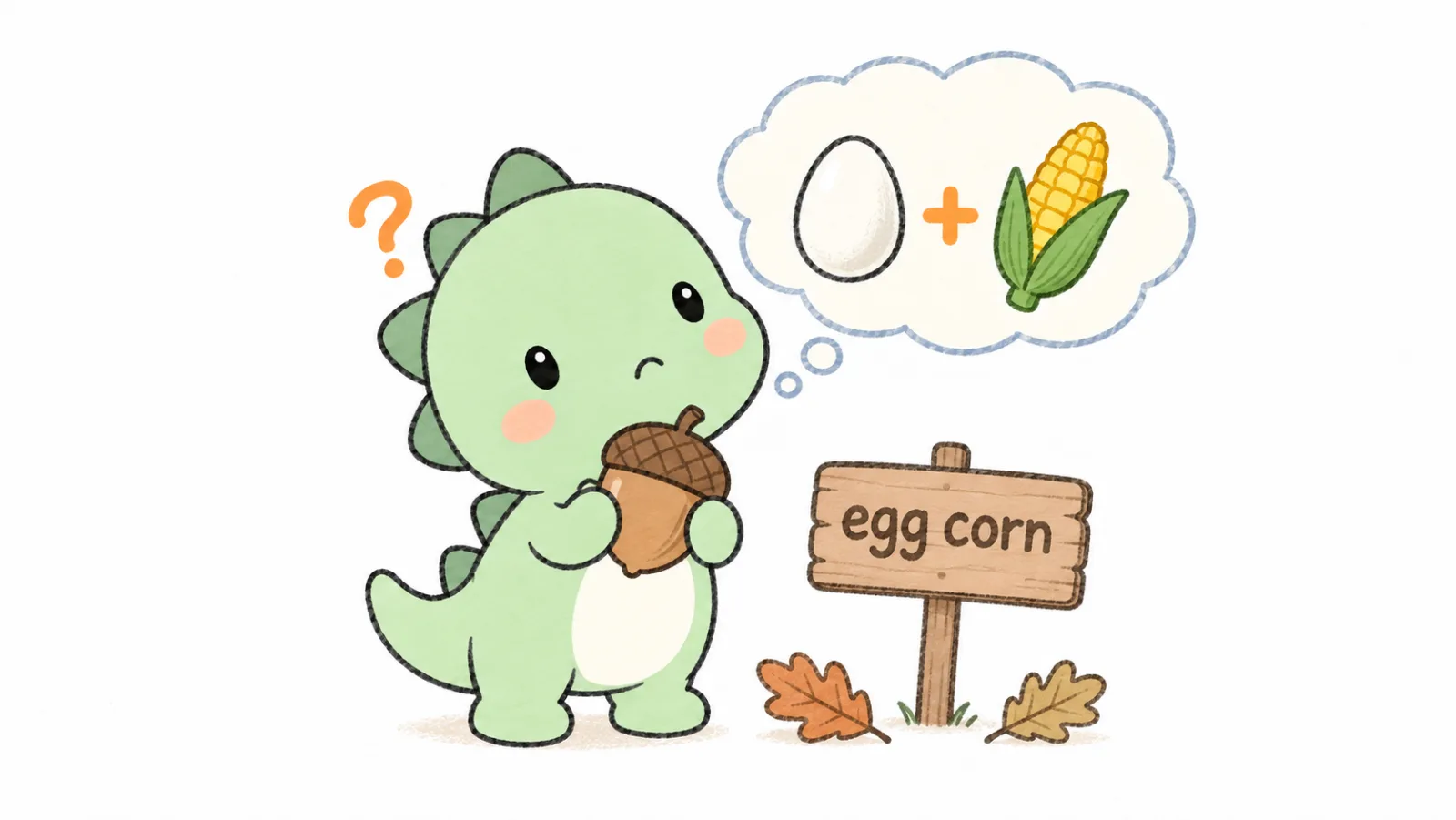
For all intensive purposes, deep-seeded, nip it in the butt, free reign — native speakers really do write these, and they get them wrong in a remarkably sensible way: the writer never caught the original word, so they swapped in one that sounds the same and still makes sense. Linguists call this kind of mistake an eggcorn, after someone wrote "egg corn" for acorn in 2003. This post covers how an eggcorn differs from a malapropism, a mondegreen and folk etymology, lists eleven phrases that often get "fixed" and what they originally meant, and then turns to the one that matters on the TOEIC listening section: why should've sounds like should of.
The woman who wrote "egg corn" for acorn
On 23 September 2003, the linguist Mark Liberman put up a short post on the linguistics blog Language Log titled "Egg corns: folk etymology, malapropism, mondegreen, ???". The trigger was something the linguist Chris Potts had told him: a woman had written egg corns for acorns.
You can guess at her logic. What is an acorn? An egg-shaped, seed-like thing. Egg is egg; and corn, besides maize, also means "grain, seed" (a peppercorn is a grain of pepper). Egg corn: an egg-shaped seed. For someone who had heard the word but never seen it written, that spelling is arguably more sensible than acorn.
Liberman went looking for an existing term for this kind of error and couldn't find a good one. The three question marks in the title are his puzzlement: it looks like folk etymology, and like a malapropism, and like a mondegreen — but on closer inspection it isn't quite any of them.
A week later he added an update: the linguist Geoffrey Pullum suggested that if no suitable term existed, they should simply be called egg corns — in the tradition of mondegreen, a word that is itself named after one representative mistake. In time the two words fused into today's eggcorn.
On 15 February 2005, Chris Waigl opened the examples to the public as The Eggcorn Database, with Language Log regulars Arnold Zwicky and Ben Zimmer among the contributors. Most entries come with real sentences "spotted in the wild": newspapers, forums, press releases — who wrote what, and where.
Eggcorn, malapropism, mondegreen: what's the difference?
English already had several names for saying or hearing things wrong. Liberman tested egg corn against each one in turn and found it didn't fit:
| Term | Where the name comes from | Classic example | How it differs from an eggcorn |
|---|---|---|---|
| malapropism | Mrs. Malaprop in Richard Brinsley Sheridan's 1775 comedy The Rivals; her name comes from French mal à propos ("inappropriate") | she calls someone as headstrong as an allegory on the banks of the Nile — she means alligator and says allegory | the substitute merely sounds similar; it usually makes no sense, which is the joke |
| mondegreen | the American writer Sylvia Wright's essay "The Death of Lady Mondegreen" in the November 1954 Harper's Magazine | as a child, hearing her mother read a Scottish ballad, she heard And laid him on the green as And Lady Mondegreen — and took it that the Earl had been slain along with a Lady Mondegreen | usually a song, a poem or a recitation; the misheard version needn't make sense |
| folk etymology | an old term in linguistics | Old English brȳdguma ("bride's man") became today's bridegroom | the whole speech community has adopted the change, and the spelling has moved for good |
| eggcorn | the woman on Language Log in 2003 who wrote egg corn for acorn | for all intensive purposes | an individual's mistake; the substitute sounds the same and still makes sense |
Liberman was specific about it. Egg corn isn't a malapropism, because in casual speech egg corn and acorn are pronounced the same, whereas allegory and alligator are only similar. It isn't a mondegreen, because no song or poem is involved. And it isn't folk etymology, because it is the usage of one person, not of a whole community.
Later definitions of the eggcorn tend to stress the "makes sense" part. A malapropism is funny because the substitute is absurd; an eggcorn earns a knowing smile because the substitute is too reasonable — reasonable enough that you start to wonder whether the original was the odd one.
Eleven phrases native speakers often "fix"
Most of these are in the Eggcorn Database, with real examples. Standard form on the left, common eggcorn next to it:
| Standard form | Common eggcorn | What it originally means | Why the wrong version sounds right |
|---|---|---|---|
| for all intents and purposes | for all intensive purposes | in effect, in every practical respect; from the 16th-century English legal phrase to all intents, constructions, and purposes | spoken quickly, intents and runs together into something very like intensive |
| deep-seated | deep-seeded | firmly established; seated means "situated, lodged" | a seed planted deep is firmly established too |
| nip it in the bud | nip it in the butt | pinch off the bud before it can flower — stop a problem early | bud and butt differ by one final sound and blur in quick speech; nip can also mean a small bite, and a bite on the behind would stop most things |
| pique someone's interest | peak someone's interest | arouse interest; pique comes from French piquer, "to prick" | to push someone's interest to its peak |
| free rein | free reign | let the reins go slack so the horse can run as it likes — full freedom | reign means "rule", and "ruling freely" sounds perfectly plausible |
| a moot point | a mute point | moot is the Old English word for an assembly, so a moot point was one open to debate; today it also often means a point of no practical importance | mute means "silent": a point there's no need to raise |
| with bated breath | with baited breath | bated is a shortening of abate ("to lessen"): breath held in; first recorded in Shakespeare's The Merchant of Venice | baited means "with bait on it", and waiting breathlessly is a bit like waiting for a bite |
| on tenterhooks | on tenderhooks | a tenter is a wooden frame for drying cloth, and tenterhooks are the hooks that stretch it taut: you are stretched tight | tender means "sore, sensitive", and suspense does hurt |
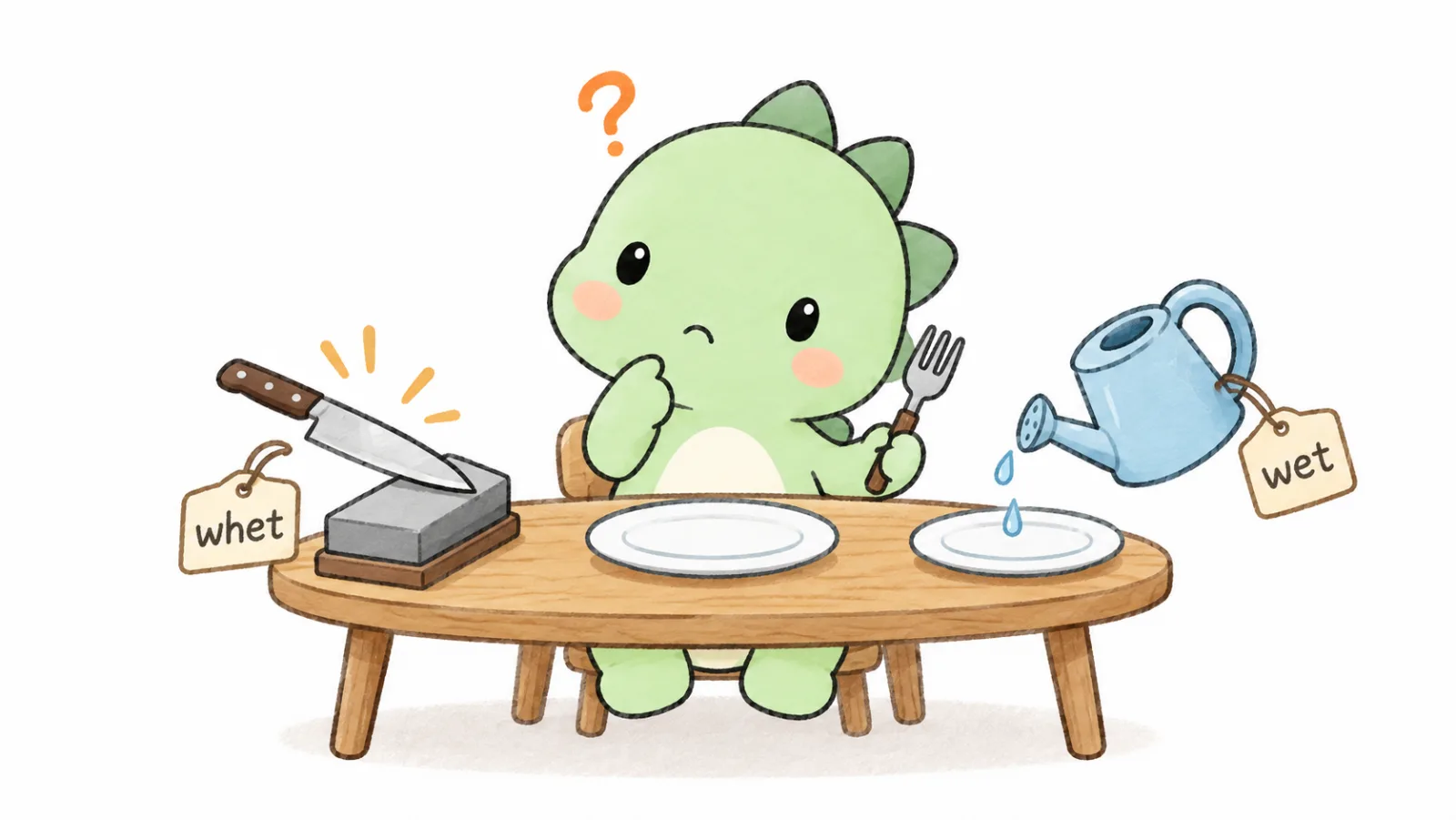
| whet your appetite | wet your appetite | whet means "to sharpen" (a whetstone sharpens knives): to sharpen your appetite | food makes your mouth water, so: wet |
| sneak peek | sneak peak | a peek is a quick look | a peak is a high point, and a preview usually shows the highlights |
| toe the line | tow the line | put your toes to the line, hence conform to the rules (accounts differ on which line it first was) | tow means "pull": dutifully pulling on the rope |
The table has one thing in common: the original word is usually rare or old-fashioned. Bated, tenter, whet, moot, rein — few people use them on their own in everyday life now, so the ear swaps in a more familiar word: baited, tender, wet, mute, reign. And afterwards, the phrase still makes sense.
Why do the mistakes make so much sense?
If you are a native speaker, you have probably heard these phrases since childhood, but not necessarily seen them. Eggcorns live in the gap between hearing and writing.
Gap one: homophones. Rein and reign, peek and peak, whet and wet, bated and baited sound exactly alike in most accents. Listening gives you no clue at all; the only thing that helps is knowing what the phrase originally meant.
Gap two: connected speech and weak forms. The and in for all intents and purposes is usually short and light in the middle of a sentence, reduced to a vague /ən/. Intents plus a vague and sounds a lot like intensive. Phoneticians call these reduced pronunciations weak forms — we covered how they swallow can in can and can't.
Gap three: the American t. In American English, a t between two vowels, before an unstressed syllable, often becomes a quick d-like tap (phoneticians call it flapping). Analysing deep-seeded on Language Log, Liberman pointed out that for most Americans, deep-seeded and deep-seated are pronounced exactly the same. The writer didn't mishear anything; the ear simply had nothing to go on.
Should of: the one you'll actually meet in TOEIC listening
The eleven phrases above are not common on the TOEIC (more on that below). But one mistake that works the same way as an eggcorn is much more directly relevant to the listening section:
I should of called you.
The correct form is I should have called you, or in contracted form should've. So why do people write should of?
Because unstressed have is often reduced to /əv/, or even just /v/, and unstressed of is also reduced to /əv/. The Cambridge Dictionary lists both weak forms — and they are identical. So should've, could've, would've and must've sound just like should of, could of, would of and must of.
Strictly speaking, should of isn't necessarily an eggcorn: the writer probably doesn't believe there is an of there, and is more likely just writing down the sound. But the mechanism is the same — writing down what the ear heard, rather than what the word actually is.
For TOEIC candidates the job runs the other way: when you hear that vague /əv/, turn it straight back into have + past participle, and remember that it is talking about the past:
| What you hear | What it actually is | Meaning |
|---|---|---|
| should've | should have + past participle | ought to have (but didn't); or something is expected to have happened already |
| could've | could have + past participle | was able to (but didn't); or may possibly have happened |
| would've | would have + past participle | would have done it (if things had been different) |
| must've | must have + past participle | surely did (a conclusion about the past) |
Our own Part 3 conversations include sentences like these. In one, a colleague points out that a rush order went out with the standard carrier, and the man who processed it says I must have picked the wrong option in the shipping system; the question then asks what he says caused the mistake. In another, a woman's freshly printed brochures look dull, a colleague points out that the printer's paper setting was never changed, and she says I should have checked that myself; the question asks exactly what she means by it — the answer is that she accepts the error was her own.
Across our bank, should, could, would, must or might + have + past participle appears 69 times in the reading items (passages plus questions) and 16 times in the listening items (transcripts plus questions); the contracted spelling should've and its siblings appear not once — on the page it is always the full have. In other words, what you see written is should have, and what you hear may be should of. You need to recognise both.
Hone in or home in? When the eggcorn wins
An eggcorn doesn't necessarily stay wrong forever. When enough people use a mistake for long enough, dictionaries take it in.
Home in on is the traditional form: home as a verb means "to head for a target", like a homing pigeon flying back or a missile locking on, and by extension "to focus on". Hone means "to sharpen" — the same family of meaning as whet.
But plenty of people say hone in on, and sharpening your focus seems to make sense too. According to a 2009 round-up on the Grammarphobia blog, the earliest example in the Oxford English Dictionary is from George Plimpton's 1966 book Paper Lion, and Merriam-Webster's Collegiate Dictionary (11th edition) has an entry for hone in, saying it seems to have established itself in American English and made inroads in British English — before adding that using it, especially in writing, is likely to be called a mistake.
(Our phrase bank includes both, three questions each, because dictionaries include both. In a letter to a client, though, home in on is the safe choice.)
Stretch the timeline further and some eggcorns won long ago, so thoroughly that nobody remembers they were ever mistakes:
- bridegroom. Old English had brȳdguma, where guma meant "man". When that word died out and people no longer understood it, they swapped in a familiar one: groom (a servant, an attendant).
- crayfish. Middle English crevis, from Old French crevice, had nothing to do with fish. Presumably a creature in the water ought to be a fish, so it became crayfish.
- shamefaced. Originally shamefast, where fast means "firm, fixed" (as in steadfast). Later, presumably because shame shows on the face, it became shamefaced.
The best one is acorn itself. According to Wiktionary, Middle English acorn is an alteration, "after corn", of an earlier akern (Old English æcern) — and etymologically it is related to neither oak nor corn. So the woman who wrote egg corn for acorn was doing exactly what English speakers had done centuries earlier: reshaping a word they didn't understand into one they did. The difference is that with acorn, everyone followed.
(The s in island has a similar story: someone thought it belonged to the same family as isle and put the s in. See Why does English have silent letters?)
Your language has eggcorns too
Swapping in a word that makes sense is not an English peculiarity. Japanese has a well-documented case: the idiom 取り付く島がない ("not even an island to cling to" — said of someone so curt and cold there is no way to approach them) is often said as 取り付く暇がない ("no time to cling on"). In the Agency for Cultural Affairs' survey of Japanese usage for fiscal 2012, 47.8% of respondents said they use the original 島 version and 41.6% the 暇 version — the "mistake" is nearly as common as the standard.
Chinese has them as well. The idiom 一鼓作氣 comes from the Zuo Zhuan: in battle, the first roll of the war drum (鼓) rouses the troops' courage, the second weakens it, the third exhausts it. It is often written 一股作氣, because 一股 ("a surge of") already goes with 氣 ("energy") in everyday speech. Same story as for all intensive purposes: the original word is too old or too specialised, so the mind swaps in a more familiar one that still makes sense.
Before you laugh at anyone
A few things to be clear about:
- An eggcorn is not a sign of stupidity. Quite the opposite: it shows the writer was understanding — not writing a random sound, but finding a reasonable explanation for the phrase. It just happens not to be the original one.
- The categories are fuzzy. Whether a mistake counts as an eggcorn or a malapropism often depends on whether you think the substitute makes sense, which is partly a matter of opinion. Whether should of counts as an eggcorn is debatable too.
- The Eggcorn Database records that someone has written it, not that many people do. The examples are real, but it is not a frequency ranking.
- Right and wrong move. Hone in is drifting from "wrong" towards "acceptable"; bridegroom and crayfish finished the journey long ago. A spelling that gets corrected today may be standard in fifty years. Until then, formal letters and reports should use the standard form.
- The TOEIC doesn't really test these. We checked ETS's official TOEIC Listening and Reading sample test: none of the eleven phrases above appears in it, and neither does should have + past participle. A multiple-choice test won't print an eggcorn and ask you to spot it. The value of all this is recognising the phrase when you hear it and writing it correctly in your emails.
Conclusion: an egg-shaped seed
The woman who wrote egg corn for acorn probably never found out that she had named a linguistic phenomenon.
But what she did wasn't strange at all. She had heard a word without seeing it, and used what she knew to explain it: an egg-shaped, seed-like thing — egg corn. Centuries earlier, English speakers did the same thing to akern and turned it into acorn.
So next time someone writes for all intensive purposes, you might hold off on correcting them. They are simply one step ahead of the dictionary — or one step off the path.
In Handy 990, Phrases on the home screen holds more than 3,000 phrases in 9,417 questions, including nip it in the bud and home in on; every question is an example sentence with its meaning. In the same series, can and can't is about how weak forms swallow a word, Why does English have silent letters? tells how the s got into island by mistake, and discreet vs. discrete is about words that spell-check can't catch and the ear can't hear.