
All articles · Published 2026-10-15
Why "a five-year plan" and not "a five-years plan"? Number + noun before a noun: no s, add a hyphen
Five years is five years, but a plan that lasts that long is a five-year plan: the s disappears and a hyphen turns up. When a number and a unit go in front of another noun as a modifier, the unit goes back to the singular and is usually hyphenated: a ten-minute walk, a three-day conference, a 50-page report. This post covers where that rule comes from, why sales department keeps its s, the possessive ten minutes' walk that keeps the plural, and when a hyphen is needed and when it isn't.
Front desk and front-desk in the TOEIC sample test
The official TOEIC Listening and Reading sample test published by ETS has a conversation between two hotel employees (questions 35 to 37). The man opens with:
I'm surprised to see you at the front desk this late.
The woman explains that she is filling in for someone:
I'm covering for a front-desk supervisor who was just promoted…
The same two words appear in one conversation, once written apart and once joined by a short dash. It isn't a typo. In the first line, front desk is a place, a noun in its own right. In the second, front-desk sits in front of supervisor and tells you what kind of supervisor this is. It is doing an adjective's job.
The short dash is a hyphen, and the rule behind it is the same one behind a more familiar mistake:
Why is it five years, but a five-year plan?
Why "a five-year plan" and not "a five-years plan"?
Some pairs first:
| On its own | In front of another noun |
|---|---|
| ten minutes | a ten-minute walk |
| three days | a three-day conference |
| two hours | a two-hour meeting |
| 50 pages | a 50-page report |
| 20 dollars | a 20-dollar bill |
| five years | a five-year plan |
The rule fits in one sentence: when a number and a unit stand on their own as a noun phrase, the unit follows the number as usual (one year, five years); when they move in front of another noun to modify it, the unit is singular whatever the number, and is usually hyphenated.
Why? Because in a five-year plan the only real noun is plan. Five-year just says what kind of plan it is, much as long does in a long plan. English adjectives don't change for number: one big dog, three big dogs, never three bigs dogs. Once five-year moves into the adjective slot, it behaves like an adjective.
So where does the number go? Onto the real noun. Two plans of that kind are two five-year plans: the s goes on plans, not on year. A reading question in Handy 990 shows this neatly:
…a member who holds four two-hour client sessions each month
Two numbers, one s. Four counts the sessions, so sessions gets the s; two only says how long each one is, so hour stays singular.
There's a way to check that the unit really goes singular rather than just losing its s: try an irregular plural. The plural of foot is feet, so a person is usually described as six feet tall, but in standard writing a fence of that height is a six-foot fence. What comes back is the singular foot, not feet with something removed.
Ages follow the same rule:
- She is 30 years old. Years is a noun here: plural, no hyphens.
- a 30-year-old engineer. The whole string sits in front of engineer: year goes singular and all three words are hyphenated.
A 30-year-old can even work as a noun on its own, meaning a person of that age. A Part 7 passage in Handy 990 has both uses in one line: its oldest ninety-one, and the ninety-one-year-old drove the engine when it was new. The first ninety-one is an age; the ninety-one-year-old is a person.
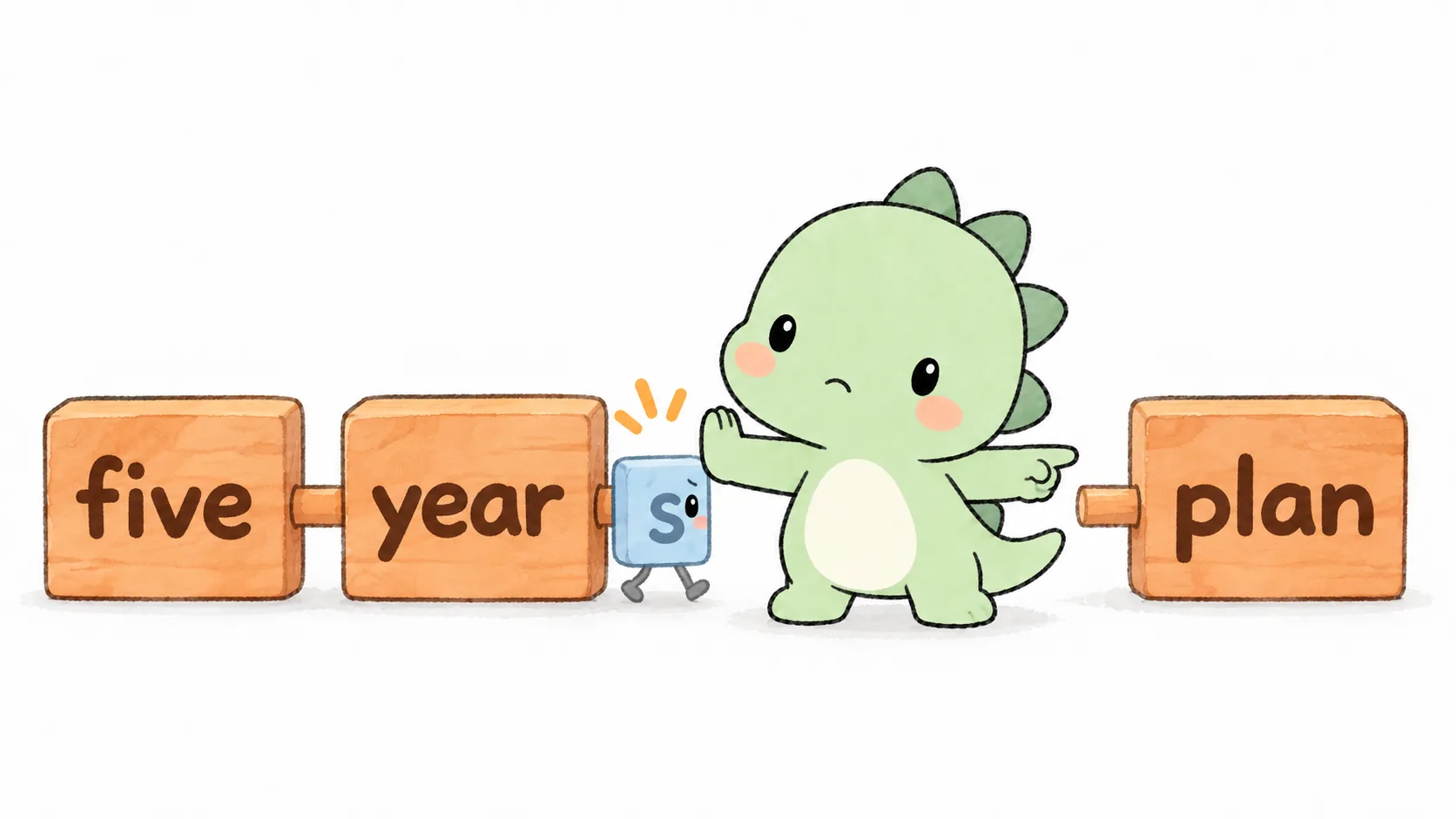
Why are nouns used as modifiers usually singular?
Five-year is one case of a wider pattern: when an English noun modifies another noun, it is usually singular.
- A shoe store sells more than one pair of shoes.
- A toothbrush cleans more than one tooth, but tooth doesn't become teeth.
- A car park, in British English, holds more than one car.
A common explanation is that the first noun names a kind, not a quantity. A shoe store is a store of the shoe kind; how many shoes is beside the point, so there is no need for a plural.
But usually is not always. English has a set of modifiers that keep their s, and one of them is in the TOEIC sample test. Question 102 reads Jamal Nawzad has received top performance reviews ------- he joined the sales department two years ago. The sales in sales department keeps its s.
Most of these exceptions fall into two groups:
| Example | Why it isn't singular |
|---|---|
| clothes shop | clothes has no singular form |
| customs officer | a custom is a habit; customs is the border service |
| arms race | an arm is a limb; arms are weapons |
| savings account | money put aside is savings; a saving is one amount saved |
| sales department | the business of selling is sales; a sale is one transaction or one discount event |
| sports car | fixed usage, though American English also has the singular sport coat |
In other words, the s stays when dropping it would change the meaning (an arm race sounds like a contest of limbs) or when the word is almost always plural in that sense anyway.
British English also uses plural modifiers more than American English. Ben Yagoda, an emeritus professor of English at the University of Delaware, tracks British usages that spread to the US on his blog Not One-Off Britishisms. In a 2019 post he used Google Ngram to compare drugs party, covers band, drinks menu and books editor in British and American books, and wrote that plural attributives seemed to him a strongly British phenomenon; Americans had traditionally said drug, cover, drink and book.
Number-and-unit modifiers such as five-year, though, are singular on both sides of the Atlantic.
Want to keep the s? Ten minutes' walk and a walk of ten minutes
If you really want minutes to keep its s, English has two other ways to say it:
| Pattern | Example | Note |
|---|---|---|
| singular + hyphen | a ten-minute walk | the pattern this post is about |
| plural + possessive | ten minutes' walk | an apostrophe after the s |
| of after the noun | a walk of ten minutes | the quantity moves behind the noun |
The second is a possessive. With one unit it is a week's notice or a day's work; with a plural unit, the apostrophe goes after the s: two weeks' notice, three months' rent. Note that a ten-minute walk has an a in front of it, while ten minutes' walk usually does not.
Its favourite partner is notice. In Handy 990's reading and listening question text (counting each repeated sentence once), a number plus a plural unit plus a possessive apostrophe appears 37 times, and 20 of those are followed by notice: thirty days' notice, two weeks' notice, 48 hours' notice. One Part 5 item in the bank reads Tenants are required to give thirty days' ___ before vacating the premises. The answer is notice.
The two forms often trade places. Under notice, Cambridge Dictionary lists both a week's/month's notice and the example I got my 30-day notice yesterday at work: one keeps the plural with a possessive, the other goes singular with a hyphen, and the meaning is much the same.
When do you need a hyphen? Before the noun, usually not after
Back to front desk and front-desk. The rule isn't only about numbers: when two or more words together modify a following noun, they are usually hyphenated; when the same words come after the noun, or stand as a noun themselves, they usually aren't.
| Before the noun (hyphenated) | After the noun or on its own (usually open) |
|---|---|
| a well-known author | The author is well known. |
| an up-to-date list | The list is up to date. |
| a front-desk supervisor | She works at the front desk. |
| a five-year plan | The plan lasts five years. |
| a 30-year-old engineer | The engineer is 30 years old. |
The Chicago Manual of Style is one of the most influential style guides in American publishing. A December 2024 post on its official blog, CMOS Shop Talk, notes that hyphenating a compound modifier before a noun but not after (a well-known author, an author who is well known) has been Chicago style since the first edition in 1906.
Why hyphenate before the noun? Because the hyphen is a signpost for the reader. In a front-desk supervisor, it tells you that front and desk belong together and jointly describe supervisor. After the noun, the sentence structure already makes that clear, so the signpost matters less.
One exception is widely used: adverbs ending in -ly take no hyphen. The Chicago Manual's Q&A, following the 18th edition (2024), puts it plainly: a two-word phrasal adjective that begins with an adverb ending in -ly is not hyphenated. So it is a highly qualified candidate and a newly opened branch, not highly-qualified. The usual explanation is that the -ly already tells the reader the word modifies the adjective after it, so no signpost is needed. Swap in better and the hyphen comes back: the Associated Press's 2019 guidance lists a better-qualified candidate among its examples.
Is the hyphen grammar or style? Depends which guide you ask
An honest note here: hyphens are mostly a matter of style, not of grammar. Style guides and dictionaries don't all agree.
- Merriam-Webster and Chicago differ. The same CMOS Shop Talk post points out that Merriam-Webster keeps the hyphen in well-known even after a noun, and that when the two disagree, Chicago style means writing well known.
- AP changed its guidance in 2019. As Merrill Perlman summarised it in the Columbia Journalism Review (September 2019), the Associated Press now says no hyphen is needed if a compound modifier is commonly recognised as one phrase and the meaning is clear without it. Its examples include first quarter touchdown, chocolate chip cookie and real estate transaction.
But there is one time a hyphen can't be dropped: when dropping it changes the meaning. AP's guidance that same year was to use a hyphen whenever ambiguity would result if it were omitted, and the examples in Poynter's report (Kristen Hare, September 2019) include small-business owner.
- a small-business owner: someone who owns a small business.
- a small business owner: could also be read as a business owner who is small.
And the example English teachers love most:
- a man-eating shark: a shark that eats people.
- a man eating shark: a man having shark for dinner.
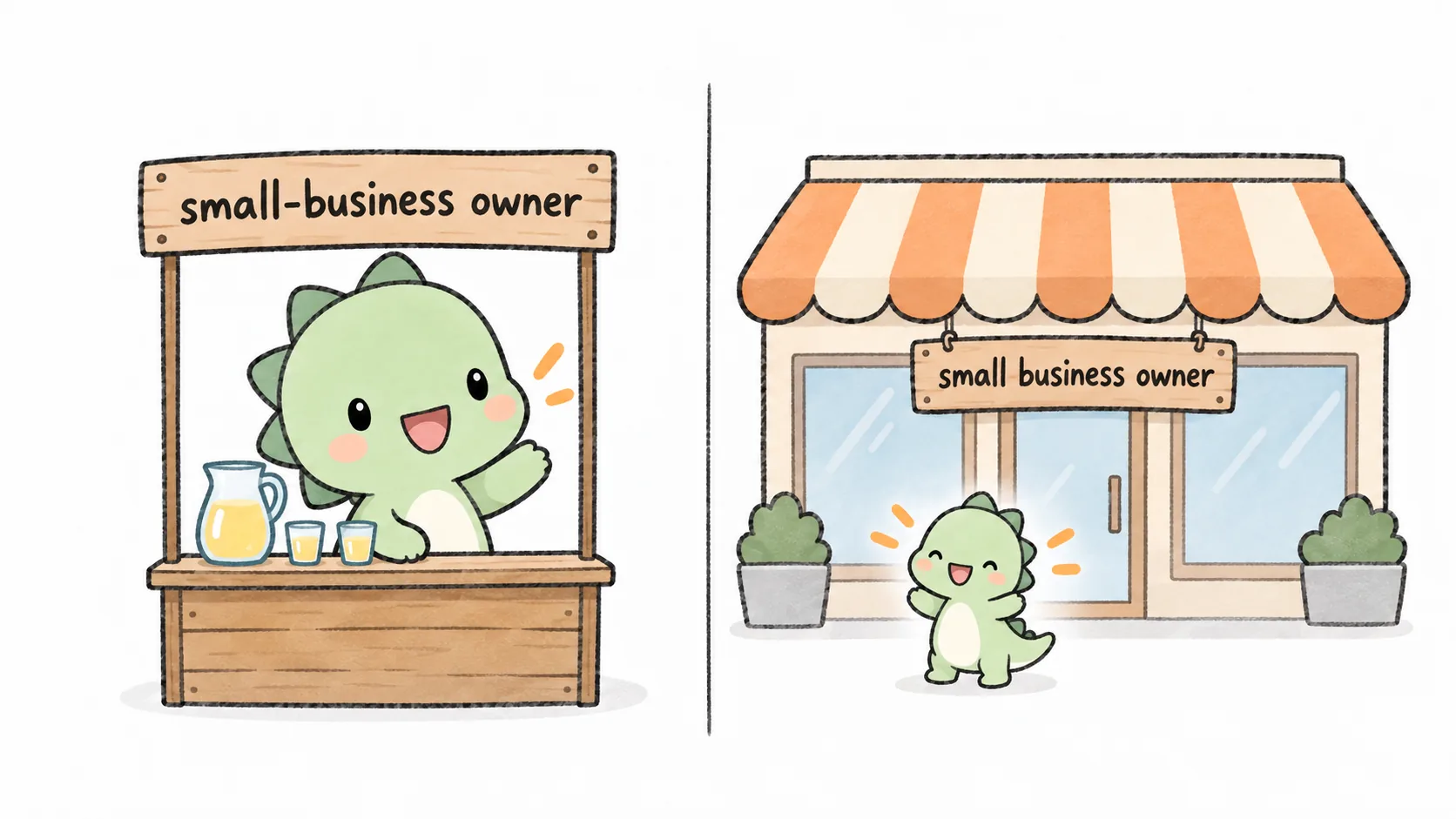
As for a five-year plan, writing it without the hyphen as a five year plan is rarely misunderstood, but formal documents usually keep it. In Handy 990's reading and listening question text (counting each repeated sentence once), hyphenated number-and-unit modifiers like two-day, one-year and 24-hour appear 387 times: day 117, year 66, month 58, minute 53, hour 48, week 38, page 7.
How does TOEIC Part 5 test it?
First, plainly: the ETS sample test doesn't contain a single number-and-unit modifier like five-year, let alone a question about one. The hyphenated modifiers it does contain are front-desk supervisor (the conversation for questions 35 to 37), on-site staff training (option (A) of question 134), standard-quality paper (the notice for questions 161 to 164), data-processing services (option (C) of question 177) and On-hold messages (option (B) of question 179). One sample test is too small to show how often the real exam tests this point.
It does, however, make a natural Part 5 item. Here is one we wrote ourselves, not an ETS question:
The company signed a ------- lease for its new warehouse.
(A) three-years (B) three-year (C) three years (D) three-years'
The answer is (B). The test is simple: look at what comes after the blank.
- If a noun follows (lease), the number and unit are a modifier → singular, hyphenated: a three-year lease.
- If no noun follows and the phrase simply says how long something lasts → the unit follows the number as usual, so three takes years: The lease runs for three years. (A compound that has become a noun, like a 30-year-old, is the exception: no noun follows it, yet year stays singular.)
Handy 990's bank happens to have an item that runs the other way:
The office aims to process most requests within five working ___.
days / dated / day / daily
The answer is days. Nothing follows the blank; five working ___ is the object of within, so the unit is plural. Only in something like a five-working-day turnaround would day go back to the singular.
Your language may not mark plurals at all
Many languages, including Chinese, Japanese, Korean, Vietnamese and Thai, don't need a plural ending on a noun after a number: the word for "year" in "five years" is the same word as in "one year". For speakers of those languages, the singular year in five-year plan is, if anything, the more natural choice.
The real trap runs the other way. English teachers spend years drilling "a plural number needs a plural noun", and the habit finally sticks, so when five-year plan comes along the hard-won s jumps in where it doesn't belong: five-years plan.
One way to hold on to the rule: say the phrase in your own language and notice that the number doesn't make the unit plural there either. English does the same thing once the phrase moves in front of a noun.
This is English, so of course there are exceptions
A few things to be clear about:
- "Modifiers are singular" is a tendency, not a law. Sales department, savings account, arms race and customs officer all keep their s, and British English uses plural modifiers more than American English does.
- Some number compounds do keep an s. A two-thirds majority keeps the plural thirds. One listening conversation in Handy 990 mentions the back-in-thirty-minutes sign: a whole sentence lifted onto the front of a noun, with its minutes left exactly as they were.
- Not every compound loses its hyphen after the noun. Some compound adjectives are hyphenated wherever they go; the 18th edition of the Chicago Manual lists cost-effective, old-fashioned and short-lived among them. A dictionary is the safest check, though dictionaries don't always agree either.
- Not every word ending in -ly is an adverb. Family ends in -ly but is a noun, so a family-sized pizza does take a hyphen. The Chicago Manual's Q&A has answered exactly this question.
- Style guides differ on the details. This post mostly follows Chicago; AP, used in news writing, has its own rules. For exams and formal documents, hyphen before the noun and none after is the safest choice.
- The counts from the question bank are counts of occurrences, not of questions that test the point.
Conclusion: five years, one plan
A five-year plan has five years in it, but only one plan. The s goes with whatever is actually being counted: two plans are two five-year plans; the five years only say how long each plan runs.
Next time Part 5 lines up three-year, three-years and three years, don't count the years. Glance past the blank: if a noun follows, the s belongs to that noun; if the phrase just says how long, as in runs for three years, the s goes back on years.
In Handy 990, Grammar Practice → Nouns and Pronouns → Possessive Nouns includes time possessives such as two weeks' notice. Elsewhere in this series, What is the plural of fish? covers nouns whose plural looks like the singular, and What is the 's in store names? covers a different possessive.