
All articles · Published 2026-10-20
Is "I before E, except after C" true? We counted 10,000 common English words, and science and weird don't play along
"I before E, except after C" is probably the most famous spelling rule in English, yet science, weird, their and eight all ignore it. We checked it against a 10,000-word frequency list, our own vocabulary bank and our TOEIC question bank. Taken literally, it is right only about two times in three in real text, and after c there are more cie words than cei words. This post covers why the rule fails, why ie and ei are such a mess, and the version of the rule — one extra condition — that actually works quite well.
Why did the British government tell teachers not to teach "i before e"?
Plenty of learners memorised this at some point:
I before E, except after C.
So it's believe, field and piece, but receive and ceiling. Neat and tidy.
Then, in 2009, the spelling guidance Support for Spelling, sent to primary schools by England's Department for Children, Schools and Families, said this on page 106:
The i before e except after c rule is not worth teaching. It applies only to words in which the ie or ei stands for a clear /ee/ sound and unless this is known, words such as sufficient, veil and their look like exceptions.
That June the British papers ran with it as if the government were abolishing a national treasure. On Language Log (22 June 2009), the linguist Geoffrey Pullum pointed out that much of the coverage had misread the document. What it actually says is that without the "ee sound" condition, words like sufficient, veil and their turn into exceptions, and that the ee-words that need ei after c are so few that it is easier to learn them outright. The list it gives: receive, conceive, deceive (plus receipt, conceit, deceit), perceive and ceiling.
So how wrong is the rule, really? We decided to count.
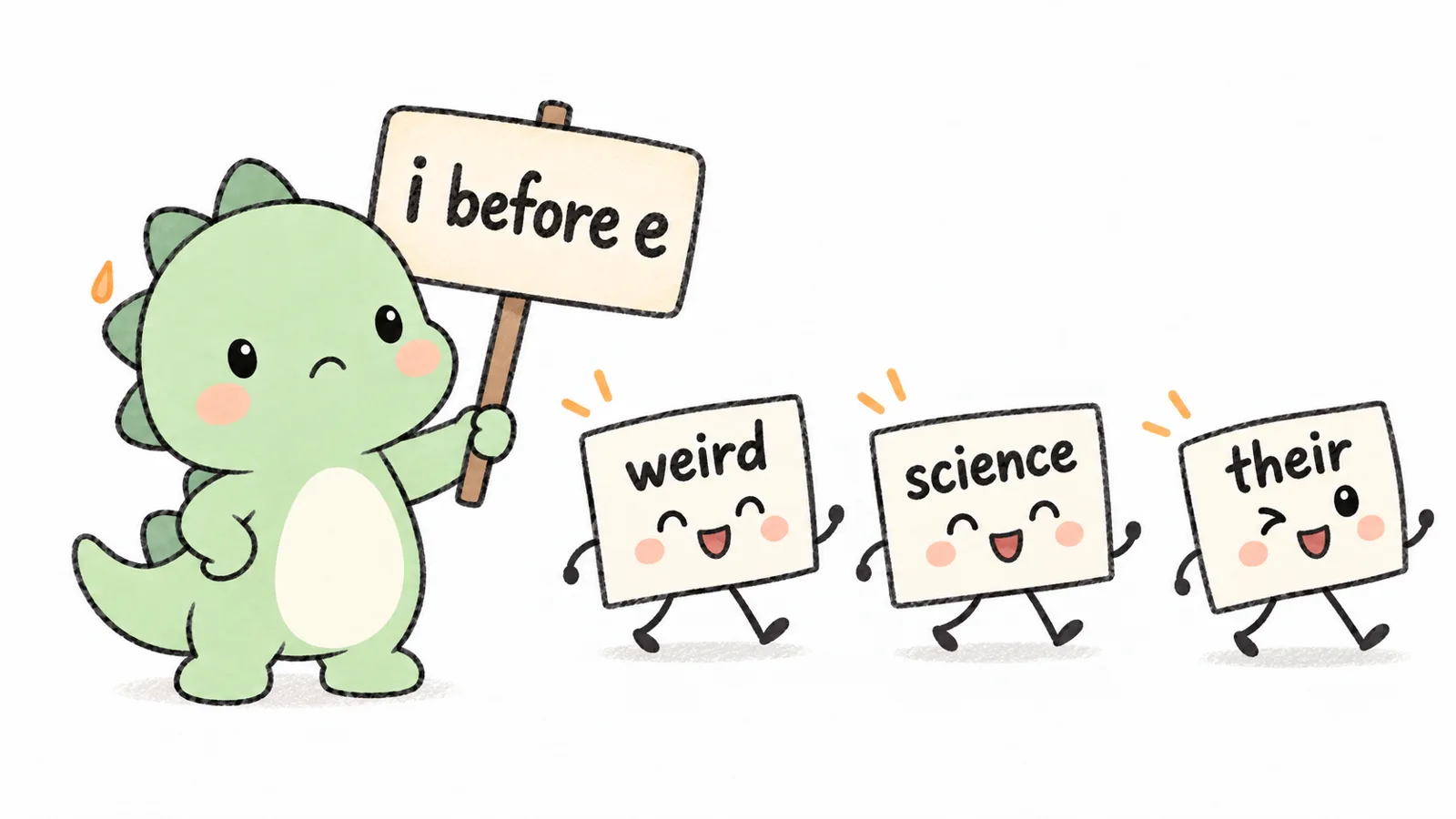
How often is the rule right? We counted 10,000 words
The method. We used three sources:
- A frequency list: the 10,000 most common English words in the wordfreq database developed by Robyn Speer and colleagues. After removing thirty proper names (Keith, Beijing, Leicester…), 317 words contain ie or ei.
- A vocabulary bank: the 3,834 words in Handy 990's vocabulary practice, 106 of which contain ie or ei.
- A TOEIC bank: all the reader-visible English in Handy 990's reading and listening questions (passages, questions, options, listening transcripts), about 680,000 words, counting every occurrence.
Scoring the rule is simple: ie not after c, or cei, counts as "right"; ei not after c, or cie, counts as "wrong".
The results:
| Source | Counting | Rule right |
|---|---|---|
| Frequency list (317 words) | each word once | 81% |
| Frequency list, minus y-to-ie words | each word once | 70% |
| Frequency list | weighted by frequency | 63% |
| Vocabulary bank (106 words) | each word once | 68% |
| TOEIC bank (about 680,000 words) | every occurrence | 65% |
The 81% in the first row is padded. Of the 317 words, 127 are forms like companies, studied and easier, where a final y turned into i before an ending. They are spelled ie because of a different rule (change y to i before -es, -ed, -er), not because of the rhyme. Take them out and the score falls to 70%.
Weighting by frequency is worse still, because the most common words are exactly the ones that misbehave: their, being, either, foreign, eight, weight. Their alone accounts for nearly half of all occurrences of words containing ei in the list.
We are not the first to count. In 2006 the linguist Mark Liberman, also on Language Log, ran the rule over a random month of New York Times newswire from 2001, about 8.7 million words: the rule was right 65% of the time. He also tested a lazier rule — "i before e, no matter what" — and it scored 67%, better than the original. Our frequency list agrees: "always ie" is right 84% of the time counting each word once and 66% weighted by frequency, beating the real rule both ways.
In other words, the second half of the rhyme, "except after c", doesn't just fail to help. It costs points.
"Except after c" is worse: after c, cie is the more common spelling
According to the rhyme, c should be followed by ei. Here is what we found:
| Source | Words with cie | Words with cei |
|---|---|---|
| Frequency list | 17 (society, science, species, ancient, efficient, sufficient…) | 9 (receive, received, receipt, ceiling, perceived, conceived…) |
| Vocabulary bank | 15 | 5 |
After c, it is cie that wins: by almost two to one in the frequency list, and three to one in the vocabulary bank.
Now look at those nine cei words. Apart from ceiling, every one of them belongs to the receive, perceive, conceive family. The lexicographer Henry Fowler said as much in A Dictionary of Modern English Usage (1926): the c exception "covers the many derivatives of Latin capio" ("to take"), such as receive, deceit and inconceivable. "Except after c", in other words, isn't really a rule about the letter c at all. It is shorthand for "the receive family, plus ceiling".
Why are ie and ei such a mess? Because they come from different places
English ie and ei aren't one system. They are layers left by several languages over several centuries:
| Word | Where it comes from | How the ie/ei is said |
|---|---|---|
| field, friend | Old English feld, frēond | ee, short e |
| eight, weigh, height | Old English eahta, wegan, hīehþu | ay, ay, eye |
| their | Old Norse (the Vikings' language) þeira | air |
| chief, piece | Old French chief, piece | ee |
| receive, deceive | Old French receivre, from Latin recipere | ee |
| seize, leisure | Old French seisir, leisir | ee; short e (mostly ee in American English) |
| forfeit, counterfeit | Old French forfait, contrefait | short i |
| science, species, efficient | Latin scientia, speciēs, efficiēns | split across two syllables, or merged with the c into a sh sound |
| protein | named in 1838 by the Swedish chemist Berzelius, from Greek prōteios ("primary") | ee |
| caffeine | French caféine (café + -ine) | ee |
| weird | Old English wyrd ("fate") | eer |
Sources: the etymology sections of the Wiktionary entries; for protein's naming, the English Wikipedia article "Protein".
A few things stand out:
- ie and ei stand for at least five or six different sounds: ee (field), ay (eight), eye (height, pie), air (their), short e (friend), short i (forfeit). A rule that only looks at letter order can't keep all of those in line.
- In science, species and efficient, the i and e aren't a pair at all. Sci-ence is two syllables; in efficient the ci together makes a sh sound. They count as "exceptions" only because the letters happen to sit side by side.
- caffeine is assembled, too. It is café plus -ine, a common ending for chemical names, so the e belongs to the first part and the i to the second.
- In eight, weigh and height, the ei is followed by gh. That gh is the trace of a sound once spoken in the throat (we covered it in Why does English have silent letters?), and the ei spells the vowel in front of it. foreign turned up in that post as well: Middle English spelled it forein (from French forain), and the g was squeezed in later.
A well-known longer version of the rhyme tries to patch some of this:
I before E, except after C, or when sounded as A, as in neighbor and weigh.
Adding "ei when it sounds like ay" takes care of eight, weigh, vein, reign and freight. But their, height, foreign, forfeit, leisure and science are still left out.
The version that works: only for words with an "ee" sound
Go back to the condition that the British guidance and Fowler both state: the rule applies only to words where ie or ei spells ee, the sound in see.
When the sound is ee, it's i before e, except after c.
That is exactly how Fowler put it in 1926: the rule "is very useful", but "it applies only to syllables with the vowel sound e"; seize is "an important exception"; and the rule "is useless with proper names". Pullum wrote in 2009 that anyone who knows what they are doing teaches it with "when the sound is ee" attached.
With that condition in place, we counted again, this time only words where ie or ei spells ee in a stressed syllable (American pronunciation — the CMU Pronouncing Dictionary for the frequency list, our own transcriptions for the vocabulary bank — with every word checked by hand):
| Source | Follow the rule (ie, or cei) | Exceptions | Rule right |
|---|---|---|---|
| Frequency list | 49 | 6 | 89% |
| Vocabulary bank | 25 | 3 | 89% |
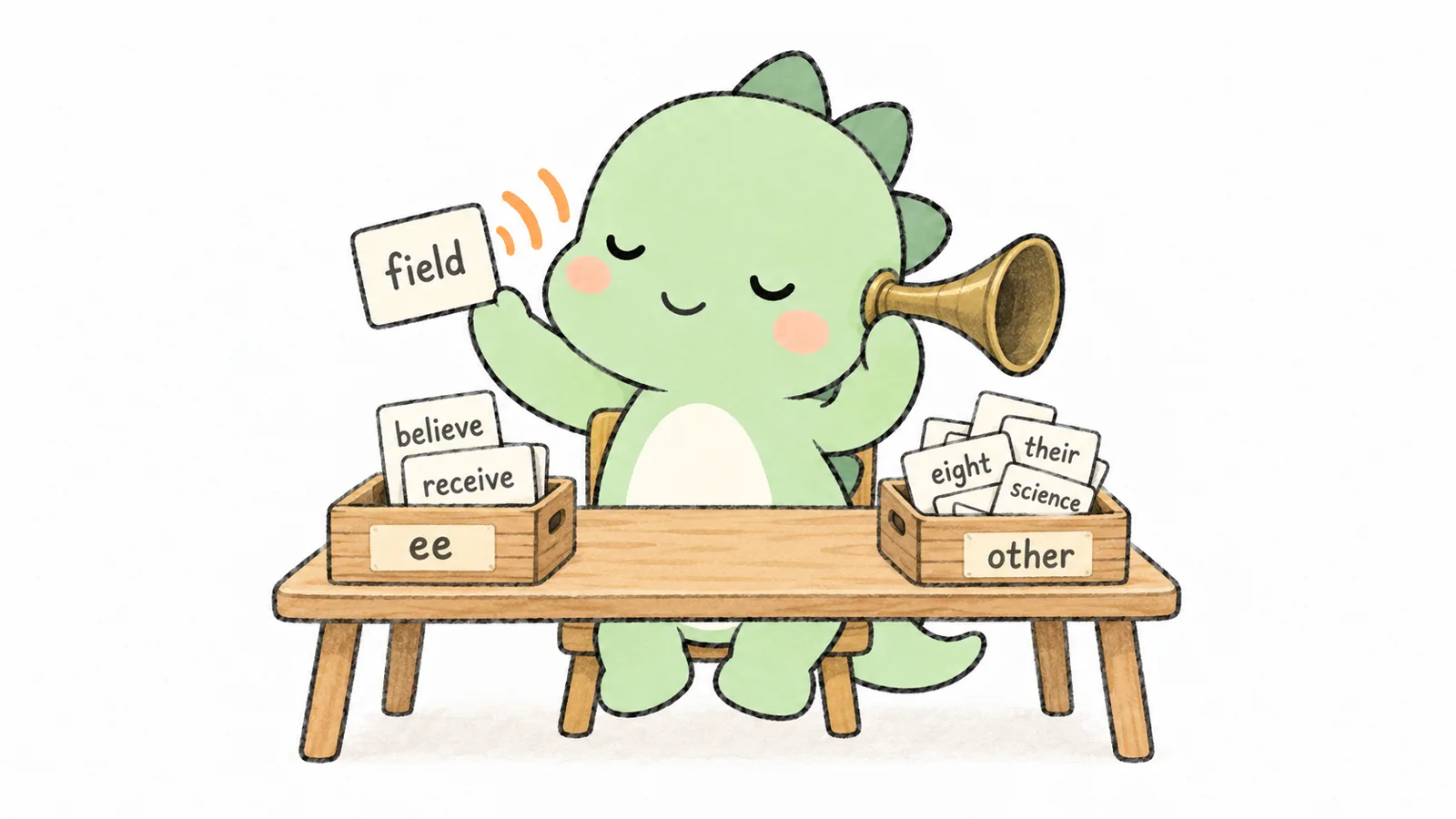
From two in three to nine in ten. The six exceptions left in the frequency list are either, neither, seize, seized, protein and proteins; in the vocabulary bank, neither, protein and seize. And either and neither depend on how you say them: many British speakers say "eye-ther", in which case those two don't fall under the rule at all.
So what you actually need to remember is short:
- For an ee sound, write ie: believe, achieve, field, piece, chief, brief, relief.
- For an ee sound after c, write ei: receive, receipt, deceive, perceive, conceive, ceiling. That's essentially one family.
- A few exceptions to learn by heart: seize, protein, caffeine, plus either and neither if you say them with ee. weird is said "eer", so our strict count left it out, but it is commonly listed as an exception, so it's safest to learn it alongside the others.
- For words without an ee sound, the rule says nothing: eight, their, height, foreign, science, efficient… These have to be learned by eye and ear, not by rhyme.
Your language probably has rhymes like this too
Using a single rhyme to tame a set of tricky spellings isn't unique to English. Plenty of writing systems have one: a short saying that tells apart two or three look-alike words, or that holds a list of words with an unusual spelling.
The good ones share a feature the English rhyme lacks: they cover a small, clearly bounded set of words, and they work for all of them. "I before e" has the opposite problem. It tries to cover every word with ie or ei in a single line, and it can't. Only once you narrow it to "words with an ee sound" does it become as reliable as those other rhymes.
Which ie and ei words will you meet on the TOEIC?
In the official TOEIC Listening and Reading sample test published by ETS, question 200 asks what problem a customer's complaint e-mail mentions; the correct answer, (A), is He received the wrong item. Question 39 asks why the woman in a conversation says I can't believe it. receive and believe: one representative for each half of the rhyme.
Here is how often these words appear in our question bank (inflected forms included, so received and receiving count as receive):
| Words that fit the rhyme as written | Count | Words that don't | Count |
|---|---|---|---|
| receive | 712 | eight (incl. eighteen, eighty) | 478 |
| receipt | 350 | weigh (incl. weight) | 175 |
| brief (incl. briefing) | 160 | neighbor/neighbour | 117 |
| field | 98 | efficient | 41 |
| ceiling | 60 | forfeit | 17 |
| believe | 49 | sufficient | 17 |
| achieve | 13 | leisure | 8 |
| relief (incl. relieve) | 12 | foreign | 6 |
| perceive/deceive/conceive | 6 | seize | 3 |
There is a twist here. Among common words in general, cie outnumbers cei; but in our TOEIC bank, cei appears 1,129 times and cie only 244. The reason is simple: business English is forever receiving things and issuing receipts. So "except after c", shaky as it is for English in general, happens to cover the two ie/ei words you'll meet most often in TOEIC-style English.
To be honest about it, though: TOEIC Listening and Reading is multiple choice, so you almost never have to spell anything yourself. Recognising receipt, and hearing "re-ceet" as receipt, matters far more than spelling it. Spelling earns its keep when you write your own e-mails, or if you take the TOEIC Speaking & Writing test, whose writing section asks you to compose a reply and a short essay. If you want to practise, Handy 990's Vocabulary → Practice → Vocabulary Spelling gives you an example sentence with one word missing and has you spell it on an on-screen keyboard.
The rule has exceptions, and so does our counting
A few things to be clear about:
- The numbers move with the word list and the method. A different list, keeping or removing proper names, keeping or removing the y-to-ie words, counting words or counting occurrences — each choice shifts the result by a few points, sometimes by more than ten. The direction never changes: taken literally, about two in three; with "when the sound is ee", about nine in ten.
- Some "ei"s aren't a letter pair at all. being is be + ing, seeing is see + ing, reimburse is re + imburse. In our question bank, being appears 1,384 times, making it the single biggest "offender" — but nobody spells being by the rhyme. Set words like these aside and the bank's score rises from 65% to 75%.
- The "ee sound" calls were made by hand. We used American pronunciation and counted only ee in stressed syllables. So weird, fierce and pier, where the vowel runs into an r, weren't counted; nor was the -cies at the end of species, which comes close to ee but sits in an unstressed syllable. Counting these would add a few exceptions without changing the conclusion.
- Accent changes the answer. either and neither are often said with "eye" in Britain; leisure is mostly said with ee in America and with a short e in Britain (our pronunciation sources mark it with a short e, so we didn't count it; with ee it would be one more exception). The same word can be an exception for one speaker and outside the rule entirely for another.
- Our question bank isn't ETS's test. It is TOEIC-style material we wrote ourselves, so its word counts reflect our writing; and the official sample test is a single test with a limited number of questions.
Conclusion: one rhyme, made useful by five extra words
"I before E, except after C" isn't wrong. It just leaves out five words: when the sound is ee.
Without them, the rule is trying to govern eight, their, science, foreign and being — a crowd of words with completely different sounds and histories — so no wonder it is only right two times in three. With them, it governs only believe, field, piece and the receive family, and it is right nine times in ten; the exceptions left over fit on one hand.
As for the British guidance the papers made such a fuss about, that is exactly what it said. It's just that "this rule needs a condition before it works" isn't much of a headline, and something like "Government scraps i before e" is.
Even the test's own name, TOEIC, puts e before i — though that's only the initials of English and International happening to sit next to each other, so it doesn't count.
In Handy 990, Vocabulary → Practice → Vocabulary Spelling has you spell the missing word in an example sentence on an on-screen keyboard, free of charge. In the same series, Can you end a sentence with a preposition? traces where six school grammar rules came from — this post is its spelling counterpart; Why does English have silent letters? covers the gh in eight and the g in foreign; and British vs. American spelling explains how colour and color (and neighbour and neighbor) parted ways.