
All articles · Published 2026-10-13
English numbers vs 萬: why 15 萬 is "150 thousand", 1 億 is "100 million", and 1.000 means a thousand in Vietnam
Chinese, Japanese and Korean count big numbers in blocks of four digits — 萬, then 億; English counts in blocks of three — thousand, million, billion. So 15 萬 is "one hundred fifty thousand", 1 億 is "one hundred million", and a TOEIC recording plays each sentence only once. This post gives a conversion table and two mental shortcuts, then covers how English numbers are said aloud — whether to put "and" in "one hundred and fifty", why $12.50 is often "twelve fifty", how years and room numbers are read, why a British billion used to be a million million — and finally 1,000.50 versus 1.000,50: in Vietnam and much of Europe, the decimal point and the thousands separator trade places.
On the TOEIC, you hear a number once
In ETS's official TOEIC Listening and Reading sample test, questions 41–43 in Part 3 are an office conversation. A woman asks a colleague to order a laptop for a new graphic designer, then says:
Our budget per work area is $1,000 maximum.
The test book shows a table: an 11-inch screen for $799, 13-inch for $899, 15-inch for $999, 17-inch for $1,099. Question 43 asks which size the man will order. The answer is (C), 15 inches — $999 is the largest screen that stays inside a thousand-dollar budget.
The numbers in that item are small, and "a thousand dollars" causes nobody much trouble. But suppose the speaker had said "one hundred fifty thousand", or "two point five million". A listener whose first language counts in 萬 has to turn that into "15 萬" or "250 萬" before the next sentence starts.
The English words are not the hard part. The hard part is that the two systems cut numbers in different places.
Why do big English numbers trip up Chinese, Japanese and Korean speakers?
Chinese counts ones, tens, hundreds, thousands — and after those four places starts a new unit: 萬 (ten thousand). Four digits later comes 億 (a hundred million), and four after that 兆 (a million million, as the word is used in Taiwan and Japan).
English starts a new unit every three digits: one, ten, hundred, then thousand; three digits later million; then billion; then trillion.
| Digits | Numeral | Chinese | English |
|---|---|---|---|
| 4 | 1,000 | 一千 | one thousand |
| 5 | 10,000 | 一萬 | ten thousand |
| 6 | 100,000 | 十萬 | one hundred thousand |
| 7 | 1,000,000 | 一百萬 | one million |
| 9 | 100,000,000 | 一億 | one hundred million |
| 10 | 1,000,000,000 | 十億 | one billion |
| 13 | 1,000,000,000,000 | 一兆 | one trillion |
The odd thing is that Taiwan, Japan and Korea all write numbers with a comma every three digits: 1,500,000. The eye sees English-style groups; the mouth reads them in fours — 一百五十萬 in Chinese. Speakers of these languages make this conversion every day, but in the direction "see commas, say 萬". A listening test runs it backwards, and that is where it jams.
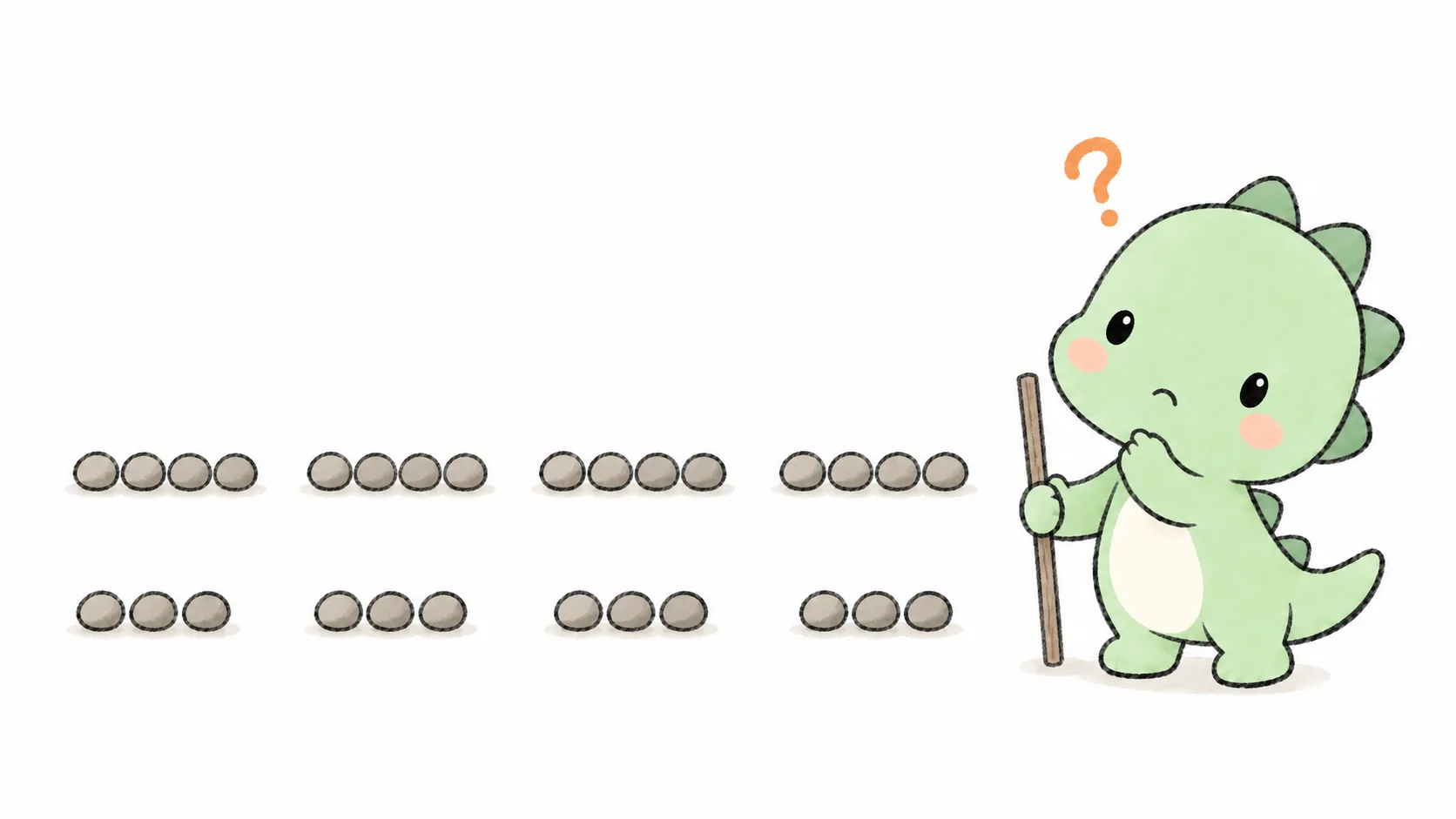
How do you convert 萬 to thousands? A table and two shortcuts
The ones worth memorising:
| Chinese | Numeral | English |
|---|---|---|
| 1 萬 | 10,000 | ten thousand |
| 5 萬 | 50,000 | fifty thousand |
| 10 萬 | 100,000 | one hundred thousand |
| 15 萬 | 150,000 | one hundred fifty thousand |
| 100 萬 | 1,000,000 | one million |
| 350 萬 | 3,500,000 | three point five million |
| 1,000 萬 | 10,000,000 | ten million |
| 1 億 | 100,000,000 | one hundred million |
| 10 億 | 1,000,000,000 | one billion |
Shortcut one: from 萬 to English, add a zero. One 萬 is ten thousands, so 15 萬 is 150 thousand and 8 萬 is 80 thousand. At a hundred 萬, switch to million: 350 萬 is 3.5 million. For 億, remember that 1 億 is 100 million, and 10 億 is 1 billion.
Shortcut two: from English to 萬, look at the number before the unit.
- thousand: divide by ten to get 萬. Fifty thousand is 5 萬; two hundred thousand is 20 萬.
- million: multiply by a hundred to get 萬. Two point five million is 250 萬; twelve million is 1,200 萬.
- billion: multiply by ten to get 億. Three billion is 30 億.
And if converting is too slow, there is a more direct route: don't convert — write the digits. Hear "one hundred fifty thousand", write 150, add a comma and three zeros: 150,000. TOEIC answer options and graphics are printed in numerals anyway. You never need to pass through 萬 at all.
"One hundred fifty" or "one hundred and fifty"?
Both are correct. The Oxford English Dictionary lists and as the word that links tens and units to hundreds (two hundred and one), and notes that it is frequently omitted in colloquial North American usage.
The linguist John Algeo counted. In British or American English? (Cambridge University Press, 2006), he reports that in British texts the ratio of hundred and followed by a number to hundred followed directly by a number was 329 to 10; in American texts it was 149 to 42. Americans still say and most of the time — they just drop it far more often than the British do.
The sample test's script labels its speakers as American, British, Canadian and Australian, so you may hear either form. Don't worry about which one is "right"; just recognise both.
Two smaller rules from Cambridge's English Grammar Today:
- We normally say a hundred, a thousand, a million, and say one hundred only to emphasise the number.
- After a number, hundred, thousand and million take no plural -s: two hundred people, not two hundreds people. For large, unspecified amounts the plural comes back: hundreds of people, millions of dollars.
Prices, years, room numbers: how are numbers read aloud on the TOEIC?
Prices. Liz Walter, writing on the Cambridge Dictionary blog (2015), gives the most common pattern as the two parts said straight through: £3.50 is three fifty, $4.95 is four ninety-five. If you name the currency, American English needs and: twenty dollars and eighty cents. So in a conversation about prices, "twelve fifty" is most likely $12.50.
Numbers in the thousands are often counted in hundreds. One Part 3 conversation in our question bank is about an office supply order the purchasing system has blocked:
— How much did it come to? Anything over a thousand trips the approval rule. — It's at twelve hundred.
Twelve hundred is 1,200. Chinese has no "twelve hundreds", and the first time you hear it, it takes a beat. English uses this "so many hundreds" pattern a lot; you will see it again with years below, where 1700 is seventeen hundred.
Decimals: say "point", then the digits one by one. Cambridge's dictionary example is two point two (2.2); the Wikipedia article "English numerals" gives 3.1416 as three point one four one six. So 3.14 is three point one four, not three point fourteen.
Percentages. In questions 32–34 of the sample test, a man answering a complaint about a broken coffee machine offers the customer a coupon for forty percent off. Question 34 asks what he offers to do; the answer is (A), Provide a discount. The test book prints no number at all — the 40% exists only in the audio.
Years are read in pairs. English Grammar Today lists 1492 as fourteen ninety-two and 1908 as nineteen oh eight. After 2000 both styles are alive: 2003 can be two thousand and three or twenty oh three, 2012 two thousand and twelve or twenty twelve. On that pattern, 2026 is twenty twenty-six or two thousand (and) twenty-six.
One more trap: the eighteen hundreds means the 1800s — the nineteenth century (Cambridge's example: built in the sixteen hundreds). A museum tour in our bank opens with paintings from the late eighteen hundreds.
Zero is often "oh". The 1908 above is nineteen oh eight. One of Wiktionary's senses of oh is simply "the digit 0, especially in representations of speech": room 305 is often three oh five, and the zeros in phone numbers are often oh too. British speakers also say nought, and when reading phone numbers, two identical digits in a row are often double: 007 is double oh seven.
Did a British billion once mean a million million?
Today a billion is a thousand million (1,000,000,000). In Britain, a billion traditionally meant a million million — 10¹². That system is called the long scale; the American "thousand million" is the short scale.
The turning point has a date. On 20 December 1974, the MP Robin Maxwell-Hyslop put down a written question asking the Prime Minister, Harold Wilson, to have ministers use billion only in its British sense of a million million, not the American one. Wilson's written answer, recorded in Hansard, was:
The word "billion" is now used internationally to mean 1,000 million and it would be confusing if British Ministers were to use it in any other sense.
That answer is usually treated as the moment British official usage moved to the short scale.
The long scale has not disappeared everywhere. In French, billion still means 10¹², and a thousand million has its own word, milliard. So when reading European material outside English, give billion a second look. In English today, a billion is a thousand million.
1,000.50 or 1.000,50? In some countries the point and the comma swap jobs
English writes numbers with commas between thousands and a point for decimals. Every price in the sample test follows that pattern: $1,099, $18.99, $72.99.
Not everyone does:
| Convention | One thousand and a half | How it works |
|---|---|---|
| English, Taiwan, Japan, Korea, Thailand | 1,000.5 | comma groups thousands, point marks decimals |
| Vietnam, Germany | 1.000,5 | point groups thousands, comma marks decimals |
| France | 1 000,5 | space groups thousands, comma marks decimals |
| India | 1,00,000 (one lakh) | after the first three digits, groups of two |
This table follows Unicode's CLDR locale database, which is what many phones and programs use when they format numbers. Vietnam's convention is also written into law: Government Decree 123/2020/NĐ-CP says that on invoices a point goes after the thousands, millions and billions digits, and a comma after the units digit when decimals follow — while letting businesses opt for the English style instead.
India's grouping follows its own units: a lakh is a hundred thousand and a crore is ten million (both are in the Cambridge Dictionary), so ten million is written 1,00,00,000.
What does the international standard say? Resolution 10 of the 22nd General Conference on Weights and Measures (CGPM, 2003) declares that the decimal marker "shall be either the point on the line or the comma on the line". On grouping, it reaffirms a 1948 resolution: numbers may be divided into groups of three to make them easier to read, and neither dots nor commas are ever inserted in the spaces between groups.
So the same string, 1.500, is one and a half in English and one thousand five hundred in Vietnam or Germany. The sample test uses the English convention; if your work involves European or Vietnamese invoices, the difference is worth remembering.
Your language does this too
Counting in ten-thousands is not only Chinese:
- Japanese 万 and 億 work exactly like Chinese: 1万円 is ten thousand yen, and 1億 is one hundred million.
- Korean 만 and 억 work the same way: 15만 원 is a hundred and fifty thousand won.
- Vietnamese groups in threes like English: nghìn (thousand), triệu (million), tỷ (billion) map one-to-one. Vietnamese does have a Sino-Vietnamese word for ten thousand, vạn, but it is literary and not used for everyday sums.
- Thai has dedicated words for ten thousand and a hundred thousand — หมื่น and แสน — and only lines up with English at ล้าน, a million.
In other words, Chinese, Japanese and Korean speakers all hit the same wall at 萬; Vietnamese speakers walk straight through it, and then need to watch the decimal point instead.
A few honest footnotes
- "And" is a proportion, not a rule. Algeo's figures describe tendencies: Americans still use and more often than not, and British speakers sometimes leave it out.
- "Twelve fifty" is not always $12.50. Four-digit numbers are also commonly read in pairs, so "twelve fifty" can be 1,250. Context decides: a cup of coffee or a month's rent.
- CLDR is a software default, not a census. Practice varies within a country by industry and by settings, and Vietnam's own decree allows both styles.
- The numbers in the sample test are small. The largest amount of money in it is $1,099. We can't tell you how large the numbers on a real test will get — only that fluent conversion is one less thing to think about.
- This won't jump your score. It turns something that costs half a second every time into something that costs nothing.
The bottom line: write the digits first, think in 萬 later
Chinese says "fifteen ten-thousands"; English says "a hundred and fifty thousand" — a hundred and fifty lots of a thousand. Both are right — one counts in fours, the other in threes.
The least effortful way through a listening test is to skip 萬 entirely: hear "one hundred fifty thousand", write 150,000, find 150,000 among the options. You can turn it back into 15 萬 after the exam.
As for the billion: in Britain before 1974, it often came with three extra zeros.
In Handy 990's Part 3 conversation practice, the transcript view has a "Dictate this conversation" button that takes you through the conversation line by line. When your answer is checked, 12 and "twelve" both count as correct, and missed words are sorted into types — one of them is "Numbers". For another trap you get to hear only once, read How to hear the difference between can and can't; for another British–American difference, read British vs. American English vocabulary.