
All articles · Published 2026-09-23
Everyday English words that change meaning at the office: sheets aren't bedding, bars aren't pubs, and outstanding doesn't mean excellent
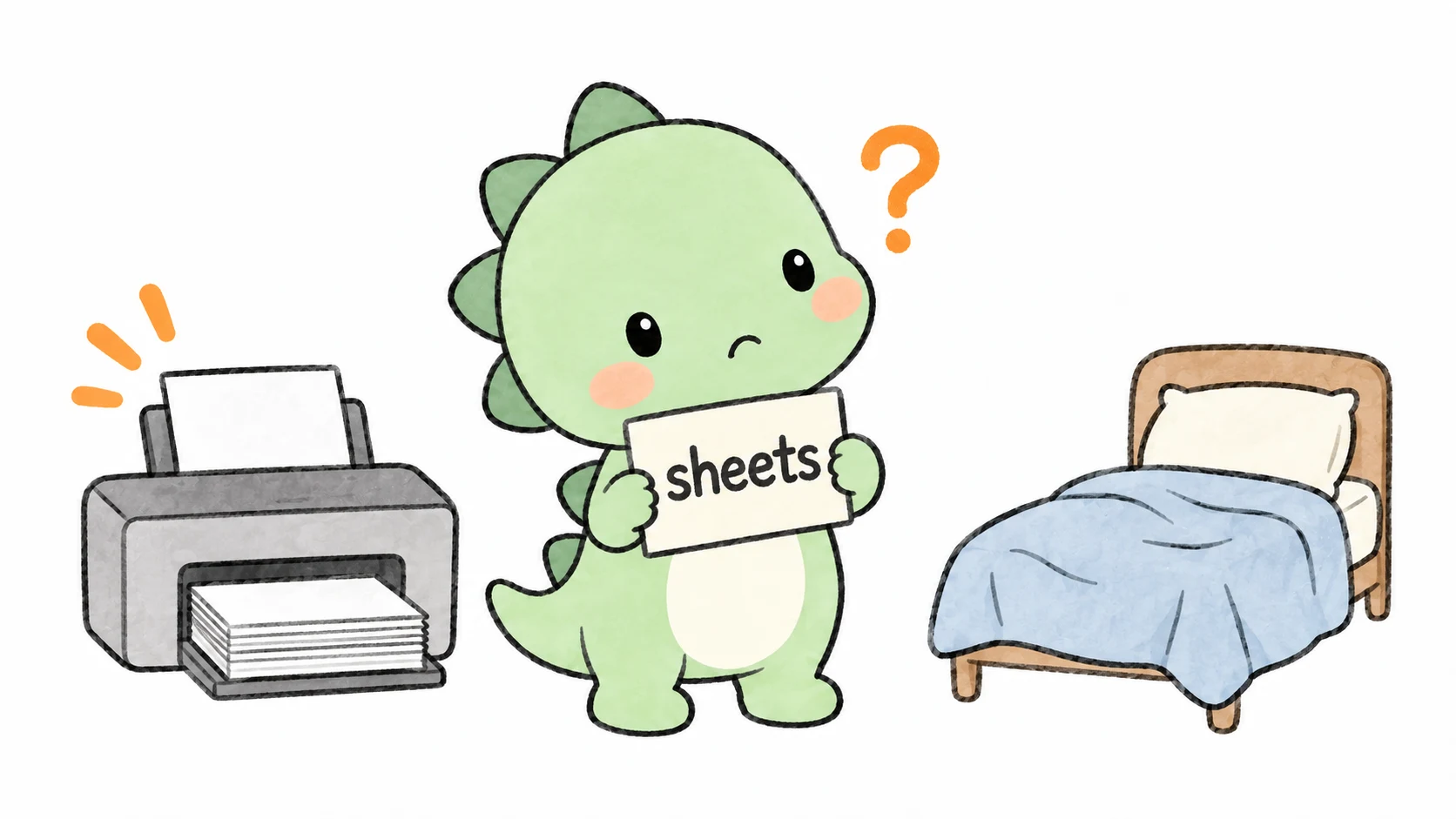
Next to a printer, "sheets" are paper, not bedding; on a café menu, "bars" are chocolate bars, not pubs; on an invoice, "outstanding" means unpaid, not excellent. The TOEIC contains very few words you have never seen. What trips people up is this other kind of word — one you learned years ago that quietly takes on a different meaning at work. This piece explains why the most common words carry the most meanings (Zipf worked it out in 1945), shows how the official TOEIC sample test tests exactly this, and ends with a table of some forty words that "change faces" in the office.
You know the word. You don't know this meaning.
Four sentences, all from the kinds of scenes the TOEIC uses:
- The printer jammed: I put back the clean sheets carefully.
- A new product at a café: Our house bars use the same beans.
- A podcast team in a meeting: The trailer goes out to new listeners first.
- At a trade-show booth: Keep a paper lead sheet in case the scanner fails.
You know all four words — bedding, pubs, something towed behind a truck, a heavy grey metal. None of those is what they mean here. The sheets are paper. The bars are chocolate bars. The trailer is a preview of the show. And the lead is a potential customer — the sales lead that sales departments talk about all day; a lead sheet at a trade show is a form for collecting visitors' contact details, not the kind of sheet music a jazz musician reads from.
These are among the words readers ask us about most often. They have one thing in common: not one of them is an unfamiliar word. You never stop to look them up. That is exactly why they catch you.
Why are the most common words the most dangerous?
Intuition says the hard words are the ones that cause mistakes. The opposite is true.
In 1945 the linguist George Kingsley Zipf (Journal of General Psychology, 33, 251–256) did something wonderfully laborious: he took Thorndike's list of twenty thousand words ranked by frequency and looked up how many senses each had in the Century Senior Dictionary. The more often a word is used, the more meanings it has — and the relationship is regular: the number of meanings grows roughly with the square root of the frequency. Later researchers named it Zipf's meaning-frequency law.
Put another way, a word is common precisely because it has been put to so many uses. When the Oxford English Dictionary revised run in 2011, the verb alone came to 645 senses, making it the longest entry in the entire dictionary; the previous record holder, set, had "only" 580 in the second edition. Run a company, the shuttle runs every ten minutes, a production run, the program is running — not one of those involves anybody's legs.
Our own word bank has the same shape. The Handy 990 dictionary holds 3,834 headwords, and 2,181 of them carry two or more senses. The words with the most senses (five each) are cast, charge, due, lead, model, mount, pitch, post and raise — every one a word you met in your first years of English. Not a single rare word makes that list.
So the real traps are not words like comprehensive or reimbursement, which you would stop and look up. They hide inside sheets, bars and charge — the words you never stop for.
How does the TOEIC test this?
Question 196 of the official TOEIC Listening & Reading sample test published by ETS reads:
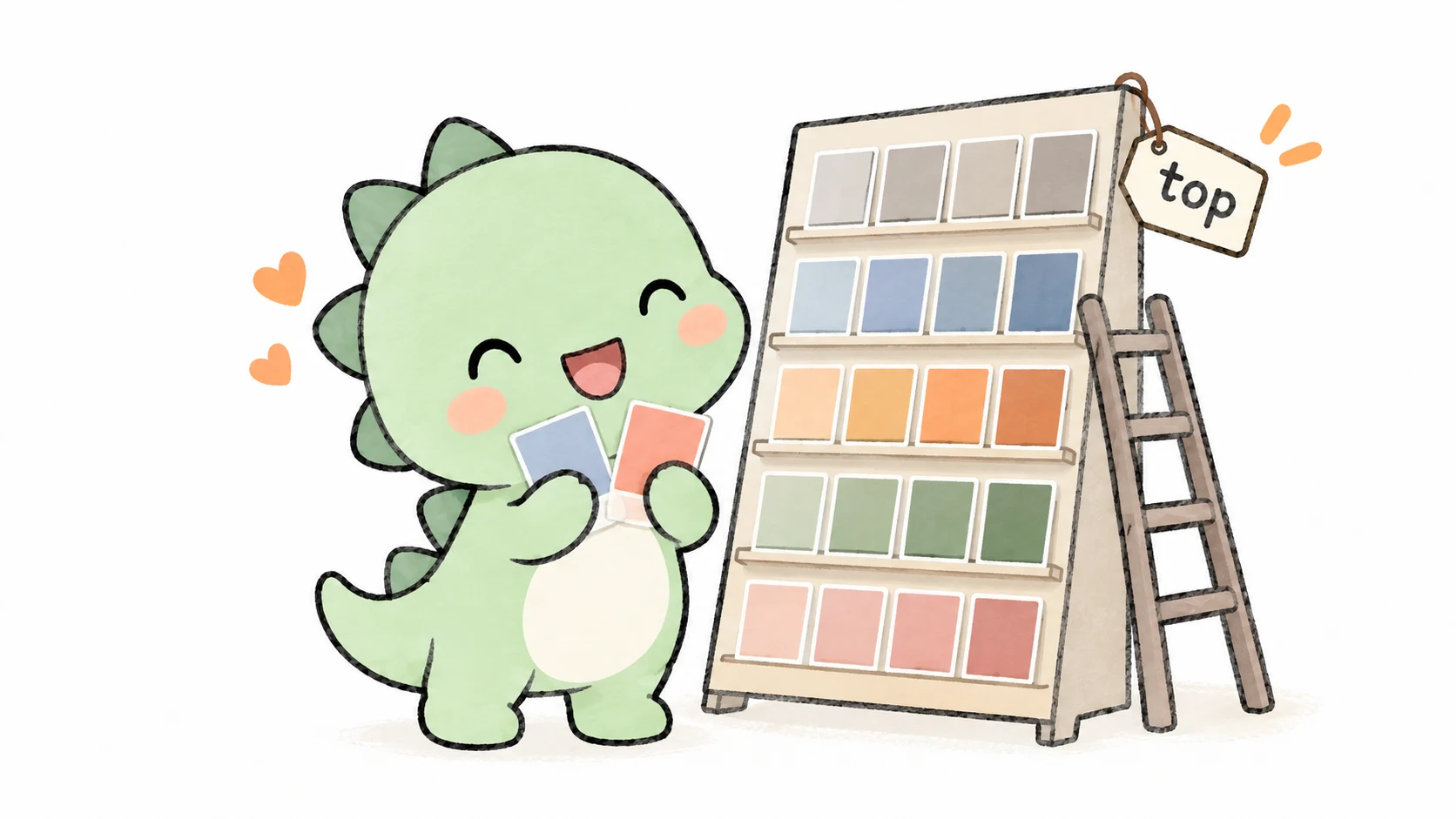
In the advertisement, the word "top" in paragraph 1, line 2, is closest in meaning to
(A) maximum (B) favorite (C) important (D) upper
The advertisement is a paint company's web page: "Select your top colors, and we'll send free samples right to your door." The answer is (B) favorite — pick the colors you like best. And (D) upper, the most literal meaning of top, sits right there waiting for you.
This "the word X is closest in meaning to" question is a regular in Part 7. It never tests whether you know the word — everyone knows top. It tests whether you can see which top is doing the work in this sentence.
In Part 4 of the same sample test, a restaurant manager briefs the wait staff:
So I'm asking each of you to be in charge of one extra table tonight. Please also remember to tell each table of guests about our new menu special.
Two face-changers in one breath: charge is neither electricity nor a fee — in charge of means responsible for; and a table is not furniture but a group of diners. A listening question gives you no time to open a dictionary. You have only the scene — a restaurant, wait staff, a short-handed evening — to decide on the spot.
Our question bank tests it the same way. A follow-up email about an overdue invoice says "the invoice was due on May 5 and now remains outstanding," and the question asks which word is closest in meaning: excellent, unpaid, noticeable or projecting outward. The answer is unpaid. There is no such thing as an excellent invoice.
The words that change faces most often at the office
The table below is grouped by scene. "You think" is the first meaning a textbook taught you; "at the office" is what the word is usually doing in a TOEIC passage. Most of the examples are taken directly from our question bank.
Money words
| Word | You think | At the office | Example |
|---|---|---|---|
| outstanding | excellent | unpaid | Pay the outstanding balance of $365. |
| balance | equilibrium | the amount still owed | Pay the $550 balance by July 17. |
| charge | electricity | a fee; responsibility | at no additional charge / in charge of the booth |
| credit | trust, reputation | store credit; a credit entry | We offer store credit rather than a refund. |
| bill | a banknote | an invoice, the check | It is added to the final bill. |
| deposit | savings | a down payment | The registration deposit is due Friday. |
| interest | curiosity | interest on a loan | The loan carries 4% interest. |
| figures | people, shapes | numbers | The finance director is reviewing the revised figures. |
| quarter | one fourth | three months of the year | Permits expire at the end of each quarter. |
| terms | school terms, jargon | conditions of a contract | Re-accept the terms of service. |
| fine | OK | a penalty; very small | a late fine / read the fine print |
| cover | put a lid on | pay for; insure | The tenant must cover all interior repairs. |
The fine print is the small type — the few lines at the bottom of a contract set in the smallest font and most worth reading. A reviewer in our bank writes "Beautiful hall, but read the fine print," and no penalty is involved.
People and positions
| Word | You think | At the office | Example |
|---|---|---|---|
| position | a location | a job opening | Whether a position is available (an option in Q36 of the sample test) |
| party | a celebration | a party to a contract; a group of guests | Either party may cancel in February. / a party of six |
| lead | to guide; the metal | a potential customer; a team leader | Team leads could review the spreadsheet. |
| chair | furniture | the person chairing | M. Achebe, Programme Chair |
| board | a plank | a board of directors; a committee; a notice board | Submit an appeal to the Health and Safety Board. |
| panel | a flat surface | a group of experts | Moderator of a panel discussion |
| firm | solid | a company | We are a consulting firm of 22 people. |
| patient | tolerant | someone receiving medical care | Requesting patient records |
| appointment | a date | a booked time; being appointed | At any time by appointment |
| minutes | sixty seconds | the written record of a meeting | Please circulate the minutes by Friday. |
Party is especially sly because all three meanings turn up in the same kind of text. In one restaurant-booking email, a retirement party is a celebration, a party of 28 is twenty-eight guests, and either party is the two sides of the agreement.
Things
| Word | You think | At the office | Example |
|---|---|---|---|
| sheets | bedding | sheets of paper; forms | Custom label sheets / put back the clean sheets |
| bars | pubs | chocolate bars; energy bars | Recall of Sunfield Granola Bars |
| trailer | a towed vehicle | a preview; a site office | the temporary office trailer at North Pier |
| fixtures | something fixed | built-in fittings (lights, sinks) | the lobby and its modern fixtures |
| plant | a green thing | a factory | the Millbrook plant |
| premises | an assumption | a business's building and grounds | The machine was transferred from other premises. |
| stock | shares | inventory | One unit was out of stock. |
| draft | a rough version | a rough version (yes); a bank draft; a cold current of air | The editor returned the draft. |
| issue | a problem | one edition of a magazine; to issue (a refund) | A free print issue / issue a refund |
| floor | what you stand on | the sales floor; a storey | thirty copies of the novel left on the floor |
| brief | short | a set of instructions; a briefing | If the brief changes materially, tell us. |
Premises deserves a note of its own. Premise (singular) is an assumption; premises (plural) is a company's building and land — on the premises means on site, in the shop, at the plant. The plural is a leftover from legal drafting: a deed would describe a property and then refer back to "the premises," the things mentioned before — and the word stuck to the property itself.
Verbs
| Word | You think | At the office | Example |
|---|---|---|---|
| book | something to read | to reserve | The workshop is fully booked. |
| file | a folder | to submit (a complaint, an application) | To file a complaint about a delayed shipment |
| address | where you live | to deal with; to give a speech | We will address your concerns at the meeting. |
| raise | to lift | to bring up; a pay increase (noun) | To raise questions in advance / request a raise |
| run | to move fast | to manage; to operate on a schedule; to execute | We run a customer-support team of nine. |
| present | a gift | to give a presentation; to submit | present a revised policy to senior management |
| suit | clothing | to be right for | The Intermediate session would suit us best. |
| table | furniture | to postpone (US); to put forward (UK) | Two members recused themselves, so it was tabled. |
| second | after first | to support a motion | I second the motion. |
| brief | short | to inform someone | To brief families about the school |
Table is the only word in these tables that means opposite things on the two sides of the Atlantic. In an American meeting, to table a motion is to set it on the table and leave it there — to postpone it. In the British Parliament it is to lay it on the table for everyone to see — to bring it up for discussion. TOEIC passages come from both sides, so when you meet tabled, check first whether the passage is spelled the American way or the British way — we counted that in British vs. American spelling.
Two traps in one sentence
A few sentences in our bank are favourites of ours because they change two faces at once.
We only have thirty copies of the novel left on the floor.
A bookshop assistant. Novel is a book, not "new"; floor is the sales floor, not the ground — the books aren't lying on the floor, there are thirty left on the shelves.
Dogs are welcome on leads in the outdoor areas but not in the glasshouses.
A botanical-garden notice. Here lead is neither a customer nor a metal but the British word for a leash. Same word, fourth meaning.
There are no bins; traders remove their own before the tip shuts.
Rules for market stallholders. Tip is not a gratuity and not advice: it is the British word for a rubbish dump. The first few senses a dictionary gives for tip — gratuity, advice, the pointed end — are all wrong here; you have to scroll a long way down.
How do you tell which meaning it is?
Three questions, in order:
- Where does this passage take place? In a restaurant, a table is a group of customers; in a boardroom, table is a verb. On an invoice, outstanding can only mean unpaid. Settle this while reading the first line, not when you hit the word.
- What is standing next to it? Outstanding balance, file a complaint, store credit, in charge of, by appointment — TOEIC words rarely travel alone, and the collocation is very nearly the answer. That is why our collocation drills exist.
- What part of speech is it? Book with to before it and a room after it is a verb; second followed by the motion is not a number.
If all three still leave you unsure, then open the dictionary — and read every sense, not just the first one. The first sense is usually the one the textbook taught you, the one you already knew.
This is English, so of course there are exceptions
The everyday meaning shows up too. The "you think" column is not wrong. A TOEIC party is sometimes a real celebration (a "Catering Order for a Retirement Party" is in our bank), and a plant is sometimes a real plant ("Spring is the best time to plant"). The table describes odds, not rules.
Zipf's law is a statistic, not a guarantee per word. The square-root curve is the average shape of thousands of words; any single word can sit far from it. But it is enough to establish one thing: a word is not safe just because it is common.
This question type is not frequent. Of the 200 questions in the official sample test, exactly one is a "closest in meaning" item. Its importance is not the count but what it reveals about the test writers: they test top precisely because they know you know it. The same thinking is spread across the other 199 questions — it just isn't announced.
"2,181 words with two or more senses" depends on how we cut. How finely to split senses is an editorial judgement; the OED cuts run into 645, we stop at five. The number describes a shape, not a precise value.
British-only meanings appear only in British-flavoured passages. Tip the dump, lead the leash, table meaning to bring forward — these arrive together with British spelling. When you see colour and organise, that is the moment to take these meanings out of the drawer.
Closing
If you read outstanding as excellent in the exam room, don't be too hard on yourself: these words fool you precisely because you know them.
That is really what Zipf said in 1945. The more a word is used, the more meanings it accumulates, until the plainest words are the ones you can least afford to take at face value. There are no unfamiliar words in the TOEIC office — only words you thought you knew.
Long-press any word in a Handy 990 question to look it up; the dictionary lists every sense together, not just the first. The collocation drills train exactly the "what is standing next to it" instinct. In the same series, British vs. American spelling explains why colour and color are both right, and wind and wind covers the other kind of collision — two different words that happen to be spelled alike.