
All articles · Published 2026-10-17
Why does English use the past tense to be polite? The distance in "I was wondering" and "Could you", and why TOEIC Part 2 answers dodge the question
"I was wondering if you could help me" is about right now, so why is it in the past tense? Because English borrows distance in time and uses it as distance between people: could, would, might, I was hoping, Did you want… all push a request or question one step back and leave the listener room to say no. This piece explains how this "attitudinal past" works, why polite English so often talks around things, and how that explains the correct answers on TOEIC Part 2 that never seem to answer the question.
Sample test question 9: "Are you driving?" — "Would you like a ride?"
The Part 2 section of ETS's official TOEIC Listening and Reading sample test has only four items (questions 7 to 10). Here is question 9:
Martin, are you driving to the client meeting? (A) Oh, would you like a ride? (B) Nice to meet you, too. (C) I thought it went well!
The answer is (A).
Taken literally, the question is never answered. She asks a yes/no question — are you driving? The correct response has no yes and no no; it hands back another question: would you like a ride?
Yet most listeners can tell what is going on. She is probably not conducting a transport survey; she most likely wants a lift and has not said so. Martin understands, so he answers not the question she asked but the one she didn't. And he says would you like, not do you want.
Those two lines hold two devices that polite English relies on:
- Using a "past" form for the present. Would started life as the past tense of will, yet Martin is asking entirely about now.
- Not saying it all. You don't ask outright for what you want, and you don't answer outright either.
We'll start with the first device.
"I was wondering" is past tense — so why does it mean now?
Compare:
- Can you help me?
- I was wondering if you could help me.
The second is in the past progressive, followed by a past-tense could. But the speaker isn't talking about yesterday — they are standing in front of you now, and they need help now.
English does this a lot. In A Comprehensive Grammar of the English Language (1985), Quirk, Greenbaum, Leech and Svartvik call it the attitudinal past: the past tense here expresses not time but the speaker's attitude — a more tentative, guarded one. Leech had already discussed questions like Did you want me? in Meaning and the English Verb (first edition 1971): past in form, but asking what the other person wants now.
The Cambridge Dictionary's online grammar, English Grammar Today, spells it out: we use a past verb form for the present to sound more polite or less direct, often with verbs such as hope, think, want and wonder, and for extra politeness the past continuous. It adds that in shops and other service situations, servers often use past forms to be polite — Did you need any help, madam?
| Direct | One step back | Where the step is |
|---|---|---|
| I want to ask you something. | I wanted to ask you something. | The wanting moves into the past |
| I hope you can join us. | I was hoping you could join us. | Past plus progressive, plus could |
| I wonder if you can help. | I was wondering if you could help. | The same; a classic way to open a request |
| Do you want more coffee? | Did you want more coffee? | Asks about now, in the past |
Why would the progressive add another layer? One way to see it: the progressive turns the wanting into something still in process, not yet settled — "I've been wondering whether…" sounds less like a decision already made.
Why are could, would and might more polite than can, will and may?
Historically, could, would and might were the past tenses of can, will and may. Today they mostly don't refer to the past at all; they express possibility, hypothesis — and politeness.
Cambridge's examples make the point: Would you follow me, please, sir? is more polite and less direct than Will you follow me?; Might I ask…? is more polite — and rather more formal — than May I ask…? In the same way, Could you…? is one step further back than Can you…?
One pattern well worth recognizing by ear: Would you mind + -ing? Cambridge notes that it is more polite, and more common, than Do you mind…? Watch how it is answered. Mind means object to, so agreeing takes a no:
Would you mind if we sat here? No, not at all. (I don't mind — please do.)
Notice also the sat in Would you mind if we sat here? — another past form, about sitting down now. Polite English often stacks its past tenses.
The sample test shows these forms at work too. Questions 196 to 200 in Part 7 include a customer's e-mail to a support team about paint delivered in the wrong color, asking for a replacement: Could you send me the correct paint…? It is a complaint, and it still uses could. In Part 3, questions 35 to 37, a woman encourages a colleague to apply for an open front-desk supervisor job: if you don't mind working evening hours, and then I'd contact the manager right now — would used to give advice, so it sounds like "if I were you, I would…" rather than "go and do it". Question 37 asks what the man should be prepared to do, and the answer is (D) Work evening hours: that polite if you don't mind is exactly what is being tested.
How does distance in time become distance between people?
The basic meaning of the past tense can be read as "not here, not now". English borrows that distance for several jobs:
- Distance in time: I lived in Taipei. — that was before.
- Distance from reality: If I had more time… — the past marks a supposition that isn't true now.
- Distance between people: I was wondering if… — the request is pushed back a step instead of being set right in front of the listener.
In a 1989 paper, "Temporal distance: a basic linguistic metaphor" (Studies in Language), the linguist Suzanne Fleischman argued that temporal distance is a basic metaphor that languages systematically extend to other kinds of distance — not only within grammar but in the pragmatic component as well.
Applied to a request, the effect is this: I was wondering sounds like "I was just thinking", without insisting now; Could you sounds like "in some possible world, could you". With the request held at a distance, saying no is easier, and being turned down is less awkward for the one who asked.
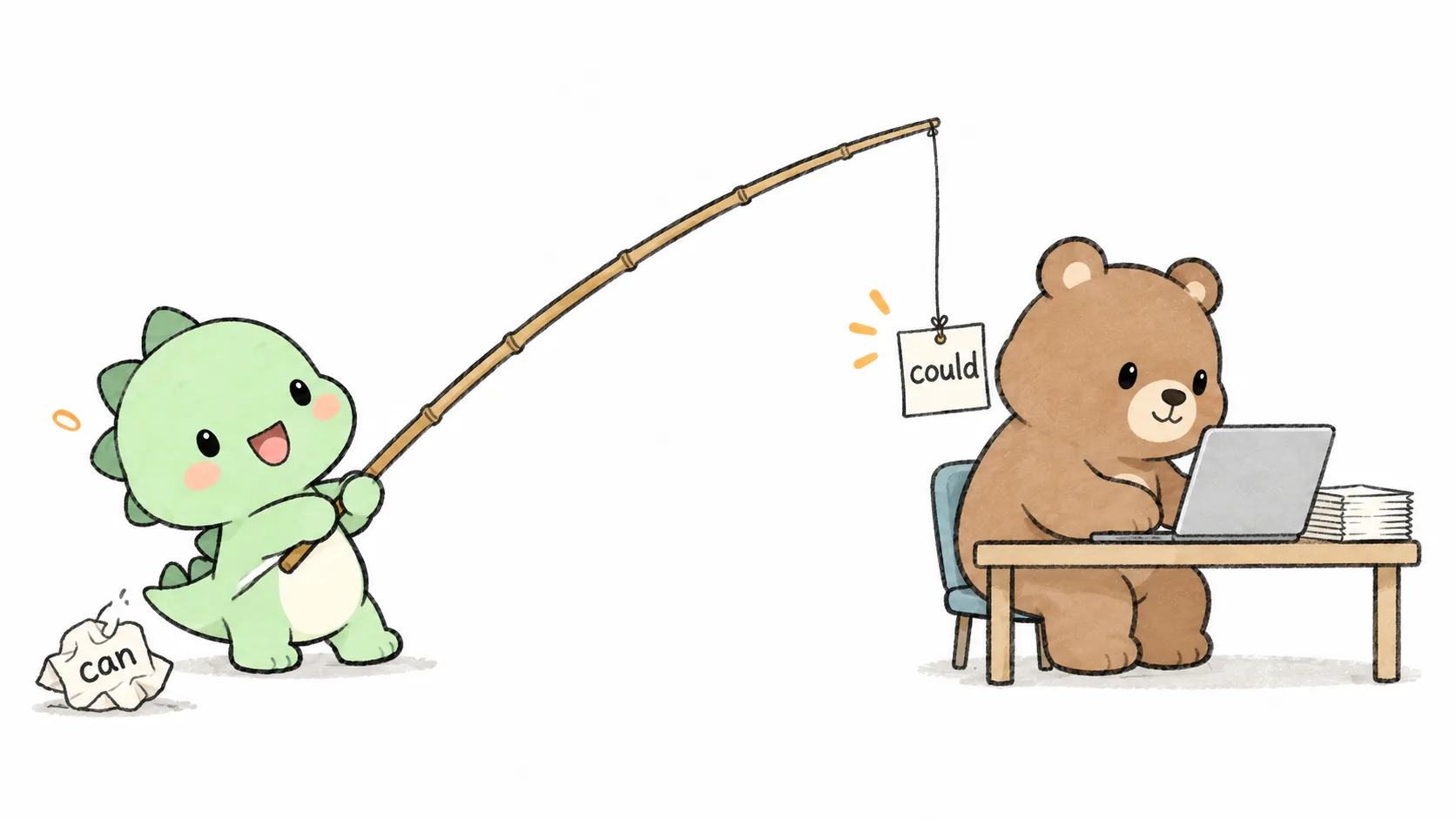
English is not alone in this. Spanish grammars have a name for it, the "imperfect of courtesy" (imperfecto de cortesía): quería pedirte un favor ("I wanted to ask you a favor") in place of quiero ("I want"). French orders coffee with je voudrais, a conditional, not je veux.
Why does polite English talk around things?
There is a well-known theory behind this device. In Politeness: Some Universals in Language Usage (1987; an earlier version appeared in 1978), Penelope Brown and Stephen Levinson proposed that everyone has "face", of two kinds: positive face, the wish to be liked and approved of, and negative face, the wish to be unimpeded — not to have things imposed on you.
Asking someone for something intrudes on their negative face, so it needs repair: you can say it straight out, you can play up your closeness, or you can step back. Brown and Levinson's step-back strategies include "be conventionally indirect" and "be pessimistic" — as in You couldn't lend me a pen, could you?, which says the "no" for the other person before they have to.
How far to step back depends on three things: how well the two people know each other, the power relation between them, and how big the imposition is. The sample test has a neat contrast in questions 41 to 43: between colleagues on first-name terms, passing on an ordering task, the woman simply says Can you place orders for those? — it is part of the job. The wrong-paint e-mail above is a customer writing to support staff they have never met, and it uses Could you.
The last strategy is to go off record: give only a hint and let the listener work it out. Back to question 9: are you driving to the client meeting? is a hint. If Martin isn't driving, nobody is embarrassed, because she never actually asked. And his would you like a ride? is just as tactful: he offers first, but as a question, without deciding for her.
Why do correct answers on TOEIC Part 2 so often dodge the question?
This takes us to the philosopher Paul Grice. In "Logic and Conversation" (1975) he proposed the Cooperative Principle: people in a conversation assume they are cooperating, roughly following four maxims — Quantity (say enough, but not too much), Quality (say what is true), Relation (be relevant) and Manner (be clear).
The key point: when a reply seems irrelevant on the surface, the listener does not conclude that the speaker has gone off topic. They look for a reading that makes it relevant. One of Grice's examples goes roughly like this: someone says their car has run out of fuel, and another person replies that there is a gas station around the corner. Nobody said the station is open or has fuel to sell, but the listener takes it that way — otherwise the reply would be pointless. Grice called this kind of unsaid-but-understood meaning a conversational implicature. Brown and Levinson's off-record strategies are built on exactly this mechanism.
The indirect answers on TOEIC Part 2 run on the same mechanism. In the sample test, two of the four Part 2 items — 8 and 9 — have keys that answer indirectly. Some examples:
- Would you like some coffee? — I just had some. (= No, thanks.)
- Can you cover the front desk during lunch? — I've got a dentist appointment at noon. (= I can't.)
- Sample test question 8: How well does Thomas play the violin? — answer (B), Oh, he's a professional. (= Very well.)
The first two are refusals with no "no" in them. In many settings a bare No sounds too blunt, so English often wraps a refusal in a reason and lets the other person work out the no. This is not a trap the test makers invented; it is how polite English often talks anyway.
So when you listen to Part 2, besides "what did they ask?", try asking yourself: why would they ask that? Someone who asks whether you're driving may want a ride; someone who asks whether the printer is fixed may have something to print. The answer often responds to the purpose nobody said out loud.
Why indirect answers are the main source of difficulty in Part 2 is covered with data in "Part 2 difficulty: the hard part isn't understanding it".

Your language probably steps back too
Not every language can push a request back with a past tense. Mandarin verbs don't mark tense, so Mandarin speakers use other tools: 想 ("would like to"), 一下 ("for a moment"), 請問 ("may I ask"). A phrase like 想請問一下 stacks all three — I'm only thinking of asking, I'm asking politely, and it will only take a moment.
Japanese, on the other hand, does use the past, much as English does: お聞きしたかったんですが ("I wanted to ask…") opens a request with a past-tense wanting, the same move as I wanted to ask you something.
The tools differ; the move is the same. Don't press the request right up against the other person — leave them a little room to say no.
The fine print: the past tense is not a politeness switch
- Most past tenses still mean the past. The attitudinal past mainly shows up on verbs of wanting and thinking — want, hope, wonder, think; the polite use of could, would and might is a closely related route. Putting just any sentence into the past does not make it polite.
- The past can sound like a complaint. Harada (2018), in a paper on the past tense and politeness, points out that What was your name? can imply "you told me and I've forgotten", and that I wanted to ask you something can, in some contexts, sound like "I wanted to ask, but you never gave me the chance". Tone and setting decide.
- Too polite is its own problem. Saying I was wondering if you could possibly pass the salt to a close friend may sound distant, or even sarcastic. Too much distance itself says "we're not close".
- Can you is not rude. The colleague in sample test question 41 uses Can you without a second thought. Between people who know each other, for small things within the job, please and a friendly tone are plenty.
- Face theory is not the last word. Brown and Levinson claimed their theory applies across cultures, which has drawn plenty of criticism: Matsumoto (1988), looking at Japanese, and Mao (1993), looking at Chinese, both argue that "face" is not quite what Brown and Levinson describe.
Conclusion: push it one step back
A large part of English politeness is distance: a present request moved into the past, a certainty turned into a possibility, a direct demand swapped for a hint.
Back to question 9. She never says "give me a ride", and Martin never says "yes, I'm driving". Neither of them says it all, and each understands the other perfectly.
That kind of understanding is what the test is listening for.
Handy 990's Part 2 bank has 1,225 items, each with a transcript and an explanation; when a correct answer doesn't seem to answer the question, the explanation shows what it was really responding to. Elsewhere in this series, "How to hear the difference between can and can't" covers another small listening device: English hides "not" in a t nobody pronounces.