
All articles · Published 2026-10-07
Why does English have silent letters? The k in knight was once spoken; the b in debt never was
knight sounds exactly like night, and the b in debt, the s in island and the p in receipt are just as quiet. English silent letters are not scattered at random. Most of them belong to one of two kinds: letters that were once pronounced and then fell silent, like the k and gh in knight; and letters that were never pronounced at all, added later by scholars, like the b in debt — some of which were added by mistake. This post covers where both kinds came from, how printing froze them on the page, how Shakespeare mocked a pedant who insisted on sounding the b, and what silent letters are actually good for when you learn English.
knight and night sound the same, so why the extra k?
Anyone who has studied English has probably memorised this rule: "In words that begin with kn, the k is silent." know, knee, knife, knock, knight — down the list you go.
Hardly anyone tells you why.
The answer: that k used to be pronounced. About a thousand years ago, Old English spelled knight as cniht, and it didn't mean a knight at all — it meant "boy" or "servant". Every letter in it was spoken: k-n at the start, then an h made by pushing air between the tongue and the roof of the mouth, much like the ch in German ich ("I"), and finally a t.
Over time, English speakers stopped saying the k, and stopped saying that ch in the middle. The spelling never caught up. Today's knight is a fossil: a thousand-year-old pronunciation, still sitting on the page.
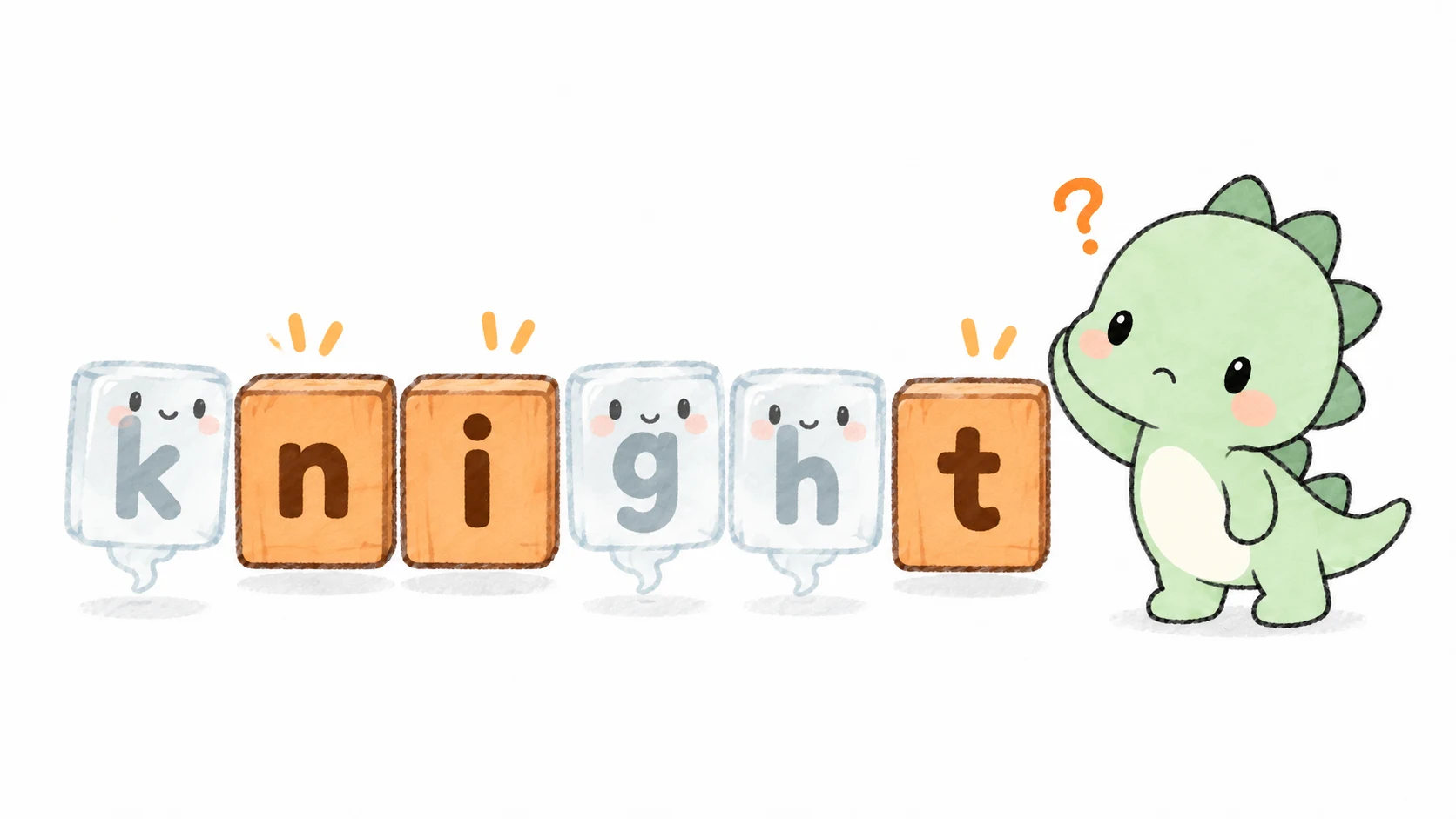
Most English silent letters fall into one of two kinds:
- Once pronounced, now silent — like the k and gh in knight. The letters stayed the same; the mouths changed.
- Never pronounced, added later — like the b in debt. The mouths stayed the same; someone changed the spelling.
On the page the two kinds look identical. The stories behind them run in opposite directions.
Kind one: the mouth changed, the spelling didn't
The easiest way to see that the k was once spoken is to visit English's relatives — German in particular. English and German come from the same ancestor, many of their words are siblings, and German still pronounces the sounds English dropped:
| English | Silent letters in English | German sibling | How German says it |
|---|---|---|---|
| knight | k, gh | Knecht (servant) | both k and ch spoken |
| knee | k | Knie | k spoken |
| night | gh | Nacht | ch spoken |
| light | gh | Licht | ch spoken |
| eight | gh | acht | ch spoken |
| daughter | gh | Tochter | ch spoken |
The knight/Knecht pair is a nice one: the same word was promoted all the way to knight in English, and is still a servant in German.
When did these sounds disappear?
- The throaty sound behind gh was lost somewhere between late Middle English and early Modern English. Sometimes it didn't vanish but turned into an f — which is why the gh in laugh, enough, cough and tough is pronounced f.
- The k in kn- held on longer than you might think. In A Modern English Grammar on Historical Principles, the linguist Otto Jespersen places its loss in educated English in the 17th century. Several grammars of English written for Germans in the late 17th and early 18th centuries transcribed English kn- as tn- or dn- — it looks as if the k put up a fight before it disappeared entirely.
- The w in wr- (write, wrong, wrap) and the g in gn- (gnat, gnaw) went silent at about the same time, in the 17th century.
- The b in final mb (lamb, climb, comb, plumb) went even earlier, in late Middle English. That is also why the b in plumber is silent: the word comes from plumb, a lead weight.
A side note: Shakespeare died in 1616. On Jespersen's timeline, people of Shakespeare's generation may still have heard the k in knight.
Why didn't the spelling change? Printing froze it
Pronunciation changes all the time; every language does it. What makes English unusual is that its spelling settled down at a very awkward moment.
In 1476 William Caxton brought the first printing press to England. Before that, scribes spelled words however they were used to, and one word having several spellings was nothing unusual. Once printed books began to circulate widely, spellings slowly started to fix in place.
The trouble is that English pronunciation was going through an earthquake during those same centuries. Linguists call it the Great Vowel Shift: roughly from 1400 to 1700, every long vowel in English moved. The i in knight started out close to the "ee" in see and ended up as the "eye" we say today — and over the same period the k and the gh went silent one after another.
Printing arrived right in the middle of the earthquake. The spellings were set in type while the sounds were still on the move. By the time the sounds had settled, the spellings could no longer follow.
The printers even added a few letters of their own. ghost was gāst in Old English — no h anywhere. According to the Oxford English Dictionary, the gh spelling turns up in a book Caxton printed in 1484, probably under the influence of Middle Dutch, where the word for ghost was often spelled gheest — both Caxton and his assistant had close ties to the Low Countries.
Kind two: the b nobody ever said — debt and doubt
Now for the more absurd kind.
English borrowed debt from French. In Middle English it was spelled dette; in French it was dette too. There was no b in it, and nobody had ever pronounced one.
Then a group of scholars steeped in Latin noticed that the word's ancestor was the Latin debitum ("something owed"). They felt English spelling ought to show where a word came from, so they squeezed a b into dette, and it became debt.
The same people did the same thing to plenty of other words:
| Spelling today | Earlier spelling | Letter added | The Latin ancestor the scholars wanted you to see |
|---|---|---|---|
| debt | dette | b | debitum |
| doubt | doute | b | dubitare |
| receipt | receite | p | receptus/recipere |
| salmon | samoun | l | salmo |
| indict | endite | c | indictare |
All of these added letters were for the eyes only. Mouths went on saying det, dout, re-ceet, sa-mon, in-dite.
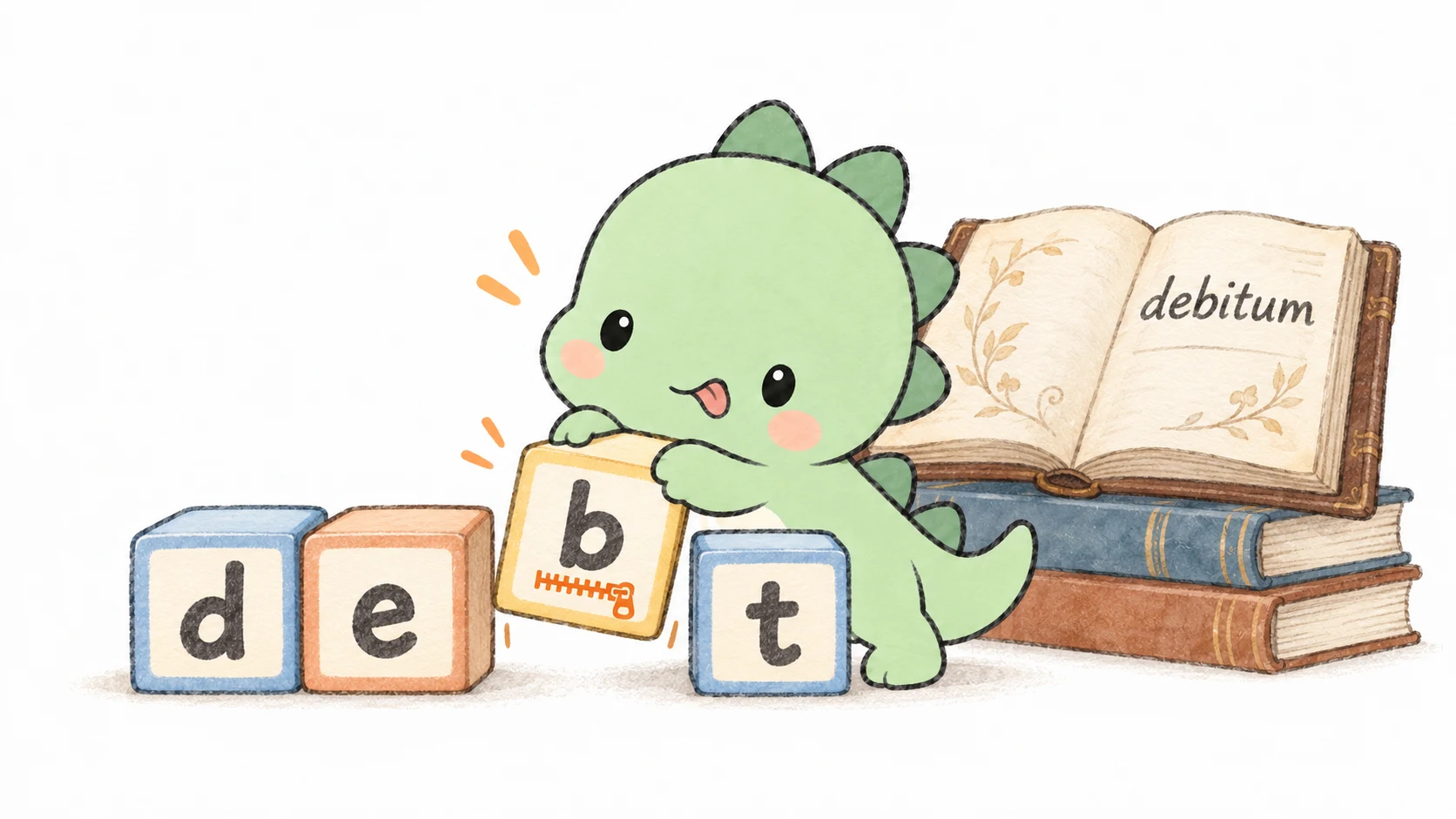
The funny part is that French scholars stuck the same b into French — and French later took it back out. Modern French still writes dette and doute. English kept its b, and is still paying off that debt.
Letters added by mistake: the s in island isn't even its own
The scholars at least had Latin to back them up. A few words got letters that were simply wrong.
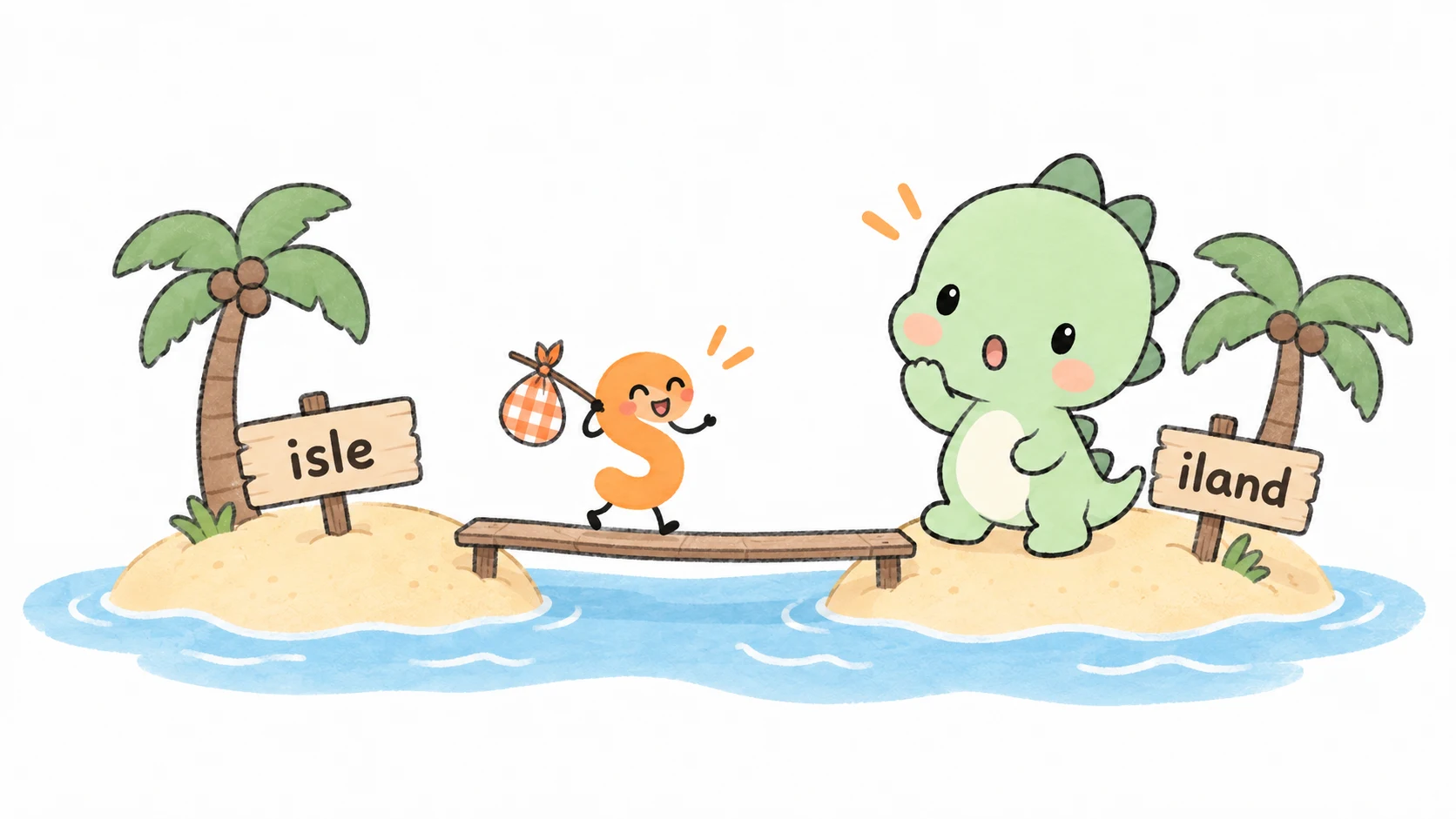
island. Old English had īegland, a thoroughly native English word with no connection to Latin at all. But English also had a word with a similar meaning, isle, which came from French and, before that, from Latin insula — so it carried an s. In the 16th century people decided island and isle must be one family, and handed isle's s over to island. island has carried a letter that isn't its own ever since.
ptarmigan (a grouse-like bird). It comes from Scottish Gaelic tàrmachan and originally had no p. Later someone assumed it was related to the Greek pteron ("wing") — it's a bird, it has wings — and put a p on the front.
could. The l in should and would was once pronounced, back in Old English (sceolde, wolde). could never had an l (Old English cūþe), but it looked so much like should and would that in the early 16th century it was given an l too, so the three brothers would match.
thumb, crumb, limb. The b in lamb and climb used to be pronounced (see above). But the b in thumb (Old English þūma) and crumb (cruma) was added later in imitation — writers saw a word ending in -m and felt it ought to have a b.
foreign, sovereign. When these came from French they had no g (French forain, soverain). English seems to have linked them with reign, and gave them a g as well.
The man in Shakespeare who insisted on saying the b
Some people took these added letters seriously at the time.
In Shakespeare's comedy Love's Labour's Lost (written around 1595), there is a show-off schoolmaster called Holofernes. In Act 5, Scene 1 he fumes about people who speak carelessly:
such rackers of orthography, as to speak dout, fine, when he should say doubt; det, when he should pronounce debt,— d, e, b, t, not d, e, t
He also complains that people say "cauf" for calf and "hauf" for half, and call neighbour "nebor". Finally he declares that they even get abominable wrong: it should be abhominable, with an h.
Shakespeare is making fun of him. The speech is funny precisely because by then nobody pronounced the b any more: an audience hearing an old pedant spell out d-e-b-t would have reacted the way we would to someone today insisting on saying knight as "k-nite".
More than four hundred years later, here is Holofernes's scorecard:
- debt, doubt: the b stayed in the spelling, but nobody says it. Call it a draw.
- calf, half: the l stayed in the spelling, and nobody says it either.
- neighbour: nobody says the gh.
- abhominable: he believed the word came from Latin ab homine ("away from man"), so it needed an h. He was wrong — it actually comes from Latin abominari ("to regard as a bad omen"), which has no h at all. His h didn't even survive in the spelling: we write abominable.
Holofernes didn't lose every round, though. A few letters the scholars added did end up being pronounced:
- perfect was parfit when it was borrowed from French, with no c. In the 15th century it was respelled the Latin way as perfect, and today we pronounce the c.
- fault was originally faute. The l was added around the 16th century in imitation of Latin and stayed silent for a long time afterwards; only in the 18th century did people start pronouncing it.
Changing a pronunciation to match the spelling is called a spelling pronunciation. For centuries the sounds moved and the spelling stayed put; once in a while, it goes the other way, and the spelling pulls the sound back.
Your language probably does this too
English is not the only language like this. Most languages that have been written down for a long time have letters that outlived their sounds.
French is full of them: in ils parlent ("they speak"), the -ent at the end is written but not said. Chinese characters do it too. Many are built from a meaning part and a sound part, and the sound part was a good hint when the character was created. Two or three thousand years of sound change later, many of those hints no longer match: the character for "river", 江 (jiāng), still carries the sound part 工 (gōng).
It is the same thing as the k in knight: what is written down outlives what is said.
What are silent letters good for? Look for the relatives
So are silent letters just historical baggage?
Not entirely. One kind of silent letter is genuinely useful: silent in this word, but pronounced in a related word.
| Silent | Pronounced in a relative |
|---|---|
| sign | signature, signal |
| design | designate |
| muscle | muscular |
| autumn | autumnal |
| column | columnist |
| condemn | condemnation |
| bomb | bombard |
The g in sign looks pointless, but thanks to it, sign, signature and signal are visibly one family. If English spelled the word sine, the way it sounds, that link would disappear.
In The Sound Pattern of English (1968), the linguists Noam Chomsky and Morris Halle went as far as calling conventional English spelling a "near optimal" system: it records not just sounds but the relationships between words. Not every linguist shares that optimism, but pairs like sign/signature do show that spelling is more than a record of pronunciation.
For anyone memorising vocabulary, this makes a practical trick: when you meet a silent letter, think of its relatives first. Learn sign together with signature and you won't forget the g; learn muscle with muscular and you'll know why the c is there.
Where will you meet these words on the TOEIC?
Silent letters aren't confined to rare, odd words. They hide in the most common ones.
In the official TOEIC Listening and Reading sample test published by ETS (counting the directions as well), should appears 11 times, through 10 times, know 8 times, would 5 times, write and talk 4 times each, and tonight 3 times. Option (D) of Part 7 question 152 reads He works for Fly Right Airlines — two silent gh's in one short sentence; the other options in the same set include flight, knows and through.
In reading, these letters cause no trouble; you recognise the words at a glance. The trouble is in listening: listening gives you the sound, never the spelling. If the receipt in your head is pronounced the way it's written, "re-ceip-t", then when someone in a Part 3 conversation asks Do you have the receipt?, the "re-ceet" you hear may not click right away. debt is "det", subtle is "suh-tl", mortgage is "mor-gij", Wednesday is "wenz-day", island is "eye-land".
So when you learn a word, listen to the correct pronunciation at least once instead of guessing from the spelling. That matters most for words with silent letters, because those are exactly the words that fool your eyes.
It's English, so of course there are exceptions
A few things to be clear about:
- Not every silent letter fits one of the two kinds. Some came with words borrowed from other languages and were never said in English: the p in psychology and pneumonia is the Greek ps- and pn- at the start of a word, an opening English doesn't do, so English simply skips the p; the h in honest and hour is silent because it was already silent in French.
- "The k went silent in the 17th century" is approximate. Dialects vary a lot: in the late 19th century a spoken kn could still be heard in parts of northern England, and some Scots dialects still pronounce it today.
- For most words we can't say who added the letter, or in what year. What we can describe is a broad 15th- and 16th-century scholarly fashion; we can rarely name names.
- Some histories are still disputed. Whether the g in foreign really comes from reign, for example, the dictionaries only call "perhaps".
- The relatives trick doesn't always work. The k in knight isn't pronounced in any relative; the b in debt is only pronounced in debit, which is a separate, later borrowing of the same Latin word.
Conclusion: one letter, two kinds of fossil
Next time you see knight, you can picture two scenes.
In one, a thousand years ago in England, someone calls out k-n-i-ch-t, shouting for a boy who helps out in the stables. In the other, five hundred years ago in a study, a scholar with a Latin dictionary squeezes a b that nobody has ever pronounced into dette, and sits back, satisfied.
Both scenes are preserved in English spelling today. The k in knight is a fossil left by speech; the b in debt is a fossil left by scholarship. The first tells you how English used to sound; the second tells you how someone once wished it looked.
As for Holofernes — he would probably be delighted to know that four hundred years later, English learners all over the world still dutifully write the b into debt. They just don't say it.
In Handy 990, Everyday English → Tricky pronunciation collects 230 words whose spelling misleads, in eight groups; the Silent letters group holds 48 of them, including knight, debt, receipt, island and salmon, and for every word you can hear the correct pronunciation and try it yourself. In the same series, British vs. American spelling tells how Noah Webster changed English spelling (and which of his proposals didn't catch on), and wind and wind is about one spelling with two pronunciations.