
All articles · Published 2026-10-04
What is the plural of fish? Why "the fish" can mean one fish or a whole school
A reader met The fish ___ swimming in a grammar drill that accepted only are, and reported: "The fish can also mean one fish." They were right. This post rounds up the English nouns whose singular and plural look the same — fish, sheep, deer, aircraft, series, headquarters — explains why they take no s (some of them are leftovers from Old English, a thousand years ago), when fishes is the right word, and where in the sentence to look when the noun won't tell you how many.
A reader's report: "The fish can also mean one fish"
In August, a reader tapped the report button in the Be Verbs and Adjectives unit of grammar practice. The question was a short passage about a river:
The river is long. The water is clear. The fish ------- swimming. It is quiet.
are/is/am
Only are was accepted. The reader's comment was short:
The fish can also mean one fish
The reader was right, and the question now reads The two fish are swimming. But the report deserves a longer answer, because it touches a corner of English that rarely gets explained properly: some nouns look exactly the same for one and for a hundred.
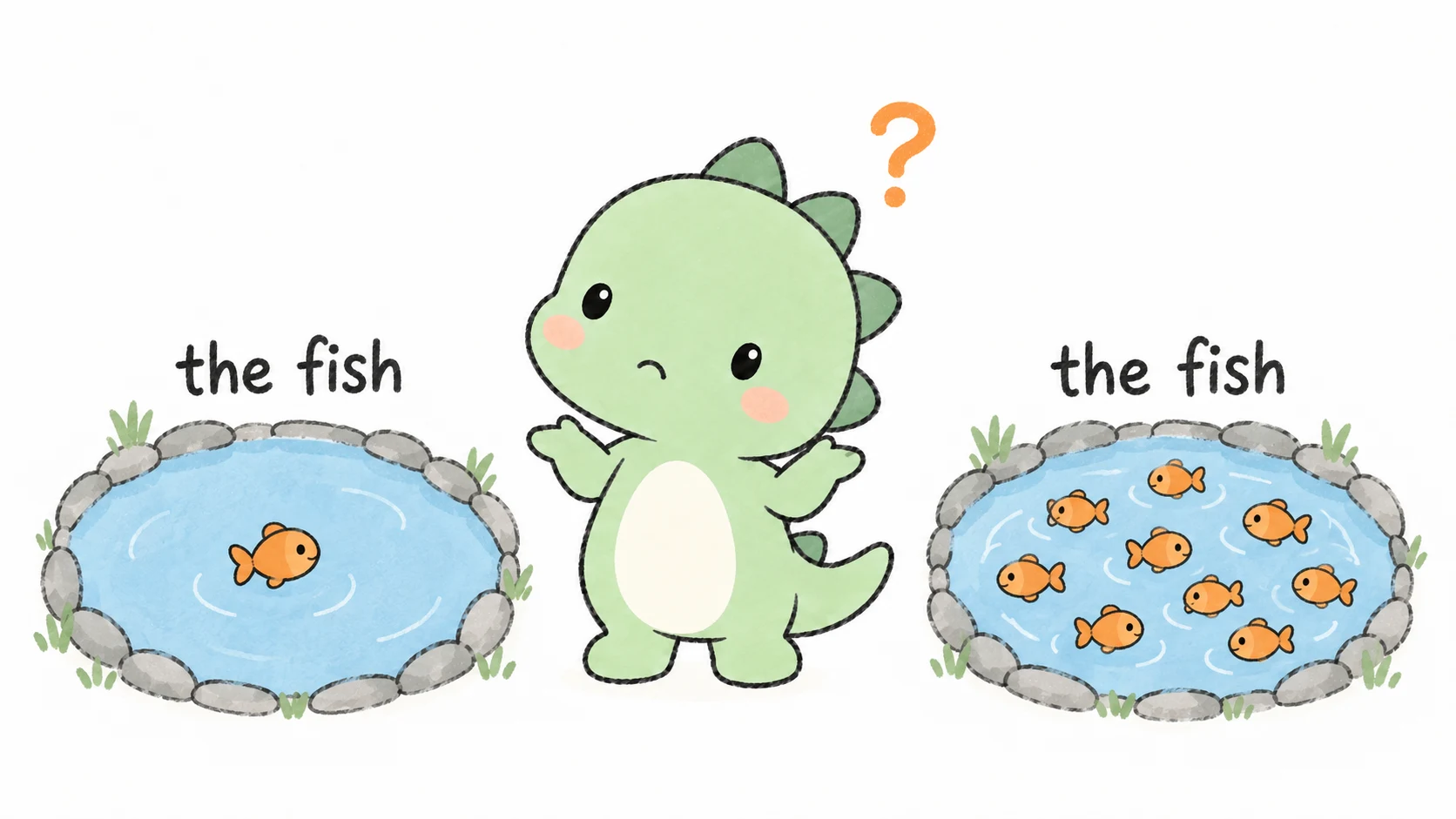
- The fish is swimming. There is one fish in the river.
- The fish are swimming. There are several fish in the river.
Both are correct. From the fish alone, nobody can tell how many fish are in the river.
Which English nouns have the same singular and plural?
Grammar books call these nouns zero plurals: the plural is the same as the singular, with nothing added. The common ones fall roughly into five families:
| Family | Common words | Example |
|---|---|---|
| Animals, especially ones that are hunted or fished | sheep, deer, fish, salmon, trout, cod, bison, moose | Three deer crossed the road. |
| Vehicles called craft | aircraft, spacecraft, hovercraft | Two aircraft were delayed. |
| Latin words in -ies | series, species | Both series are available online. |
| Words that already end in s | means, headquarters, crossroads | Every means of transport is fully booked. |
| Nationalities in -ese and -ss | Japanese, Chinese, Swiss | The Swiss use four national languages. |
The last family only counts when it means a nation's people, and mostly for the people as a whole: the Japanese, the Swiss. For one person, English usually says a Japanese colleague or a Swiss engineer.
Look at the fourth family. Means and headquarters carry an s, yet they aren't necessarily plural: a means of transport is one way of getting around. Headquarters is even more flexible; the Cambridge Dictionary marks it as taking a singular or plural verb, so The headquarters is in Brussels and The headquarters are in Brussels are both fine.
Why doesn't sheep take an s? Because it didn't a thousand years ago
The story starts in Old English.
About a thousand years ago, Old English nouns were masculine, feminine or neuter, and there were several different ways of forming a plural. One group of neuter nouns had a plural identical to the singular. According to the Online Etymology Dictionary and Wiktionary:
- sheep was sceap in Old English, and its plural was also sceap. The Online Etymology Dictionary says the plural had already merged with the singular in Old English (the northern Northumbrian dialect still had a separate plural, scipo).
- deer was deor, plural deor. Back then it mostly meant not "deer" but "wild animal, beast" — the same word as German Tier ("animal").
- swine was swin, also with an unchanged plural.
- horse was hors, and its plural was also hors.
The last one is the interesting one: horse later picked up an s and became today's horses, while sheep and deer kept their old shape all the way to the present. Why some words were regularised and others weren't, linguists have no agreed answer.
And fish? Here's the surprise: fish had a plural in Old English. Old English fisc was a masculine noun with the plural fiscas — essentially today's fishes. The zero plural of fish caught on later, and fishes never disappeared. In the Online Etymology Dictionary's words, the plural is fishes, but in a collective sense, or when referring to fish as food, the singular fish generally serves as the plural.
The plural that hunters and anglers use
Why animals in particular? Linguists have noticed a pattern: animals that are hunted, caught or eaten are especially likely to take a zero plural.
Huddleston and Pullum's The Cambridge Grammar of the English Language (2002, Cambridge University Press) sorts these nouns in detail:
- Edible and game fish such as carp, cod, salmon and trout almost always take the zero plural: We caught six trout.
- Game animals such as bison, deer and moose take only the zero plural.
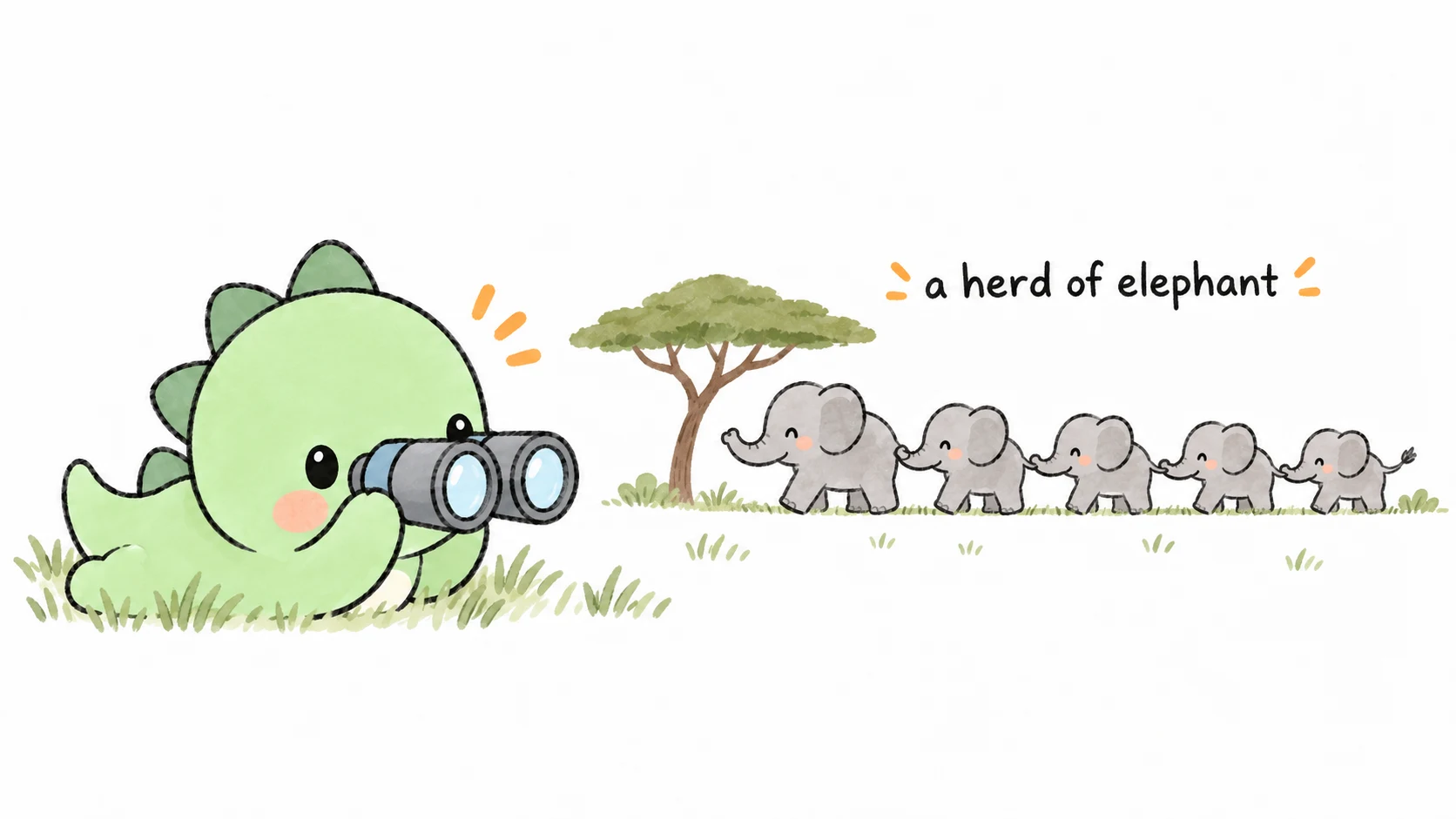
- Elephant, giraffe and lion normally take an s, but can drop it in the context of hunting: the book's examples are They were hunting elephant and a herd of elephant.
In other words, two elephants at the zoo are two elephants; in a hunter's mouth they become a mass of "elephant". The speaker isn't thinking about individual animals but about a kind of quarry. This is only an observation — not every hunter talks this way — but it shows why the zero-plural list is mostly made of animals people chase, catch and eat.
Fish or fishes?
So what is the plural of fish? The Cambridge Dictionary says "plural fish or fishes" — it lists both. In practice, they divide the work roughly like this:
- Counting individual fish: fish. How many fish live in the pond? That's the Cambridge Dictionary's own example.
- Talking about several kinds of fish: often fishes. the fishes of the Pacific (the fish species of the Pacific).
- Fish as food: fish is uncountable. We had fish for dinner. Another Cambridge example — not even an a.
- Scientific writing often uses fishes even for individuals. The Cambridge Dictionary's corpus examples include We collected 2681 fishes, representing 46 species and 10 families.
There are two more fishes you may already know. In the King James Bible, Matthew 14:17, the disciples tell Jesus, We have here but five loaves, and two fishes — the older usage. And the line from The Godfather (1972), sleeps with the fishes, uses fishes too — meaning the man is dead, dumped in the water.
In everyday English, use fish to count fish. Fishes isn't wrong; it just sounds like a biology textbook, the Bible or a gangster film.
When you can't tell singular from plural, where do you look?
The fish itself won't tell you how many, but the other words in the sentence will. The most common clues come in three kinds:
- The verb: is or are, was or were, swims or swim.
- Determiners: a, one, this and that mean one; two, several, many, these and those mean more than one.
- Pronouns: whether the fish are later called it or them.
All three kinds of fish turn up in the Handy 990 question bank:
- What happens when the flesh of a fresh fish is pressed? — the a tells you it's one fish. (Is agrees with flesh, so the clue here is the a.)
- The fish are caught and ___ on ice to keep them fresh. — are plus them: several fish. (This one is a Part 5 question; the answer is packed.)
- Fresh fish is delivered twice a week. — no a, yet is: here fish is food, and uncountable.
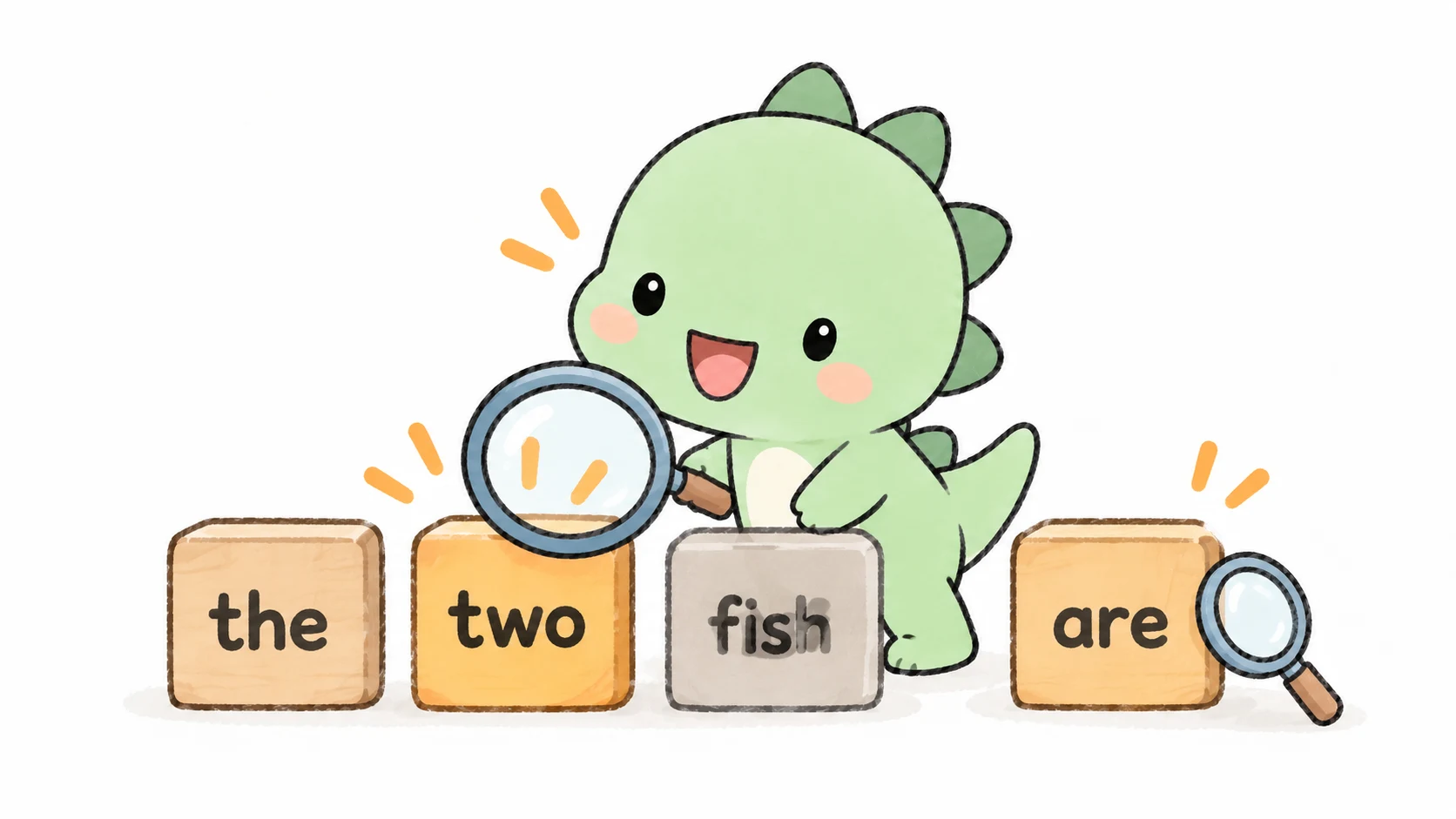
That's exactly the problem with the question the reader reported: in The fish ___ swimming, no word anywhere around it tells you how many fish are in the river. The test-taker can only guess. Change the subject to The two fish and the clue appears.
Your language doesn't mark the plural either
For many readers, this part is good news.
If your first language is Chinese, Japanese, Korean, Vietnamese or Thai, the noun itself doesn't have to change when there's more than one: one fish, three fish, a pond full of fish, and the word for fish stays the same. From that point of view, fish without an s isn't strange at all. What's strange is the rest of English, where nearly every noun insists on an s the moment there's more than one.
And the way these languages show quantity has a counterpart in English. Chinese says 一條魚 and Japanese 一匹の魚, with a counting word in between; Korean has 마리, Vietnamese con, Thai ตัว. English zero-plural nouns often lean on similar words: a school of fish, a herd of deer, fifty head of cattle — and that last head works almost exactly like a counting word for animals.
So when you meet the fish, the sheep or the aircraft, don't panic. Read it the way you read your own language: if the noun doesn't tell you how many, look at the numbers, the counting words and the context.
How does the TOEIC test this?
The TOEIC won't ask you "what is the plural of fish". What it tests is subject–verb agreement — and zero-plural nouns are exactly the subjects that make people hesitate.
In ETS's official TOEIC Listening and Reading sample test, the zero-plural nouns in this post appear only once: option (D) of Question 134 in Part 6, This is the first in a series of such lectures. (And it isn't the answer; the answer is (B).) One sample test is too small to show how often the TOEIC uses these words. In the reading and listening text of the Handy 990 question bank, fish appears 55 times, series 49, headquarters 20, aircraft and salmon 19 each, and species 16 — once a question is set in a business scene, these words come up naturally.
A few practical calls:
- series, species: check whether a or two comes before them. The question bank has The series is open to all residents aged 18 and above — one series of events, so is.
- headquarters: a singular or plural verb is fine. A question that relied on headquarters alone to choose between is and are would have two answers.
- aircraft: standard English has no aircrafts. One is an aircraft; ten are ten aircraft.
- means: a means of is one method and takes a singular verb; for several methods, the verb is plural.
This is English, so even fish come with exceptions
A few things to be clear about:
- The fish / fishes split isn't a hard rule. "Fish for individuals, fishes for kinds" is a general tendency; scientific writing often uses fishes for individuals too, and dictionaries list both.
- The zero-plural list varies by region. Shrimp, for example, is often shrimps in British English, while American English usually just says shrimp.
- "Game animals take zero plurals" is an observation, not a rule. They were hunting elephant is a grammar-book example; in everyday English, two elephants is perfectly normal.
- Why horse took an s and sheep didn't, linguists have no agreed answer, and this post doesn't try to give one.
- The question-bank figures are occurrence counts. They don't mean those words were used to test singular and plural.
Conclusion: to count the fish, don't look at the fish
The sentence the reader reported, The fish is swimming and The fish are swimming, is correct English either way — it just describes two different rivers: one with a single lonely fish, the other with a crowd.
Most English nouns carry their number in that s at the end. But fish, sheep, deer — old words that have survived for a thousand years — hand the job to the other words in the sentence: an a, an are, a them. If you want to know how many fish are in the river, don't stare at fish. Look at the words next to it.
In Handy 990, Grammar Practice → Nouns and Pronouns → Singular and Plural Nouns has fifty levels, and zero-plural nouns like fish and deer are among them; Chapter 7 of the Grammar book, Singular and Plural Nouns, walks through singular and plural from the start, with a short quiz at the end of every section. In the same series, Can you end a sentence with a preposition? looks at the grammar rules behind another reader's report, and A unique or an unique? is another small word you can only decide from what comes next.