
All articles · Published 2026-09-25
What does "Buffalo buffalo Buffalo buffalo…" mean? 10 English sentences that look like gibberish but are perfectly grammatical, parsed word by word
Fair warning: this one is purely for fun and will not raise your TOEIC score by a single point. English has a small collection of sentences built to torment readers — eight buffalo in a row, eleven hads in a row, four people named Will in one question — that look like a stuck keyboard but are perfectly grammatical. This post takes ten of them apart one at a time: most are rebuilt step by step from a short, normal sentence and laid out in a table showing the job of every word. At the end: how other languages do the same thing, and a sentence about a horse that linguists have been studying for fifty years.
First, the fine print: this post won't earn you a single point
Most posts in this series have at least something to do with the TOEIC: spelling, pronunciation, the word endings Part 5 likes to test. This one doesn't.
The TOEIC will never show you eight buffalo. Part 5 will not ask you to choose between eleven hads, and no Part 7 memo is addressed to four colleagues who share a name. If your test is three weeks away, feel free to close this tab and go practice.
But if you'd like to see what English grammar looks like when it's pushed to the limit, stay. We'll take every sentence apart until it makes sense.
Why can English do this? Three tools
The ten sentences rely mainly on three features English already has (the first one adds some sound-alikes as a warm-up). Learn these first and the parsing gets much easier:
Tool 1: a word can change its part of speech — or its meaning — without changing its shape. Plenty of languages do this a little; English does it a lot. Ship is a noun ("a boat") and a verb ("to send"); police is a noun ("the officers") and a verb ("to keep order"); will is a helper verb ("going to"), a noun ("a legal document") and a verb ("to leave something to someone in a will"). The word looks identical every time. Its job depends entirely on where it stands in the sentence.
Tool 2: the relative pronoun that can be dropped (as long as it isn't the subject of its clause). You can write the man that the dog bit or just the man the dog bit — take that out and the meaning doesn't change. Normally that's handy. But when every word in the sentence looks the same, dropping that removes the only signpost.
Tool 3: punctuation and quotation marks. Commas, periods and quotation marks do a lot more work than we notice. Strip them all out and a perfectly ordinary sentence turns into an unreadable string of words.
The ten sentences below are ordered from easiest to hardest. For each one, we'll say which tool it uses.
Sentence 1: Rose rose to put rose roes on her rows of roses.
Tool: homophones. This is the warm-up.
Read it aloud and you hear the same sound, /roʊz/, five times: rose, roes and rows are pronounced exactly alike and differ only in spelling and meaning; roses is the plural, with one extra syllable:
| Word | Part of speech | Meaning |
|---|---|---|
| Rose | noun (a name) | Rose, the subject of the sentence |
| rose | verb | past tense of rise: stood up |
| to put | infinitive | in order to put |
| rose | adjective | pink, rose-colored |
| roes | noun | fish eggs (plural of roe) |
| on her rows | noun | her lines of plants |
| of roses | noun | the flowers |
In plain English: Rose stood up to put pink fish eggs on her rows of rose bushes.
The grammar is flawless. Nobody knows why Rose is doing this.
Sentence 2: I can can a can.
Tool: one word, three jobs (Tool 1). Three cans in one short sentence, and each one does something different.
Can is a helper verb ("be able to"), a noun ("a metal container") and a verb: to can food is to seal it in cans or jars to keep it (can tomatoes, can peaches). Start with a normal sentence:
I can can tomatoes.
(I know how to can tomatoes.)
Now swap tomatoes for a can:
| Word | Job | Meaning |
|---|---|---|
| I | subject | I |
| can | helper verb | am able to |
| can | verb | seal (something) in a can |
| a can | noun, object | a can |
In plain English: I know how to seal a can inside a can.
The grammar is fine. Why anyone would put a can inside another can, the grammar doesn't say. The two cans in a row (can can) are the same trap as the buffalo sentence you'll meet later: two verbs side by side, and only their position tells them apart.
The helper can and the container can aren't even related: according to the Online Etymology Dictionary, the first comes from Old English cunnan ("to know"), the second from Old English canne, and the verb "to can" was only made from the noun in 1860.
There's a longer tongue-twister version: "Can you can a can as a canner can can a can?" — Can you can a can the way a canner (a person whose job is canning) can?
Sentence 3: I saw a saw saw a saw.
Tool: one spelling, three jobs (Tool 1 again). You may have seen it written "I saw a saw, saw a saw", but the comma breaks it — more on that below.
Saw here is the past tense of see, a noun (the cutting tool) and a verb (to cut with that tool). After see, English uses "see + someone or something + bare verb" to say you watched something happen: I saw him leave. Start with a normal sentence built the same way:
I saw a dog chase a cat.
(I watched a dog chase a cat.)
Now make the dog and the cat saws, and make chase the verb saw:
| Word | Job | Meaning |
|---|---|---|
| I | subject | I |
| saw | main verb | past tense of see |
| a saw | noun, object | a saw (the tool) |
| saw | verb, bare form | cut |
| a saw | noun, object | another saw |
In plain English: I watched a saw cut through another saw.
Why no comma? In "I saw a dog chase a cat", the dog and chase belong together — that's what you saw. A comma after "a saw" would cut the thing you saw off from what it was doing, leaving "saw a saw" with no subject.
Same story as can: the past-tense saw and the tool saw are unrelated words that happen to be spelled the same. The Online Etymology Dictionary traces the past tense of see to Old English sawon and the tool to Old English sagu; the verb "to saw" was made from the tool around 1200.
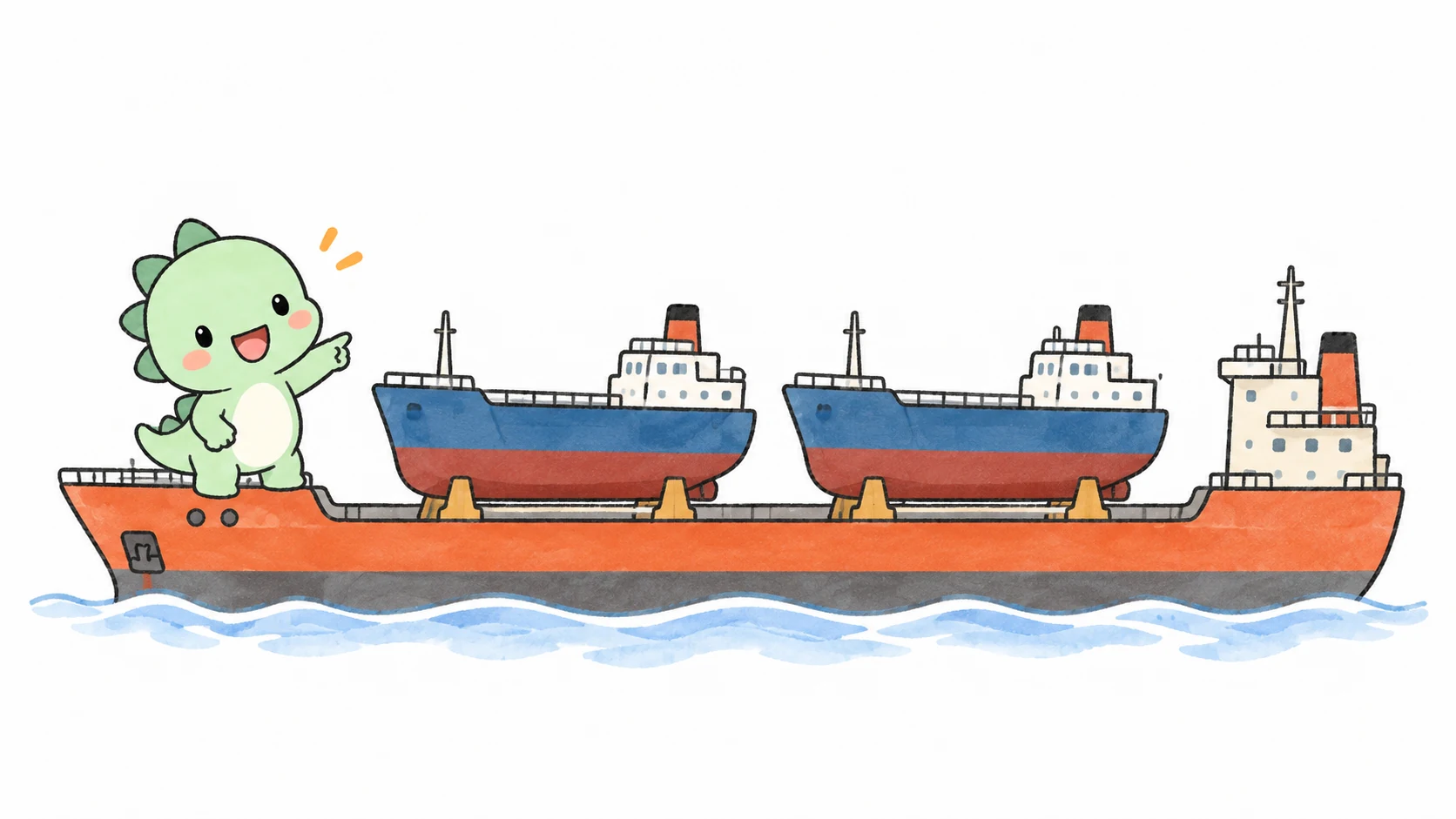
Sentence 4: A ship-shipping ship, shipping shipping-ships.
Tool: one word in two parts of speech, glued into compounds.
As a noun, ship means a vessel; as a verb, it means to send goods (not necessarily by sea — you ship a parcel today by truck). English can glue "object + verb-ing" together into an adjective: a man-eating tiger, a fire-breathing dragon.
Step by step:
- a ship → a vessel
- ship-shipping → "that ships ships", built exactly like man-eating
- a ship-shipping ship → a vessel that carries other vessels
- shipping-ships → vessels for shipping, that is, cargo ships
- shipping shipping-ships → carrying (a load of) cargo ships
In plain English: a vessel built to carry other vessels, carrying some cargo ships.
Strictly speaking, this is not a complete sentence — it has no main verb, so it reads more like a photo caption. And the photos exist: semi-submersible heavy-lift ships, which carry other ships on their decks, are a real class of vessel. When the US destroyer USS Cole was damaged in an attack in Yemen in 2000, it was the heavy-lift ship Blue Marlin that carried it, whole, back to the United States.
Sentence 5: I have a reservation reservation reservation.
Tool: one word with three meanings, plus nouns stacked on nouns.
Reservation has at least three common meanings:
- a booking (a dinner reservation)
- a doubt (I have some reservations about the plan.)
- (US) land set aside for a Native American nation
English lets you stack nouns, and the last noun is the head; everything before it describes it: a hotel reservation is a booking at a hotel, a safety concern is a worry about safety. So the three reservations are read from right to left:
| Position | Meaning | Role |
|---|---|---|
| reservation (first) | Native American land | describes the second |
| reservation (second) | booking | describes the third |
| reservation (third) | doubt | the head |
- a reservation reservation → a booking on a reservation (like a hotel reservation)
- a reservation reservation reservation → a doubt about that booking (like a safety concern)
In plain English: I have a doubt about my booking on the reservation.
This one has more than one reading — in principle, the three meanings can be shuffled among the three positions. The reading above is the one we find most natural; if you find another that works, it isn't wrong.
Sentence 6: Will, will Will will Will Will's will?
Tool: one word, four jobs.
In this sentence will is a name (Will), a helper verb (will = going to), a verb (to leave something to someone in your will) and a noun (a will, the legal document).
Start with a normal sentence built exactly the same way:
Will, will John give Mary Tom's book?
(Will, is John going to give Mary Tom's book?)
Give can take two objects: give Mary the book. So can the verb will: to will somebody something is to leave it to them in your will.
Now swap give for will, book for will, and every name for Will:
| # | Word | Job | In the normal version |
|---|---|---|---|
| 1 | Will, | the person being spoken to | Will, |
| 2 | will | helper verb: is … going to | will |
| 3 | Will | subject: a second Will | John |
| 4 | will | verb: leave in a will | give |
| 5 | Will | recipient: a third Will | Mary |
| 6 | Will's | possessive: a fourth Will's | Tom's |
| 7 | will | noun: the legal document | book |
In plain English: Will, is Will going to leave Will's will to Will?
That's up to four different people named Will. As for why anyone would bequeath somebody else's will — grammar takes no responsibility for that.
Sentence 7: That that is is that that is not is not is that it it is.
Tool: missing punctuation.
Put the punctuation back first:
That that is, is. That that is not, is not. Is that it? It is.
Most of it now makes sense. The key is "That that is": the first that is a pronoun ("the thing"), the second is a relative pronoun (= which), and is here means "exists".
| Word | Job | Meaning |
|---|---|---|
| That | pronoun, subject | the thing |
| that is | relative clause (that = which) | which exists |
| , is. | main verb | exists |
- That that is, is. → What exists, exists.
- That that is not, is not. → What doesn't exist, doesn't.
- Is that it? → Is that all?
- It is. → That's all.
In plain English: What exists, exists; what doesn't, doesn't. Is that all? That's all.
The first part has a respectable source: in Act 4, Scene 2 of Shakespeare's Twelfth Night, the clown Feste pretends to quote "the old hermit of Prague": "That that is, is." The hermit is Feste's own invention. The rest of the chain was added by later puzzle-makers.
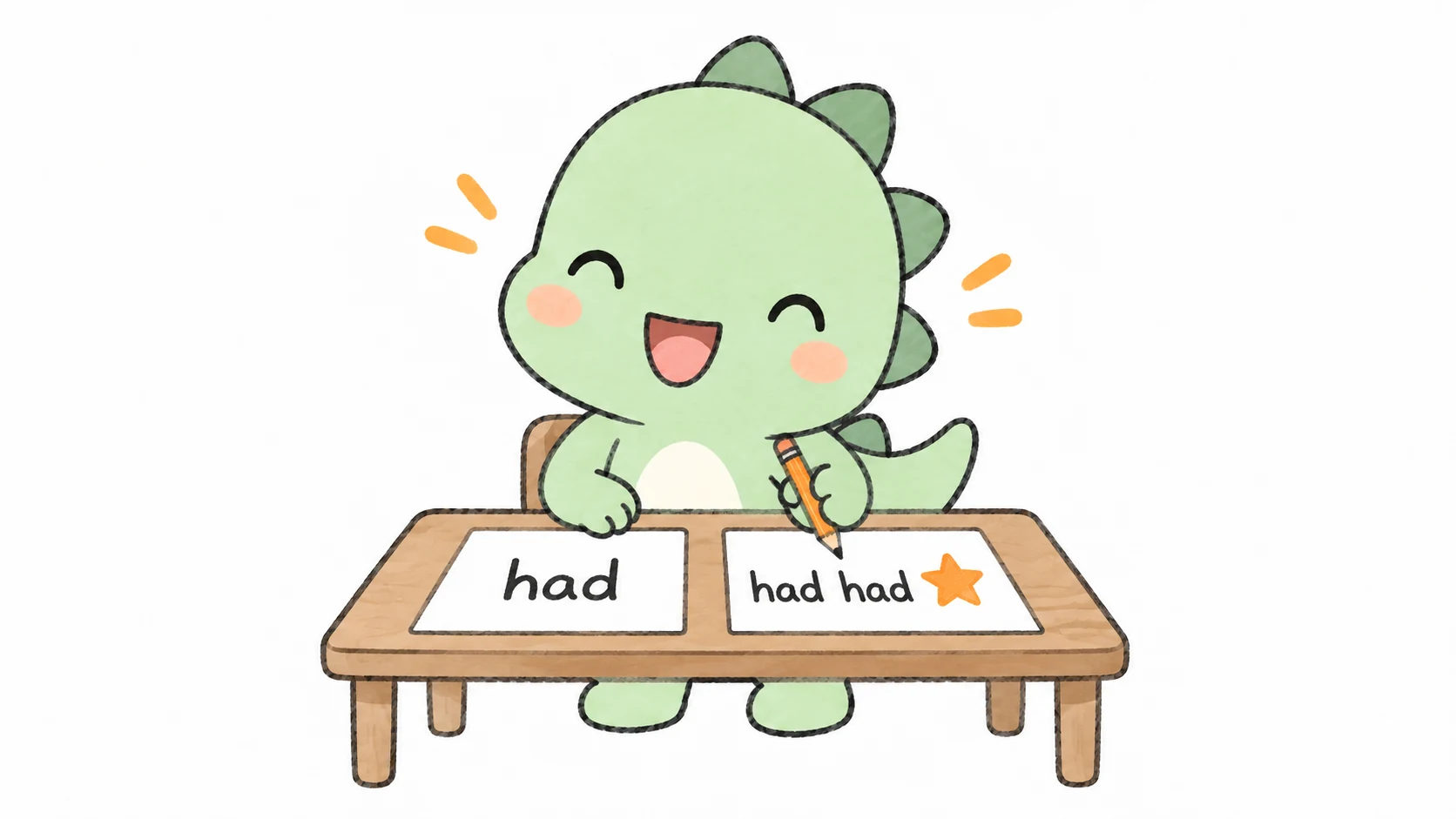
Sentence 8: James while John had had had had had had had had had had had a better effect on the teacher.
Tool: missing punctuation and missing quotation marks. This is the longest run of repeats in the post.
The backstory first. An English teacher sets an exercise: describe a man who had had a cold. Two students hand in different answers:
- John writes: The man had a cold.
- James writes: The man had had a cold. (past perfect)
The teacher prefers James's answer. The whole sentence describes exactly that. Put the punctuation and quotation marks back:
James, while John had had "had", had had "had had"; "had had" had had a better effect on the teacher.
The eleven hads fall into three parts:
| Part | Text | Meaning |
|---|---|---|
| ① aside | while John had had "had" | John had written "had" (in his answer) |
| ② main clause | James … had had "had had" | James had written "had had" |
| ③ conclusion | "had had" had had a better effect on the teacher | "had had" made the better impression |
Every unquoted had had is a past-perfect verb: in ① and ② have means roughly "used, written", and in ③ it's the have of "have an effect". The quoted had and had had are not verbs at all — they are the words themselves being mentioned, the way you might say "the word 'apple'". Count them: three in ①, four in ②, four in ③, eleven in all.
In plain English: John wrote "had", James wrote "had had", and "had had" made the better impression on the teacher.
The sentence's ancestor goes back to the logician Hans Reichenbach, who put a similar sentence in his 1947 book Elements of Symbolic Logic as an exercise for the reader. The British novelist Jasper Fforde used a variation in his 2003 novel The Well of Lost Plots.
The final boss: Buffalo buffalo Buffalo buffalo buffalo buffalo Buffalo buffalo.
Tools: 1 and 2 together — one word with three jobs, plus a dropped that.
Buffalo has three jobs here:
- Buffalo (capitalized): the city of Buffalo, New York, used as an adjective, "from Buffalo". It's the Buffalo in Buffalo wings, which are named after the city, not the animal.
- buffalo (noun): the animal. The plural is the same as the singular: one buffalo, a herd of buffalo. (Strictly, the American "buffalo" is a bison; the Online Etymology Dictionary says the name has been "wrongly applied" to the American bison since the 1630s.)
- buffalo (verb): to intimidate, bully or baffle. The Online Etymology Dictionary dates the earliest recorded use to 1900.
Step by step:
Step 1: three buffalo.
Buffalo buffalo buffalo.
(Buffalo bully buffalo.)
Built like Dogs chase cats: noun, verb, noun.
Step 2: add the city.
Buffalo buffalo buffalo Buffalo buffalo.
(Buffalo from Buffalo bully buffalo from Buffalo.)
Step 3: make a relative clause with the that dropped. Remember the man the dog bit? Same structure:
Buffalo buffalo [that] Buffalo buffalo buffalo
(Buffalo from Buffalo that buffalo from Buffalo bully)
Step 4: put it together. Use Step 3 as the subject, then add "bully + buffalo from Buffalo":
| # | Word | Job | Belongs to |
|---|---|---|---|
| 1 | Buffalo | adjective: from Buffalo | subject |
| 2 | buffalo | noun: the animals | subject |
| 3 | Buffalo | adjective: from Buffalo | relative clause (that dropped) |
| 4 | buffalo | noun: the animals | relative clause |
| 5 | buffalo | verb: bully | relative clause |
| 6 | buffalo | verb: bully | main verb of the sentence |
| 7 | Buffalo | adjective: from Buffalo | object |
| 8 | buffalo | noun: the animals | object |
In plain English: Buffalo from Buffalo that are bullied by buffalo from Buffalo go on to bully buffalo from Buffalo.
A whole cycle of bullying, written in eight identical words.
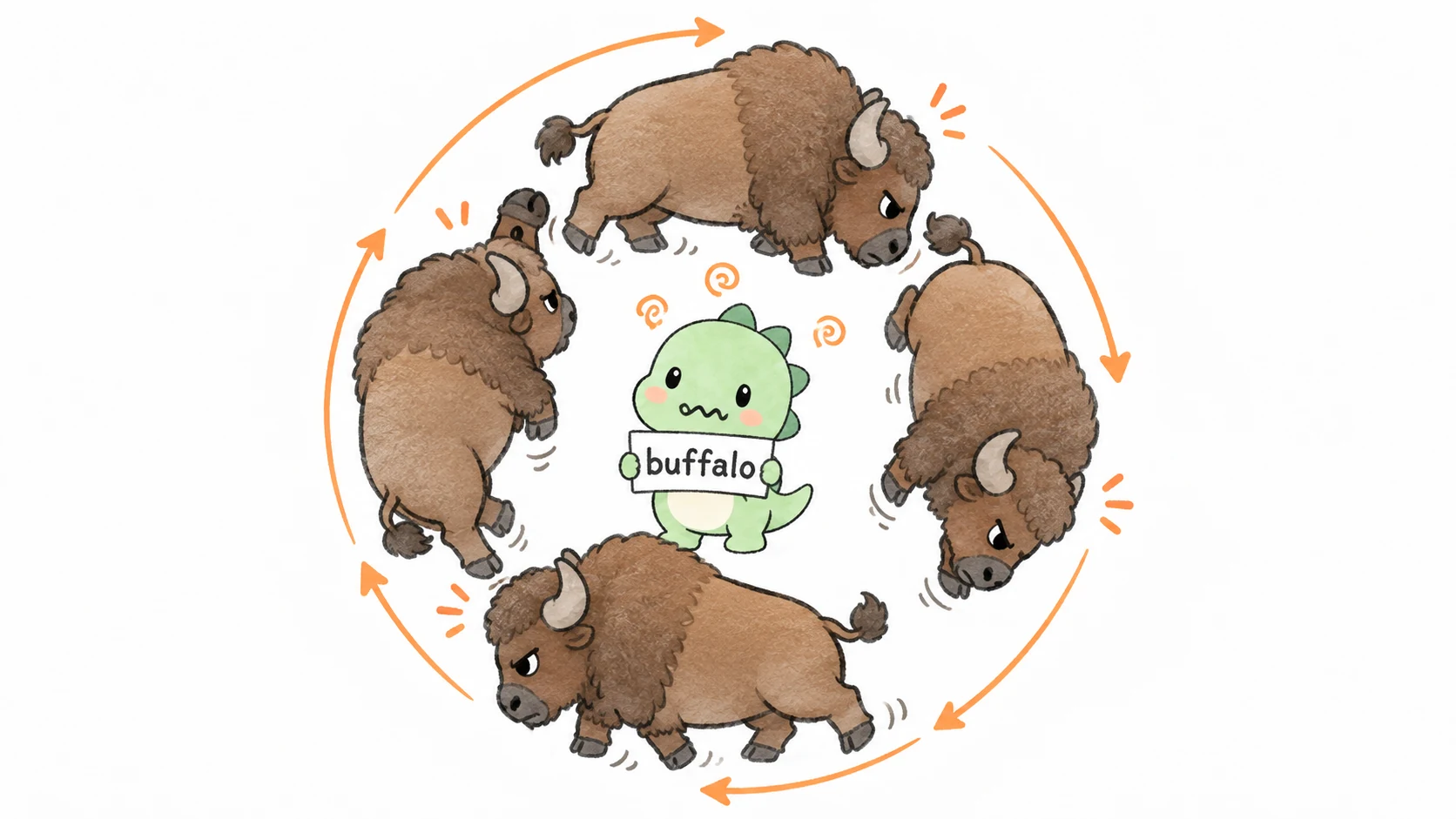
The sticking point is words 5 and 6: two verbs in a row with nothing to mark the boundary. Word 5 belongs to the relative clause (who bullies them), and word 6 is the real verb of the sentence. Put the that back — Buffalo buffalo that Buffalo buffalo buffalo buffalo Buffalo buffalo — and it becomes much clearer.
Better still: any number of buffalo in a row makes a grammatical sentence. One: "Buffalo!" (Go and intimidate someone! — an order). Two: "Buffalo buffalo!" (Go and intimidate some buffalo! — another order, this time with an object.) Three is Step 1. Eight just happens to be the famous one.
The sentence was invented more than once. According to Wikipedia's account, the wordplay writer Dmitri Borgmann included a version in his 1967 book Beyond Language; William J. Rapaport, then a graduate student at Indiana University, came up with similar sentences independently in 1972 and posted them to the linguists' mailing list LINGUIST List in 1992; and Steven Pinker used the eight-buffalo version in his 1994 bestseller The Language Instinct, which carried it well beyond linguistics.
Your turn: Police police Police police police police Police police.
Now that you've beaten the boss, you should be able to take this one apart yourself. Three hints:
- police (noun): officers. Always treated as plural (the police are…).
- police (verb): to monitor, regulate, keep order (police the streets).
- Police (capitalized): there really is a town called Police in northwestern Poland, on record since the 13th century.
The structure is identical to the buffalo sentence. Work it out before you read on.
Answer: Police police [that] Police police police police Police police.
In plain English: Police officers from Police who are monitored by police officers from Police go on to monitor police officers from Police.
It sounds like a very thorough internal-affairs system.
Do other languages have sentences like these?
They do — and some go further than English.
The Lion-Eating Poet in the Stone Den. This short Chinese poem begins 「石室詩士施氏,嗜獅,誓食十獅」, "In a stone den was a poet called Shi, who was a lion addict and had resolved to eat ten lions". All of its 90-odd characters are pronounced shi in modern Mandarin, differing only in tone. According to Wikipedia's account, it was first written by Hu Mingfu and published in 1916, then reworked by the linguist Yuen Ren Chao in the 1930s to show that Chinese characters could make a text that is readable on the page and incomprehensible when read aloud. It uses the same tool as Rose rose — homophones — pushed to the extreme: English makes you dizzy with three sound-alike words; the poem uses more than ninety.
Flies in German. "Wenn hinter Fliegen Fliegen fliegen, fliegen Fliegen Fliegen hinterher" means "When flies fly behind flies, flies fly after flies." It's the buffalo trick: German Fliegen is the noun "flies" and fliegen the verb "to fly", and apart from the capital letter they are the same word.
So the absurdity in these English sentences isn't unique to English. Every language has tools like these; English just happens to have an unusually good set for building them.
If you want more: the horse that linguists have been studying for fifty years
The horse raced past the barn fell.
Most people glide through this until barn — "the horse ran past the barn" — then hit fell, and the whole sentence collapses.
It comes from the psycholinguist Thomas Bever's 1970 paper "The Cognitive Basis for Linguistic Structures", and it became the textbook example of a garden-path sentence: the first half leads you down a path that looks right, and only at the end do you discover the path was wrong.
You already know the tool — the dropped relative pronoun — except that here English drops a little more: not just that, but that was. Put the missing words back:
The horse [that was] raced past the barn fell.
(The horse that someone raced past the barn fell down.)
Raced doesn't mean the horse ran on its own; it means someone raced it. The real verb of the sentence is the last word, fell. Just like the buffalo sentence, it's hard to read because English lets you remove the signpost.
The usual disclaimer: nobody actually talks like this
Grammatical doesn't mean natural. All ten are grammatical (the ship one as a noun phrase), and no native speaker would ever say any of them in real life. Their purpose is to show what the grammar permits and where the human sentence-parser hits its limits — not to model how people speak.
The Police sentence only works on paper. The Polish town of Police is pronounced roughly "po-LEE-tseh", nothing like the English word police. Say it aloud and the joke disappears.
Some sentences have more than one reading. For the reservation sentence we chose the most natural way to assign the three meanings, and the ship sentence is strictly a noun phrase, not a full sentence. The explanations circulating online vary, and don't always agree with each other.
The verb buffalo is rare. It's informal American English and you'll seldom hear it in everyday conversation. Write My boss buffaloes me in an essay and your examiner will probably be as puzzled as you were.
The takeaway: English words change jobs without changing clothes
Chinese hands the same sound to many different characters and tells them apart by how they are written. English sends the same word out to do many different jobs and tells them apart by where it stands. Both systems work perfectly well — until someone deliberately fills every position with the same word.
If you've read this far and can take every sentence apart — congratulations. You've just spent twenty minutes learning something the TOEIC will never test.
Want to do something that actually helps your TOEIC? The "Relative Clauses" topic in Handy 990's grammar practice tests the very grammar that makes the buffalo sentence possible — just one sentence at a time, and never with eight identical words in a row. In the same series, theatre is not a typo covers the "that must be a typo" misunderstanding, wind and wind covers words spelled the same but said differently, and everyday words that change meaning at the office covers familiar words that take on a new meaning at work.