
All articles · Published 2026-10-21
Metaphors in business English: why you don't "fire" a new product — campaign, target and ballpark were borrowed from battlefields and ballparks
To launch a product is to bring it out, not to fire it into the sky. launch first meant to hurl something like a lance; then to send a ship into the water; only later to start something off, and later still to send up a rocket. Business English is full of words borrowed from other worlds like this: campaign, strategy and target come from war; ballpark, touch base and drop the ball come from sport, especially American baseball; pipeline, bottleneck and feedback come from pipes, bottles and circuits. Starting from Lakoff and Johnson's 1980 book Metaphors We Live By, this post walks through three worlds that lend a great many words, how often they turn up on the TOEIC, and how other languages borrowed from the same places.
Why isn't launching a product the same as firing a rocket?
A reader flagged this sentence on one of our vocabulary flashcards:
The company plans to launch an innovative device similar to a smartphone in the spring of next year, anticipating market reactions.
The note was short. Chinese has two different verbs here — one for bringing out a product, one for firing a rocket — and our card's translation had used the rocket one. launch here means bringing out a new product, the reader said, and "firing" a new product sounds a bit odd.
The reader was right, and we have fixed it. But the mistake is an easy one to make, because in English launch really does mean both. Chinese uses two words; English gets by with one.
To see why one word covers both jobs, you have to go back a few centuries. According to the etymology Wiktionary gives, launch comes from Middle English launchen, "to throw as a lance," from lanchier, the Norman form of Old French lancier — built on lance.
From there, the meanings grew roughly like this:
- To hurl: to throw a lance, a dart, a stone. The sense is still around, just not common.
- To send a ship into the water: in the King James Bible of 1611, Luke 5:4, Jesus tells Simon to Launch out into the deep. To launch a ship still means putting a vessel into the water — the classic picture is a new ship sliding down the slipway for the first time.
- To start something off: among Wiktionary's quotations, the Eikon Basilike of 1649 already uses it this way — someone is doing everything they can to sink (sink) episcopacy and launch (lanch) presbytery in England. Sink one, launch the other: the ship is still visible. This is the sense in launch a product and launch a campaign — getting something new under way.
- To send up a rocket: space rockets belong to the 20th century, several hundred years after the "start something off" sense.
So launch a product was not borrowed from rocket launches. The two senses are more like two branches of one family: both grew out of hurling things and floating ships, and each went its own way.
Chinese happens to keep the two branches apart — one verb for products, another for rockets. Our flashcard's mistake was to treat the two branches as one.

Why is business English full of war and sport?
launch is not an exception. A large share of business English is borrowed from somewhere else.
The linguist George Lakoff and the philosopher Mark Johnson made this point famous in their 1980 book Metaphors We Live By. Their first example is ARGUMENT IS WAR. When English talks about arguing, it often reaches for the vocabulary of fighting:
- Your claims are indefensible.
- His criticisms were right on target.
- He shot down all of my arguments.
This, they argue, is not just a figure of speech. We really do win or lose arguments; we see the other person as an opponent, attack their positions and defend our own. Then they ask the reader to imagine a culture in which an argument is seen as a dance, the participants as performers, and the goal as performing in a balanced, pleasing way. People in that culture would talk about arguments, and carry them out, very differently.
Their second chapter's example is closer to office life: TIME IS MONEY.
- You're wasting my time.
- That flat tire cost me an hour.
- You need to budget your time.
They call this a conceptual metaphor: we understand an abstract domain through a familiar, concrete one. Cognitive linguists later named the familiar side the source domain and the side being understood the target domain — so even the terminology borrowed target from archery.
Business is a very abstract thing. You can't see a market or touch competition, and a project's "progress" is not an object. So when English talks about business, it keeps borrowing words from the concrete world. Three worlds lend a great many: the battlefield, the ballpark, and the factory and circuit board.
The battlefield: campaign, strategy and target started out at war
Many words in this group have been in business use for so long that nobody hears the metaphor any more.
| Word | On the battlefield | At the office today |
|---|---|---|
| campaign | Latin campus (field) → Italian campagna (field, military operation) → French campagne; a series of military operations | a marketing or advertising campaign |
| strategy | Greek stratēgia, "the office of a general, generalship"; stratos is army, agō is lead | a plan for reaching a goal |
| target | Middle French targette, a diminutive of targe, a light shield; later a mark to shoot at | a goal, a sales target |
| headquarters | the post from which troops are commanded | a company's head office |
| rank and file | ordinary soldiers drawn up in ranks (rows) and files (columns) | ordinary staff or members, not the leadership |
| front line | the boundary between opposing forces | the front line: where staff deal directly with customers |
| launch an offensive | to begin an attack | launch a campaign |
A few deserve a second look:
- campaign and champagne share an ancestor. According to Wiktionary, both go back to Late Latin campania, "open country." One ended up on the battlefield, the other in the Champagne region of France. Next time a company opens champagne at a campaign launch party, the two cousins are back together.
- target was once a shield. It later came to mean a mark to shoot at, and the mark became a number you have to hit. The word went from the thing that stops arrows to the thing arrows are aimed at.
- rank and file has left the army. One passage in our question bank is an orchestra's audition notice for two rank-and-file first violins — not the leader of the section, but the players who sit further back and play along.
The ballpark: ballpark, touch base and drop the ball are mostly American baseball
The second group is very American, and much of it comes from baseball.
| Word | On the field | At the office today |
|---|---|---|
| ballpark figure | a ballpark is a (baseball) stadium | a rough estimate |
| touch base | to step on a base while running | to check in with someone briefly |
| drop the ball | to fail to catch the ball | to neglect something, to mess up |
| out of left field | left field is part of the outfield | coming from nowhere, unexpected |
| curveball | a pitch that curves | an unexpected problem |
| slam dunk | a forceful dunk (basketball) | a sure thing |
| game plan | the plan for a match | a plan of action |
| kick off | the first kick of a game | to start; a kick-off meeting starts a project |
| level playing field | a flat field to play on | fair conditions for competition |
| move the goalposts | to move the goal | to change the rules partway through |
| team player | a player who plays for the team | someone who works well with others |
If an American colleague says Let's touch base next week, I just need a ballpark figure, they mean "let's check in next week; I only need a rough number" — two baseball metaphors, and nothing to do with baseball.
move the goalposts is the most British item in the table. William Safire discussed it in his language column in The New York Times Magazine in 1990 and quoted Peter Stothard, then United States editor of The Times of London: the term is British, and he guessed it came more from children's games, where the sticks marking the goal can be moved, than from organised football. Yet the earliest use Safire himself could find was from 1978, by Albert V. Casey of American Airlines — an American. The origins of idioms are often this murky.
The factory and the circuit: pipeline, bottleneck and feedback
The third group comes from pipes, bottles and electrical engineering.
| Word | The original thing | At the office today |
|---|---|---|
| pipeline | a line of pipes carrying oil, gas or water | a sales pipeline is the set of deals still in progress; in the pipeline means "on the way" |
| bottleneck | the narrow neck of a bottle | the step where a process gets stuck |
| bandwidth | the width of a frequency band; a network's data rate | how much time and energy a person has left |
| feedback | the part of a circuit's output that is fed back into its input | comments on someone's work |
| onboard | on board a ship | to bring a new hire or customer up to speed; onboarding is induction training |
feedback has the best story. Wikipedia, drawing on Stuart Bennett's A History of Control Engineering, 1800–1930 (1979), sums it up: around 1912, researchers working with early vacuum-tube amplifiers found that feeding part of the output back into the input made the signal much stronger, but could also make the set howl; by 1920, feedback was a word in its own right. When you hold a microphone too close to a speaker today, that piercing squeal is also called feedback. So when your manager says I'd love your feedback, the word comes out of the same circuit loop as that squeal.
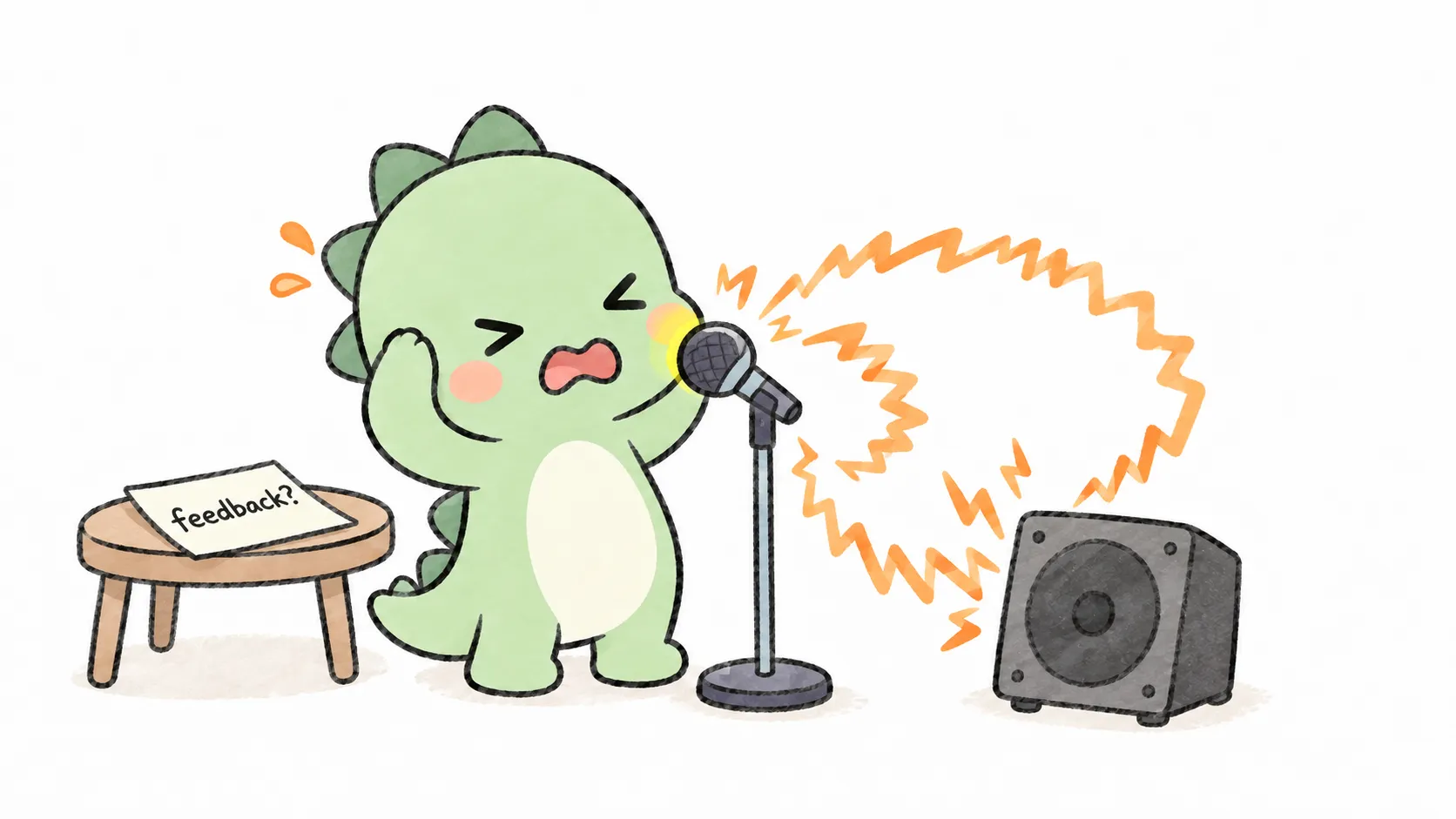
bandwidth is a more recent borrowing, and not everyone likes it. On 9 February 2018 the BBC ran a round-up of readers' nominations for the worst business jargon (Joe Miller, "Are these the worst examples of business jargon?"), and I don't have the bandwidth for this — meaning "I don't have the time or capacity" — was one of them.
onboard takes us back to the water: getting a new hire on board and launching a new ship happen in the same sea.
Do these words appear on the TOEIC?
Start with the official TOEIC Listening and Reading sample test from ETS. We searched all of it, including the scripts for Parts 1 to 4: launch, campaign, target, strategy, roll out, kick off, headquarters, pipeline and feedback do not appear even once, and neither do baseball phrases like ballpark or touch base. The closest thing to a business metaphor in the whole sample is probably a wrong answer — question 38, option (B), A move into a new market, which treats a market as a place you can move into.
The sample has only 64 questions, so a word missing from it doesn't mean the real test never uses it. We also counted our own question bank (4,256 sets, counting only what learners actually see: passages, questions, options and listening scripts):
| Word | Number of sets it appears in |
|---|---|
| launch | 93 |
| feedback | 51 |
| campaign | 35 |
| target | 27 |
| roll out / rollout | 16 |
| strategy / strategic | 14 |
| headquarters | 14 |
| onboard / onboarding | 9 |
| kick off / kick-off | 8 |
| pipeline | 3 |
| ballpark, touch base, drop the ball, curveball, slam dunk, game plan, level playing field, move the goalposts | 0 |
Read this table honestly: it reflects how our own questions are written, not how often ETS uses these words. But its shape makes sense. The battlefield words have long since become ordinary business vocabulary, common in the notices, emails and ads in our bank. The American ballpark words are more casual, more at home in meetings and small talk, and they appear neither in our bank nor in that sample test.
One thing is genuinely useful for the test: the same phrase often turns up both literally and figuratively.
- roll out: one Part 1 photo item in our bank has the option A rug is being rolled out in a hallway; a Part 7 notice says we are rolling out an expanded recycling program.
- kick off: one passage is from someone booking a five-a-side football pitch who would like a 6:30 P.M. weekday kick-off; another item is about a kick-off meeting next Monday.
- pipeline: a utility notice is about a real gas pipeline; an ad for CRM software promises to streamline your sales pipeline.
When you meet one of these words, ask: is this a real rug, a real ball, a real pipe — or a metaphor? Part 1 describes photos, so it is usually the real thing.
As for ballpark, touch base and the rest of the baseball phrases, learning them probably won't add points to your TOEIC score. Their value is outside the exam room: meetings with American colleagues, emails, business news. If you don't know drop the ball but you know it means failing to catch the ball, you can guess most of the meaning.
Your language borrowed from the same worlds
English is not alone here. Chinese talks about business in borrowed words too:
- 戰略 and 策略 (strategy): the character for "war" is right there in 戰略. A common saying, 商場如戰場, puts it outright: "the marketplace is a battlefield."
- 打頭陣: to fight at the head of the battle line; today a new phone can be the one that leads a product range.
- 搶灘: to seize the beachhead in a landing; today a company "storms the beach" of the electric-car market.
- 臨門一腳: the last kick in front of the goal in football; today, the final step that closes a deal.
- 瓶頸: literally a bottle's neck — the same picture as bottleneck.
- 推出: the Chinese verb for launching a product literally means "push out." A Chinese product is pushed out; an English one is thrown, or slid down into the water.
Not every borrowing comes from war or sport. The dictionary meanings of 拍板 start with a wooden clapper for beating time, then the slap of a board that once sealed a sale at auction, and only then "the person in charge makes the decision."
So the pattern Lakoff and Johnson described is not unique to English. Different languages often borrow from similar worlds, but the words don't always line up one to one: English has a single launch where Chinese splits it into two verbs — and our flashcard fell into exactly that gap.
Before you turn every word into military history
A few things to be clear about:
- Using a metaphorical word doesn't mean you're thinking the metaphor. The psychologist Gregory Murphy questioned Lakoff and Johnson in "On metaphoric representation" (Cognition, 1996): many conventional expressions may simply have hardened into ordinary words, without the speaker mapping one domain onto another. A salesperson talking about targets is probably not picturing a shield.
- Etymology is not meaning. campaign and champagne share an ancestor, but you can't swap one for the other. A word's history helps you remember it and make a guess; context decides what it means: launch an attack is an attack, launch a product is bringing it out.
- The origins of idioms are often disputed. move the goalposts is called British, but the earliest example Safire found was from an American. The tables in this post give the origins the dictionaries we consulted give, not the only possible stories.
- The ballpark metaphors lean American. Wiktionary labels touch base as North American and ballpark figure as chiefly US. In a British or Australian office you may not hear them as often.
- Too many metaphors turn into jargon. The BBC's list of worst business jargon is the proof. In an email, the plain word is often clearer: I'm too busy this week works just as well as I don't have the bandwidth.
Conclusion: three worlds in one meeting
Next time you hear this in a meeting:
Let's launch the campaign next quarter, hit our targets, and touch base on Friday — I don't want anyone to drop the ball.
you can hear at least three worlds talking at once. launch is a lance in flight and a ship sliding into the water; campaign and target are a battlefield and a shield; touch base and drop the ball are a ballpark, most likely an American one.
Nobody is at war, and nobody is playing ball. English just has a habit of describing work in terms of something else.
As for that flashcard: its launch now means bringing out a product, not firing one. Rockets can stay with NASA.
In Handy 990's Vocabulary Flashcards, words such as launch, campaign, strategy, target and feedback have an Etymology button under their definitions — tap it to follow launch from a lance to a ship, and target from a shield to a sales goal. In the same series, Everyday English words that change meaning at the office covers sheets, bars and outstanding, and British vs. American English vocabulary covers words the two sides say differently.