
All articles · Published 2026-10-12
Buy or purchase? Why TOEIC English sounds so formal: the three floors of English vocabulary
In one official TOEIC sample question the speaker says bought and the answer says purchase; and most learners picture TOEIC English as full of assist, inquire and commence. Why does English have two sets of words to swap between? Because its vocabulary was built in layers: an everyday ground floor of Old English, a middle floor of French borrowed after the Normans conquered England in 1066, and a top floor of learned words taken straight from Latin and Greek around the Renaissance. This post starts from one question in the official ETS sample test, looks at how the three floors were built, where the "cow is English, beef is French" story is too neat, and then counts real words in our own question bank to see which floor the TOEIC actually lives on. The answer is the middle one, and the stiffest words are far rarer than you might think.
He says bought; the answer says purchase
In the official TOEIC Listening and Reading sample test published by ETS, questions 32 to 34 in Part 3 are a customer-service call. A woman phones an online shop because the coffee machine she bought has stopped working. The man asks her:
Do you know when you bought it?
Question 33 asks what the man asks the woman about. The correct answer is (D):
A date of purchase
The recording says bought. The test book prints purchase.
Question 42 in the same sample does the same thing. On the recording a man says our vendor has raised their prices; the correct answer, (B), reads A supplier has increased its prices. Raised has become increased, and vendor has become supplier.
This isn't ETS being sneaky; this kind of swap is common on the TOEIC: the recording uses the everyday wording, and the answer choice restates it, often in a more formal word. Understanding bought is not enough; you need to recognise, within a second, that purchase means the same thing.
Why does English have two sets of words to swap between in the first place? The answer starts about a thousand years ago.
Why does English have three words for the same thing?
At bottom, English is a Germanic language. Old English, spoken more than a thousand years ago, is a relative of today's German and Dutch, and many of the most basic everyday words come from it: buy, help, ask, begin, tell, need.
In 1066, Duke William of Normandy crossed the Channel and defeated the English king: the Norman Conquest. For the next two or three centuries, England's kings, nobles and law courts mostly spoke French, official records were kept in French and Latin, and ordinary people went on speaking English. By the time English became the language of the upper classes again, it had absorbed a huge number of French words. Purchase, request, inform, require and assist all came in from French during the Middle English period.
A few centuries later, in the Renaissance of the 16th and 17th centuries, scholars felt English lacked words for learned subjects and imported another large batch straight from Latin and Greek. The scholars in our silent letters post who pushed a b into debt were part of the same Latin-admiring mood.
The result: for many ideas, English has an Old English word, a word from French and a word from Latin, all at once. The American linguist Albert C. Baugh, in his classic textbook A History of the English Language (2nd edition, 1957), said this gives English "synonyms on three levels": popular, literary and learned. His examples:
| Old English (everyday) | French (formal) | Latin or Greek (learned) |
|---|---|---|
| ask | question | interrogate |
| rise | mount | ascend |
| fire | flame | conflagration |
| fear | terror | trepidation |
| holy | sacred | consecrated |
| time | age | epoch |
| goodness | virtue | probity |
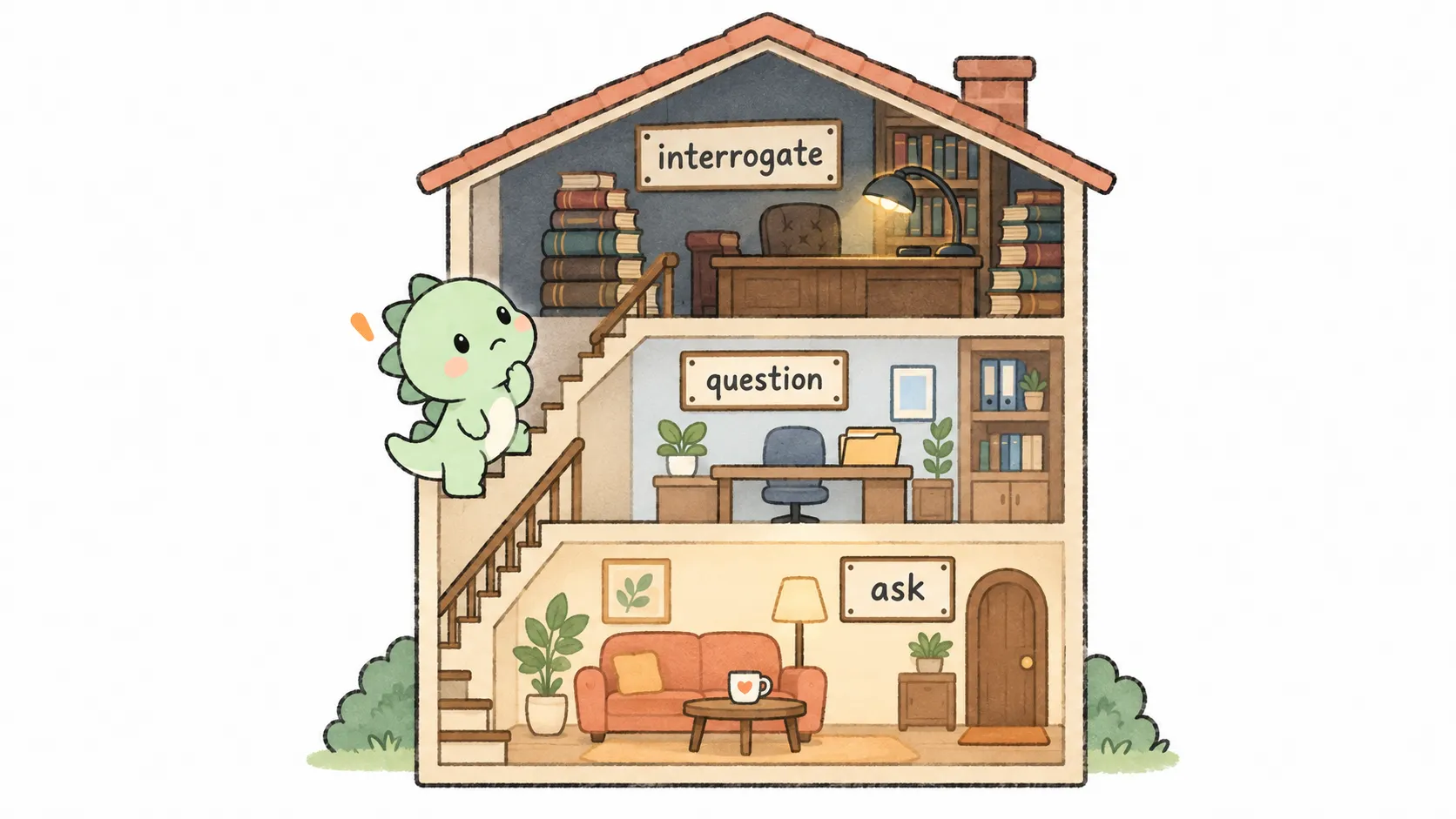
Broadly, the further right you go, the longer the word and the more formal the tone. You ask a friend something; you question a point in a meeting; the police interrogate a suspect. A fire in your kitchen is a fire; a newspaper describing a blaze that destroyed half a city might call it a conflagration.
Cow is English, beef is French? A story that's a little too neat
Any account of the layers of English almost always gets to this example:
| The living animal (Old English) | The meat on the plate (French) |
|---|---|
| cow, ox | beef |
| pig, swine | pork |
| sheep | mutton |
| calf | veal |
The story goes like this: after the Norman Conquest, the people who raised the cattle and pigs spoke English, and the people who ate the meat spoke French. So the animals kept English names in the field and took French names once they reached the table.
The observation is old. The Danish linguist Otto Jespersen, in Growth and Structure of the English Language (1905), says it was first made by John Wallis in his 1653 grammar of English, Grammatica Linguae Anglicanae, and was made popular by Walter Scott's novel Ivanhoe (published in December 1819). In the first chapter, the jester Wamba tells the swineherd Gurth that while the pig is alive and tended by a Saxon serf, it goes by its Saxon name, swine; once it is butchered and carried into the castle hall for the nobles, it becomes Norman-French pork. He goes on: the ox becomes beef when it reaches the nobles' table, and the calf becomes "Monsieur de Veau".
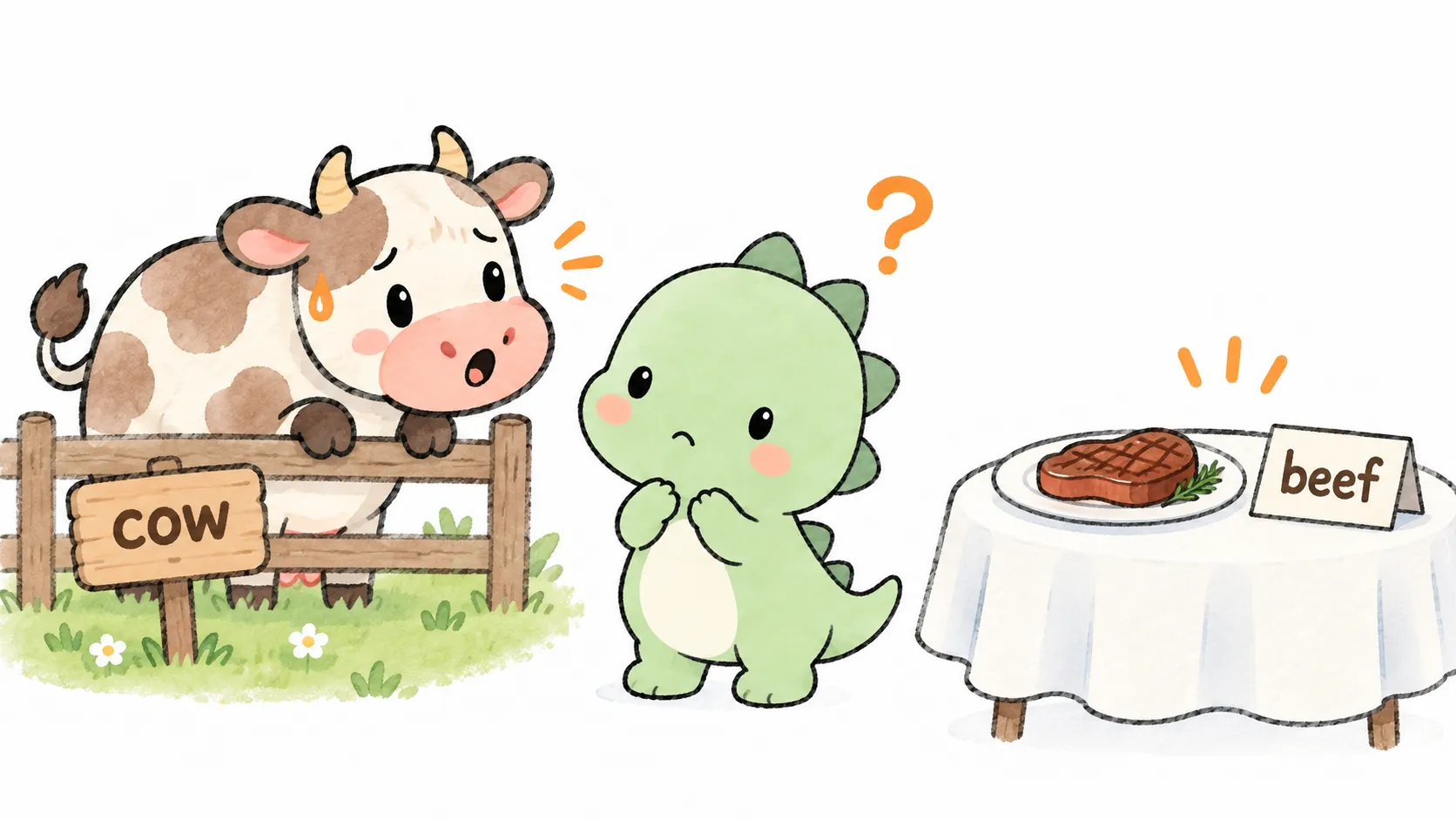
The story is memorable, and it points in roughly the right direction. But it has been polished too smooth:
- The French words first meant the animals too. Old French boef simply meant "ox" or "cow". Robert Burchfield, once chief editor of the Oxford English Dictionary's supplements, called the popular account "no more than a half-truth" in The English Language (1985): when beef, veal, mutton and pork entered English, they named the animals as well as the meat. A 2015 study by the Hungarian scholar Tibor Őrsi ("Cow versus Beef", Eger Journal of English Studies) lays out the dictionary record: when beef first appears in English, around 1300, it means "a bovine animal". The split between animal and meat formed gradually, over the 14th and 15th centuries.
- The timing is off. Baugh also pointed out that Scott's scene has only one flaw: the novel is set at the end of the 12th century, about a hundred years too early, since beef is first found around 1300.
- There is more than one explanation. Jespersen himself noted that you could just as well credit the prestige of French cooking: sauce, boil, fry, roast and pastry are French words too, and they all belong in the kitchen, not to whoever tended the pigs.
One more twist: cow and beef are distant relatives. Trace them back a few thousand years and both come from the same Indo-European root. One travelled the Germanic road into English; the other took the long way round through Latin and French, and the two met again in England.
Which floor does the TOEIC live on? The middle one
Back to the TOEIC. Many of its "formal" words live on the middle floor, the one borrowed from French:
- Purchase comes from the Anglo-Norman purchacer, "to seek to obtain", built on chacier, the source of English chase. Taken literally, to purchase is roughly to go chasing after something until you get it.
- Assist, request, require, inform, increase and obtain all came into English through French.
- Commence is French too (Old French comencier). Today it sounds much stiffer than purchase, but by origin it lives on the same floor.
The Latin top floor (interrogate, conflagration, terminate) rarely shows up on the TOEIC (numbers below). The TOEIC tests workplace English: company notices, customer emails, meeting announcements. That is middle-floor English: formal and polite, but not showing off.
Baugh and Thomas Cable, who later took over revising the book, make the same point in its 6th edition (2013): the difference in tone between the English and the French words "is often slight", and it is the Latin word that is generally more bookish. In other words, to a native speaker purchase is simply a bit formal, not stiff. The woman in the sample test opens her complaint call with I'm calling about a coffee machine I purchased from your Web site.
So how often do these "formal" words appear in the ETS sample? We counted the whole sample test (60 questions, including the listening script):
- The buy family (buy, bought…) appears once; the purchase family three times.
- Assist, inquire, commence, obtain, sufficient: zero times.
Sixty questions can't tell you much. But they do tell you the TOEIC is not a paper stuffed with commence and sufficient.
Do listening and reading use the same words?
The sample is small, so we turned to a bigger one: the Handy 990 question bank. To be clear, these questions are written by us in the TOEIC format, not by ETS, so treat them as a reference only. We separated the listening scripts (about 148,000 words) from the reading passages (about 238,000 words) and counted some common everyday : formal pairs:
| Pair | Listening scripts | Reading passages |
|---|---|---|
| buy : purchase | 74 : 24 | 188 : 146 |
| need : require | 466 : 30 | 681 : 232 |
| tell : inform | 100 : 1 | 201 : 26 |
| get : obtain | 263 : 0 | 187 : 6 |
| help : assist | 119 : 4 | 194 : 8 |
| start : commence | 342 : 0 | 261 : 1 |
| go up : increase | 18 : 15 | 7 : 30 |
| find out : discover | 3 : 0 | 5 : 23 |
(Every inflected form counts, such as bought and purchased; purchase as a noun counts too.)
The table says three things.
First, the formal words live in reading. Per 10,000 words, purchase is about 4 times as frequent in the reading passages as in the listening scripts, and require about 5 times; inform appears in the listening scripts exactly once.
Second, reading doesn't replace the everyday words; it adds a layer on top. Even in the reading passages, buy still outnumbers purchase and need still outnumbers require. Only a few pairs (go up / increase, find out / discover) are overtaken by the formal word in reading.
Third, the stiffest words barely appear. In the reading half of the whole bank, commence appears twice (once in a passage, once in an answer choice), and terminate twice, both in answer choices. Assist is rarer than people think, too: in listening and in reading alike, help outnumbers it by more than twenty to one.
The last pair, find out / discover, points to something else: the everyday version of an English word is often not one word but a phrasal verb, a verb plus up, out or off. Find out for discover, put off for postpone, set up for establish. Saying the phrasal verb in conversation and switching to a single French- or Latin-derived word on paper is a very common English pattern. But it is a tendency only: in our bank, carry out actually appears more often than conduct in the reading passages.
Your language probably has floors too
If English layering sounds like a nuisance, look at your own language.
Japanese, for example, has native words, words borrowed from Chinese and modern loanwords from Western languages, often for the same thing: an inn can be a yadoya, a ryokan or a hoteru, and the choice changes the tone (and a little of the meaning). Chinese has the same habit without the borrowing: you tell a friend you mǎi (買) a coffee machine, but a company notice says gòumǎi (購買) and the purchasing department writes cǎigòu (採購).
The details differ from language to language. The effect is the same: one thing, several ways to say it, and which one you pick depends on who you are talking to.
So purchase is not a strange word. It is simply the English equivalent of the word your company notices use. Native speakers rarely say purchase when chatting with friends, but when they see it in a company notice, it doesn't strike them as odd at all.
So how should you learn them? In pairs
The most useful conclusion fits in one line: learn each formal word together with its everyday partner.
| Everyday (common in listening) | Formal (found mostly in answer choices and reading) |
|---|---|
| buy | purchase |
| help | assist |
| ask | inquire (noun: inquiry) |
| start, begin | commence |
| get | obtain, receive |
| enough | sufficient |
| need | require |
| tell | inform |
| go up, raise | increase |
| put off | postpone |
| find out | discover |
Learning them this way pays off three times:
- Listening. The recording says bought, the answer choice says purchase; the recording says raised their prices, the choice says increased. What you are looking for among the choices is often the middle-floor version of what you just heard.
- Reading. Part 7 answer choices often restate a word from the passage: in question 161 of the sample test, the passage says free and the answer says available at no charge.
- Writing. In a work email the middle floor is the safest: I'd like to purchase… and Please inform us… sound right. Climb to the top floor (We hereby commence…) and you sound like a contract; stay on the ground floor (Tell us if you wanna buy…) and you sound too casual.
Every house has a few unpermitted extensions
As always, the fine print:
- The three floors are a tendency, not a rule. Baugh and Cable themselves point out that many French words are just as simple and vivid as native ones, citing river, rock, cry and fool; everyday words like people, face, chair and use came from French too.
- Origin is not the same as tone. Commence and purchase both came from French; one is stiff, the other ordinary. Get and raise were brought by the Vikings, from Old Norse (also Germanic). Postpone was borrowed straight from Latin, yet it is a common word in TOEIC answer choices. Whether a word is formal depends on how it is used today, not on its family tree.
- The cow-and-beef story is simplified. The animal/meat split is real, but it formed over centuries, not overnight in 1066.
- Our counts come from our own bank. It is practice material written in the TOEIC format, not official ETS questions, and the ETS sample test has only 60 questions. Read the numbers as a direction, not as official TOEIC statistics.
- Tone depends on the situation. Purchase is perfectly normal on a customer-service call and odd in a chat with friends. When you learn a word, noting where it usually shows up is more useful than noting which floor it came from.
The TOEIC lives on the middle floor
English is a house that has been under construction for a thousand years. The ground floor is Old English, for talking. The middle floor is French, moved in after 1066, for the office. The top floor is the Latin study that Renaissance scholars added, for writing papers.
The TOEIC lives on the middle floor. It is unlikely to test you on conflagration, and it doesn't expect anyone to say commence on a customer-service call. What it wants is this: when you hear the ground-floor bought, you can spot the middle-floor purchase among the choices.
As for the cow, it can relax. According to Őrsi, beef started out as a word for the cow itself. It's just that, over time, people mostly mentioned it on a plate.
The Handy 990 vocabulary bank has 3,834 words. It includes purchase, assist, inquire, commence, obtain and sufficient, but not buy, help or ask: you already know those. Start from purchase in Word Web and obtain and acquire appear among its synonyms. Elsewhere in this series, Everyday English words that change meaning at the office covers sheets, bars, outstanding and other words you know that mean something else at work, and Why does English have silent letters? tells how Renaissance scholars pushed a Latin b into debt.