
All articles · Published 2026-11-01
How Canadians Measure Things: Celsius Outside, Fahrenheit in the Oven, Pounds on the Scale, and Distance in Hours
Canada began going metric in 1970, and half a century later it still mixes the two systems: Celsius for the weather, Fahrenheit for the oven, litres of milk, feet for height, and for the distance between two cities, "about four hours." The flowchart How to Measure Things Like a Canadian is a joke, but the polls mostly back it up. This post takes the chart apart, then covers a jet that ran out of fuel over a unit mix-up, and phrases like 15-inch and five foot ten. Just for fun.
Why would measuring something need a flowchart?
Ask a Canadian how cold it is outside and you get Celsius. Ask how hot to set the oven and you get Fahrenheit. Height comes in feet, driving speed in kilometres.
A chart that has been circulating online for years turns this into a flowchart called How to Measure Things Like a Canadian, and it has been posted on Reddit's r/Metric too. It's a joke, but it's funny because the locals recognize it at a glance.

Metric or imperial? What the flowchart says
The original chart is short. As a table:
| What are you measuring? | Case | Use |
|---|---|---|
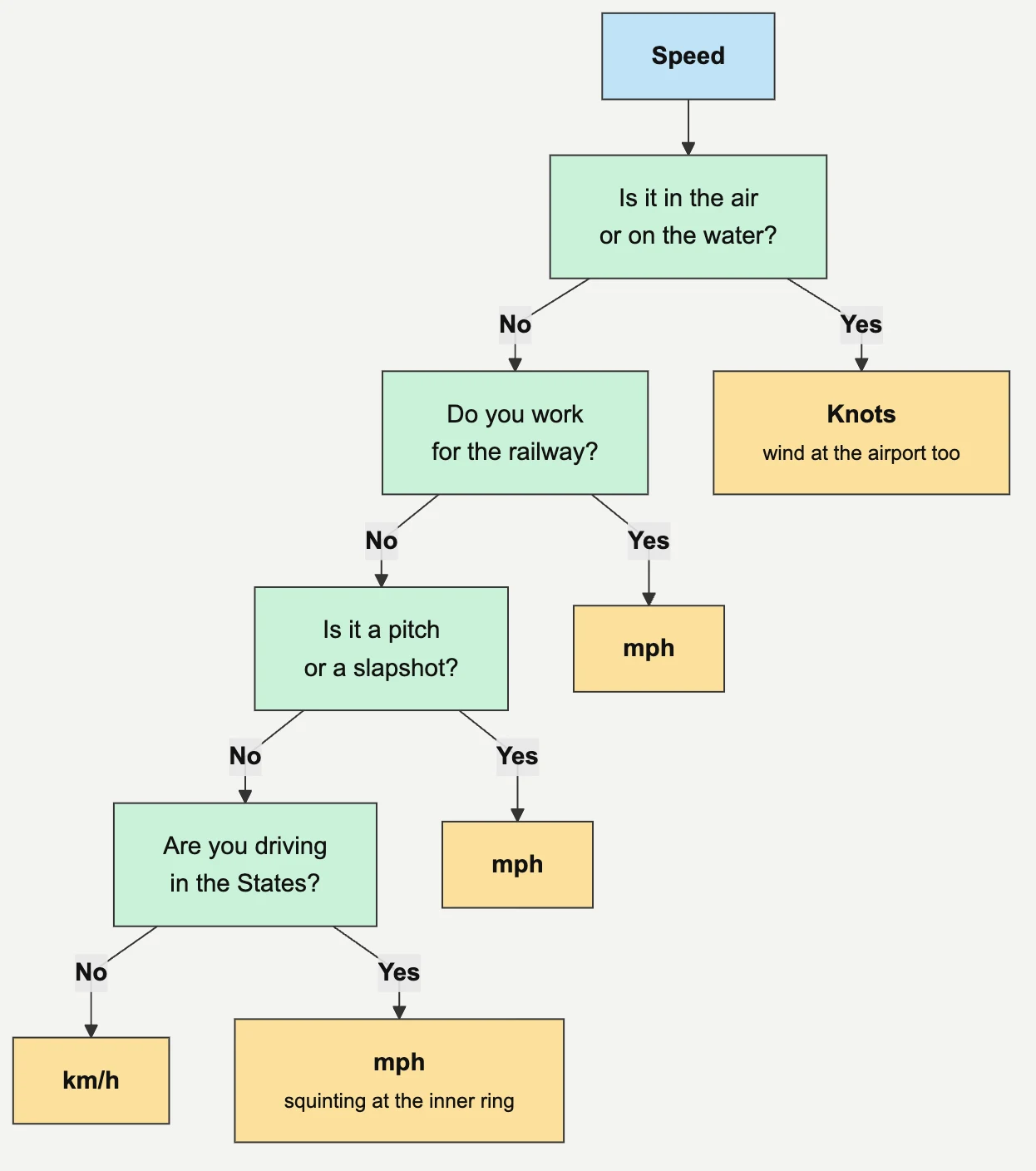
| Speed | Always | Metric |
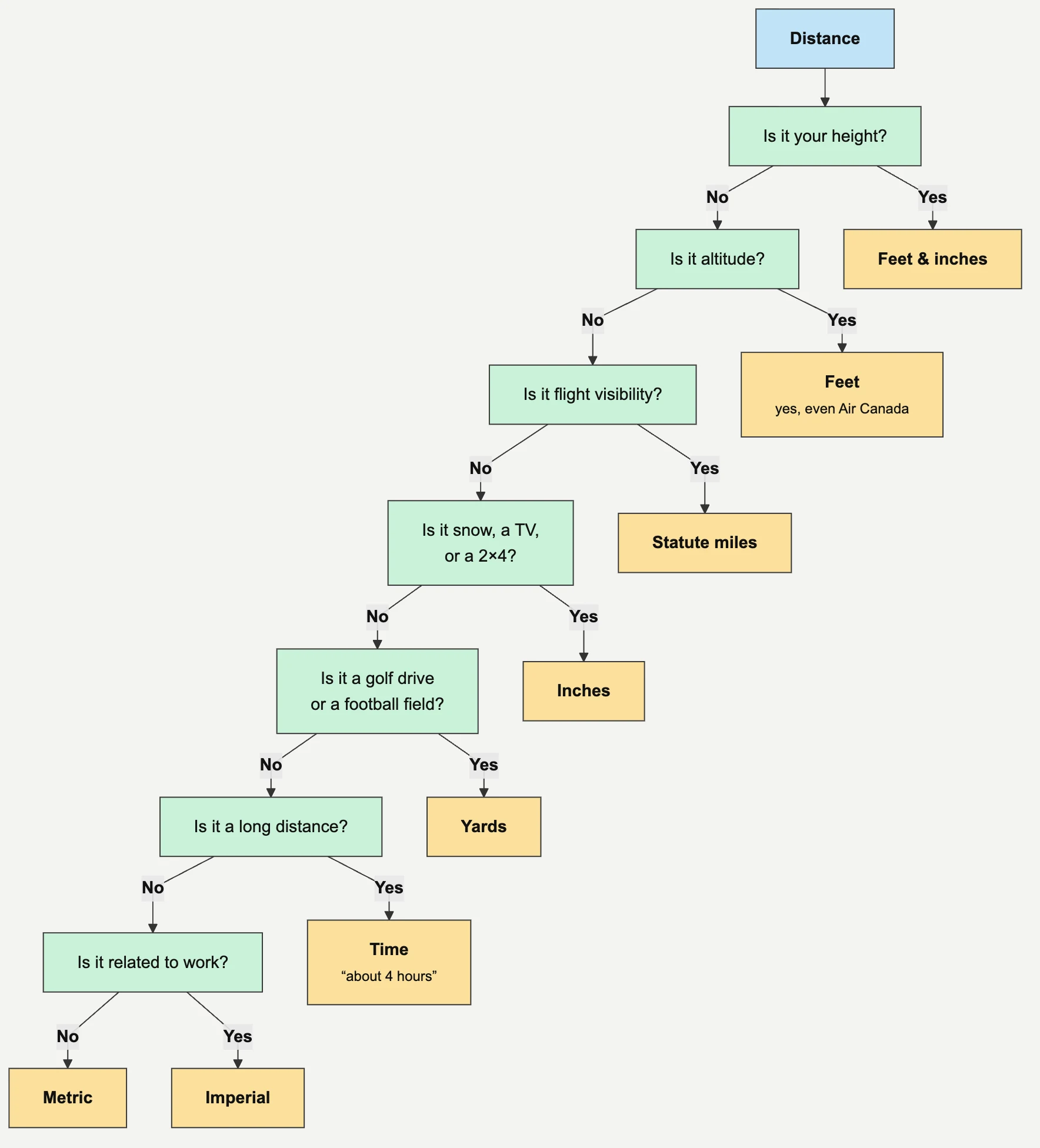
| Distance | Your height | Imperial |
| A long distance | Time | |
| Related to work | Imperial | |
| Anything else | Metric | |
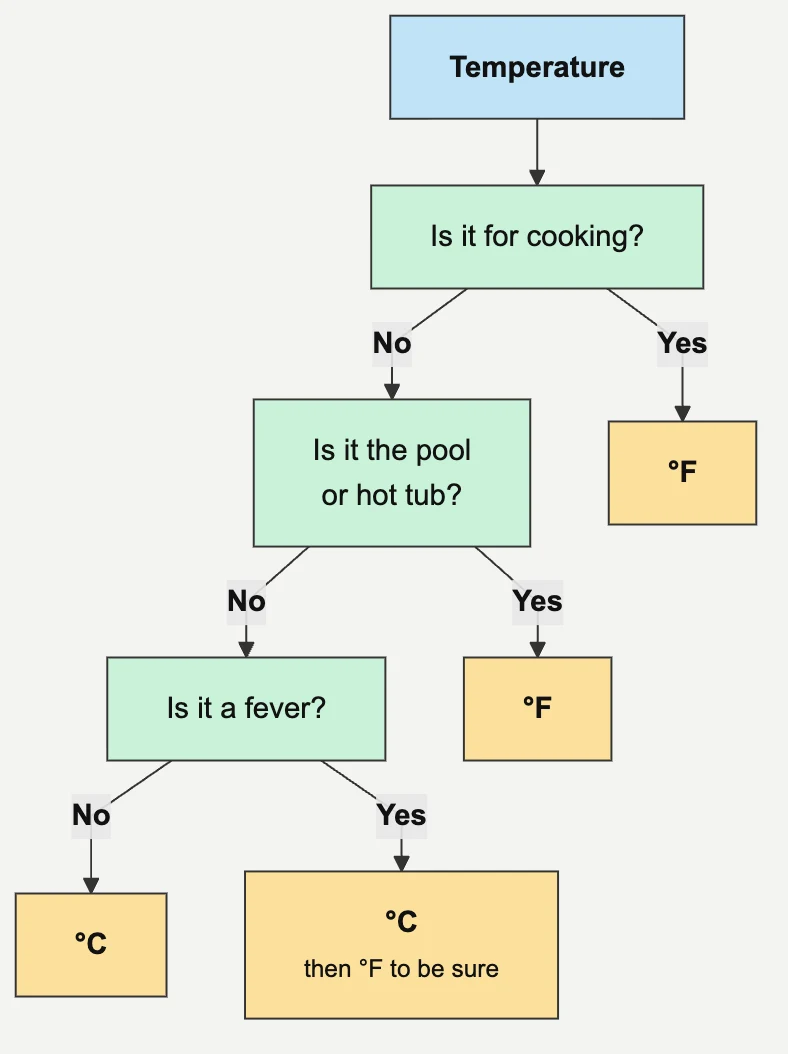
| Temperature | Cooking | Fahrenheit |
| The pool | Fahrenheit | |
| Anything else | Celsius | |
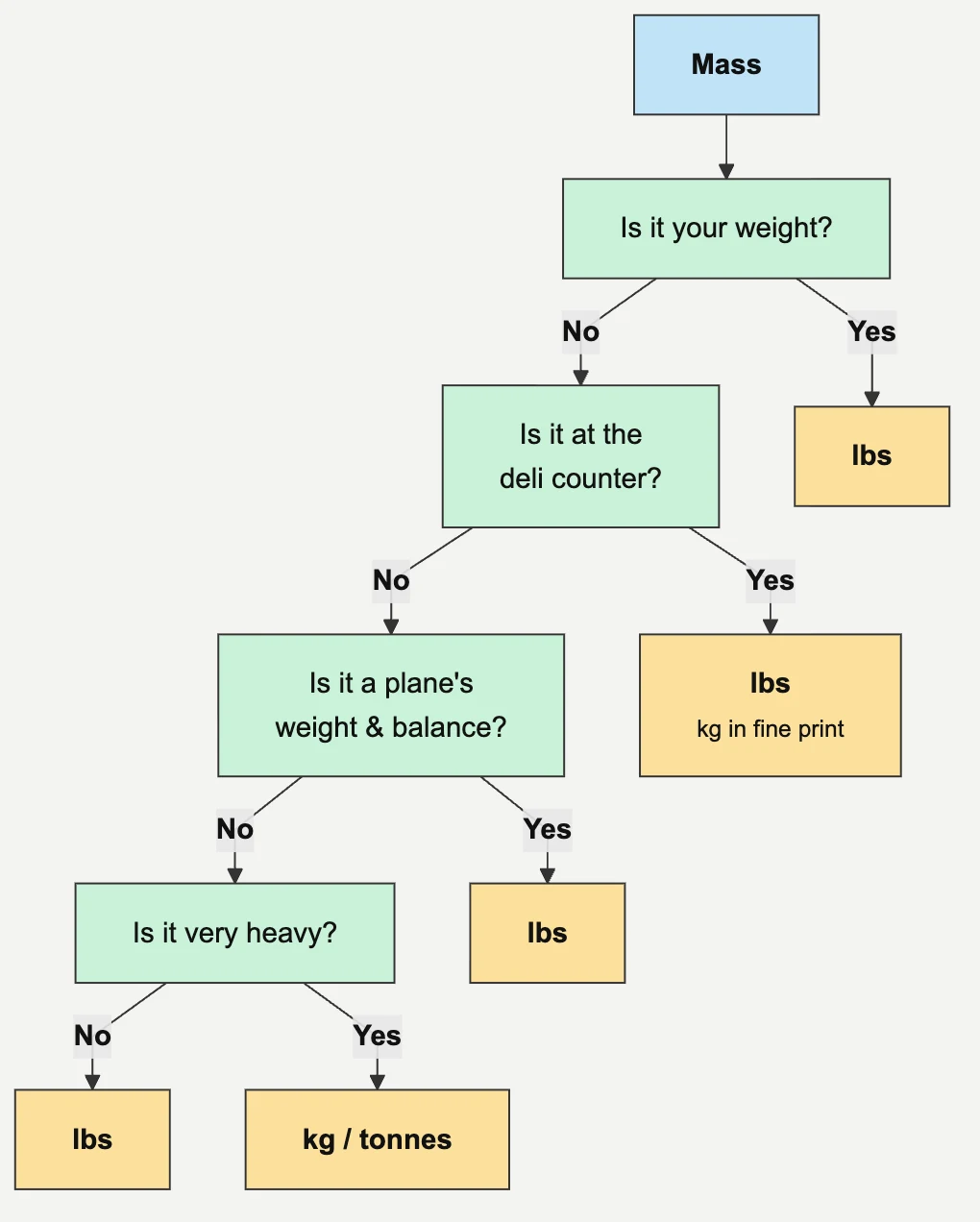
| Mass | Your weight | Pounds |
| Something very heavy | Kilograms | |
| Anything else | Pounds | |
| Volume | Cooking | Cups and spoons |
| Anything else | Metric |
There is also an extended edition, with enough branches to pass for a tax form. We redrew it, one chart per category (the chart text stays in English, because the wording is part of the joke):
Speed
Distance
Temperature
Mass
Volume
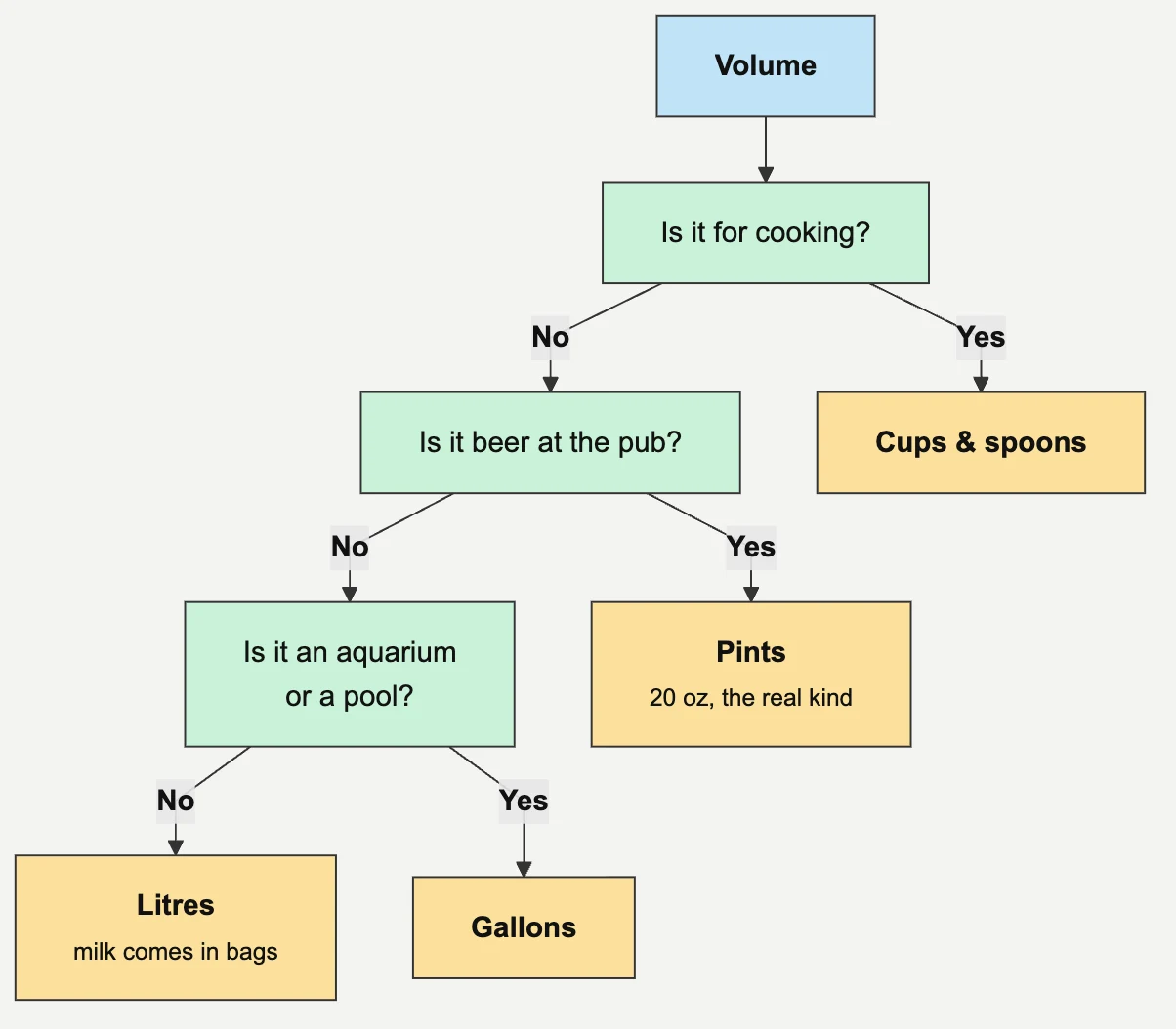
Pressure
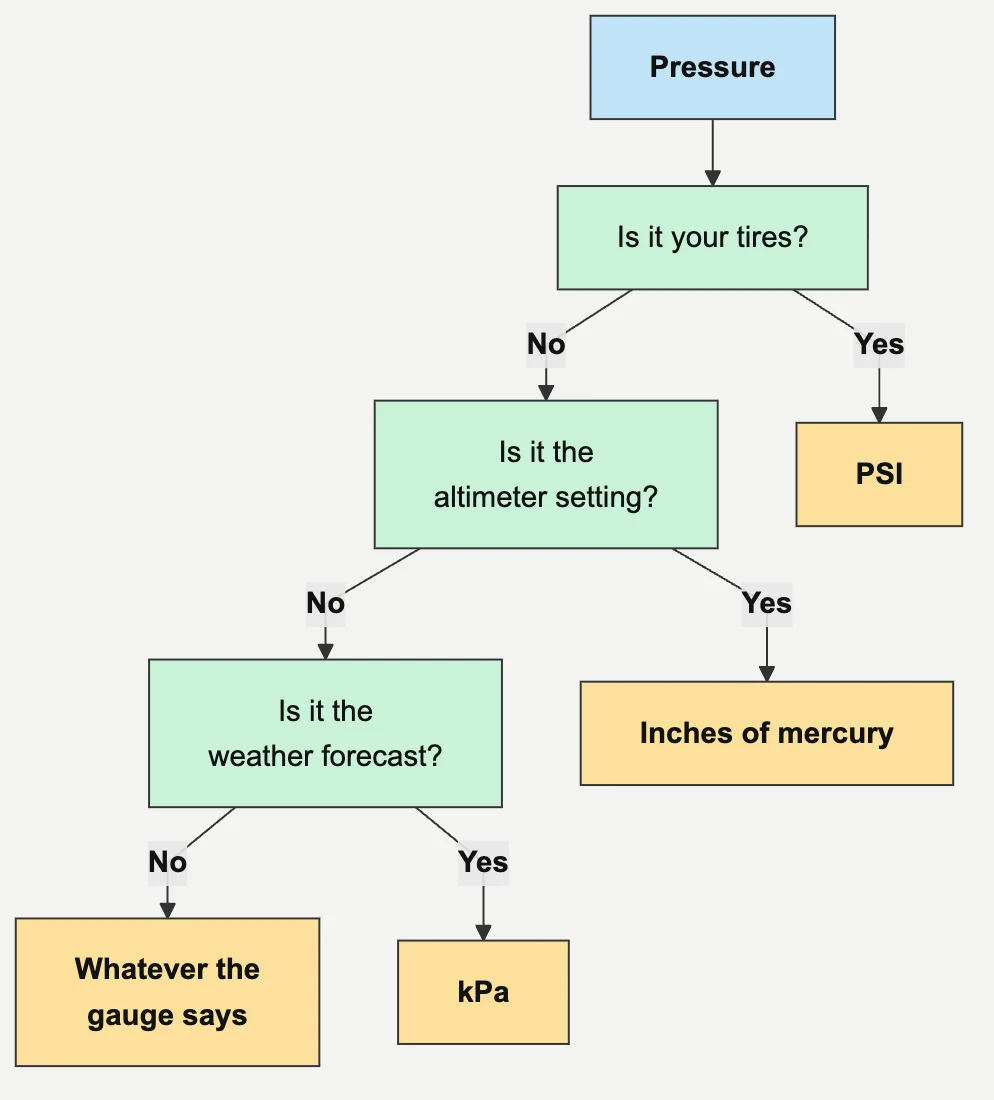
Area
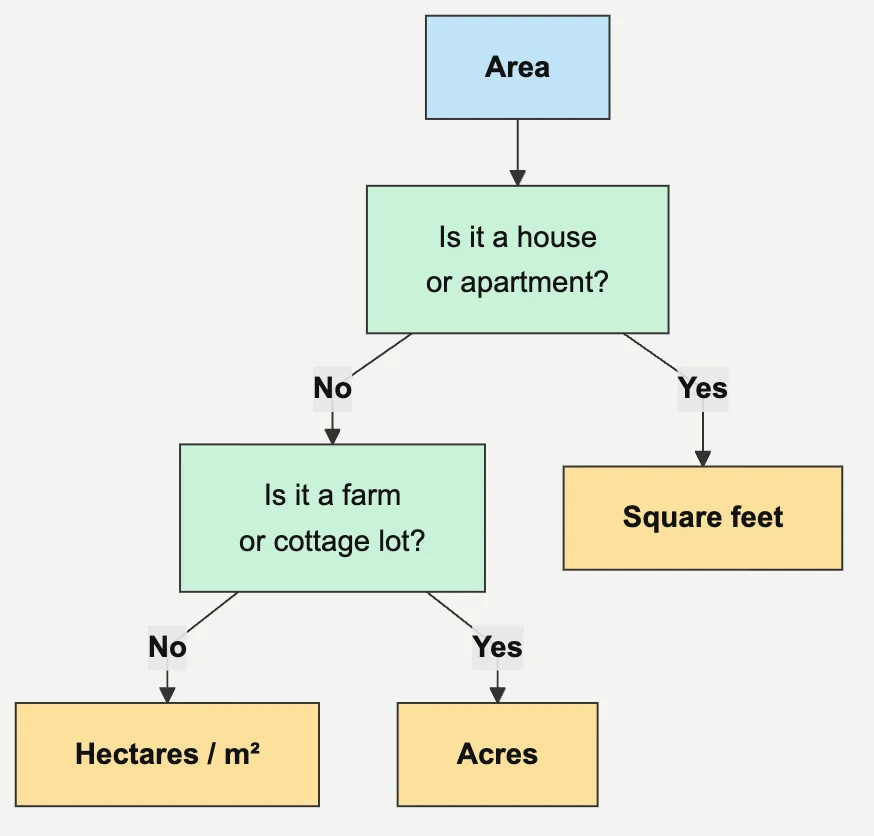
Fuel economy
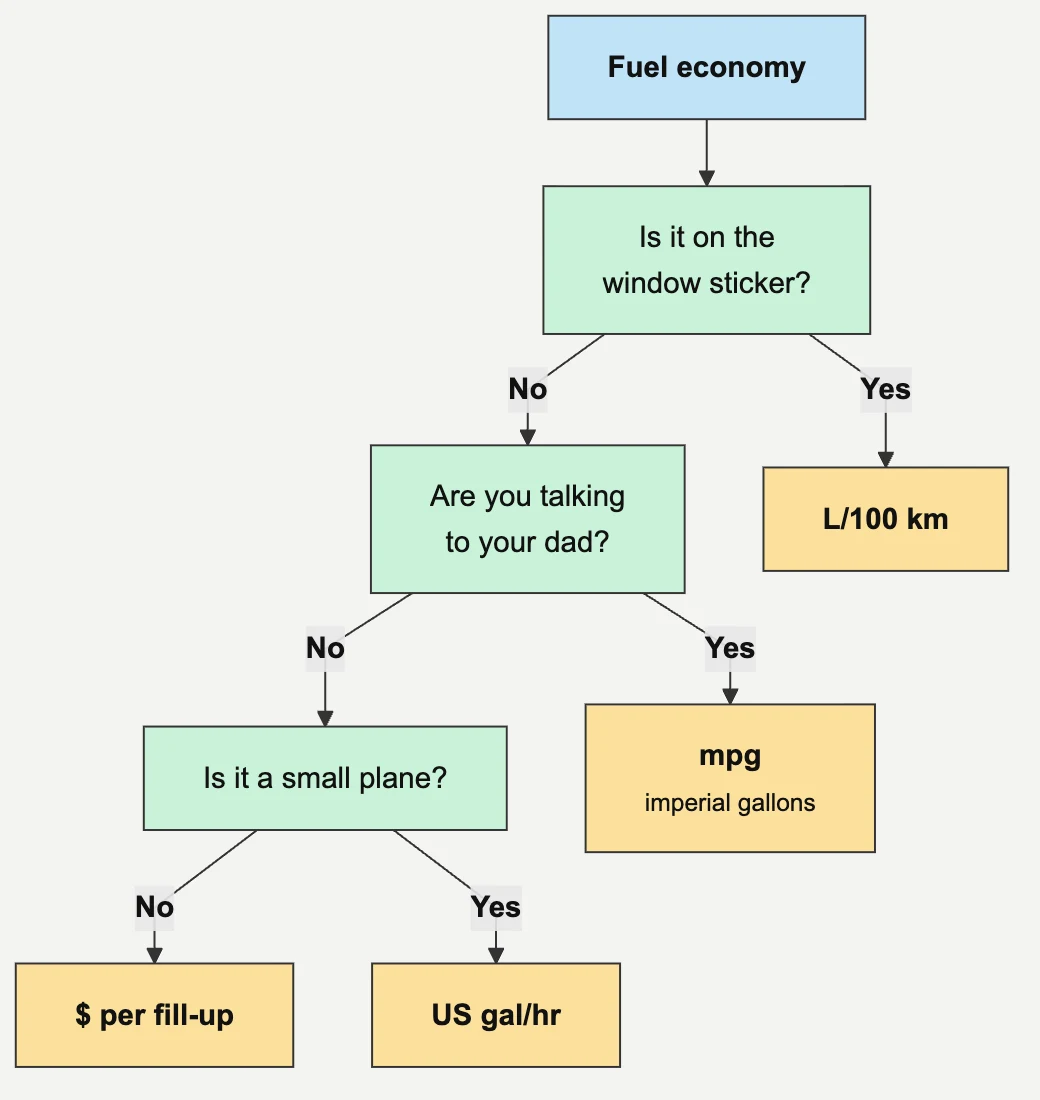
What do the words on the charts mean?
| Word on the chart | Meaning |
|---|---|
| slapshot | The hardest shot in ice hockey, with the stick swung down from high up. Like a baseball pitch, it's something fans quote speeds for |
| squinting at the inner ring | To squint is to look with your eyes half shut. Speedometers often have a small inner ring in mph, and that's what you squint at once you're driving in the US |
| altitude | Height above sea level, or a plane's flying height |
| mph | Miles per hour |
| aquarium | A fish tank; also a building full of them |
| altimeter | The instrument that tells a pilot the plane's altitude |
| mercury | The liquid metal. Inches of mercury is a unit of air pressure: how far the pressure pushes up a column of mercury |
| gauge | A dial or meter, pronounced /ɡeɪdʒ/. "Whatever the gauge says" means you read off whatever is printed there |
| cottage | A small house in the country; in Canada, often a holiday place by a lake. A cottage lot is the land for one |
| hectare | A unit of land area: 10,000 square metres |
The fuel chart is my favourite: L/100 km on the window sticker, mpg when talking to your dad, and otherwise dollars per fill-up. The pub box's "20 oz, the real kind" isn't a joke, though. Under Measurement Canada's guidance, draft beer sold as a pint means an imperial pint of 568 mL, not the 473 mL American one.
A German comedian reads the chart on stage
German comedian Mario Adrion has an 84-second clip called Canadians can't Decide on Units of Measurement. He asks the crowd where in Canada they use kilograms. Nowhere, they say, even though they do use kilometres an hour. He asks someone how tall they are: 5'2". Then someone adds that grams are for pot and cocaine.
Clip: Mario Adrion. It has bleeped swearing and a drug joke, so use your judgment at work.
Then he pulls out this very Reddit chart and reads it box by box, falling apart as he goes. Pounds for your weight, kilograms if it's heavy, back to pounds if it isn't, which he calls horrible. Speed is the only thing that's consistently metric. And the answer to "long distance" is time. At that point he asks: "How are you an engineer in this country, dude?" The reply from the room is that Toronto is six hours away.
He's reading a joke chart, but the answers the crowd gave him earlier, 5'2" and no use for kilograms, match it exactly.
Is the chart accurate? Two polls
Research Co. surveyed 1,000 Canadian adults in August 2022, and the Angus Reid Institute asked similar questions in 2017. The results line up with the chart:
| Item | Research Co. (2022) | Angus Reid (2017) |
|---|---|---|
| Outdoor temperature in Celsius | 77% | 87% |
| Height in feet and inches | 80% | 91% (height and weight combined) |
| Weight in pounds | 76% | Same as above |
| Oven in Fahrenheit | 59% | 76% |
| Liquid in a container in litres | 84% | — |
Angus Reid also found a neat contrast: 27% think metric when weighing things at the grocery store, but only 8% on the bathroom scale. Same person, different system, depending on which side of the front door they're on.
Nobody seems to mind much. In the Angus Reid poll, 67% said the mix is perfectly fine, while 16% wanted to go back to imperial and 17% wanted to push metric harder.
Why isn't it finished after fifty years?
The chart looks chaotic, but broken down there's a pattern. Here's how I read it: where the government could reach, it's metric; where it couldn't, it stayed imperial; and where Canada shares supply with the US, it follows the US.
Where the government could reach, the change was thorough. The timeline, from Canada's History and Wikipedia:
- 1970: A government white paper warns against becoming "an inch-pound island in an otherwise metric world"
- 1971: The Metric Commission is set up
- 1975: Weather forecasts move to Celsius. The commission's ad in more than 100 newspapers says "Say goodnight to Fahrenheit"
- 1977: Road signs change to km/h
- 1979: Gas stations start selling by the litre
Temperatures, road signs and fuel prices are all printed by someone else, so once they change, they've changed. Height is different. No ministry can reach how you tell a friend how tall you are. Your parents said five foot ten, so you do too.
The third line runs through the United States. Wikipedia notes that ovens stayed in Fahrenheit because many kitchen appliances are imported from the US, and building materials like lumber and plywood are still imperial. Canadian drinks are even better, since the label gives away the ancestry:
| Label | What it really is |
|---|---|
| 341 mL bottle of beer | 12 imperial fluid ounces |
| 355 mL can of beer | 12 US fluid ounces |
| 591 mL soft drink | 20 US fluid ounces |
Nobody chose 341. It's an old unit in a metric coat.
Politics played a part too. In early 1985, store owners were allowed to choose metric or imperial pricing, and on March 31 that year the Metric Commission was abolished under the Mulroney government.
Why do flyers say per pound when the checkout says per kilogram?
On the extended chart, the deli counter's answer is "lbs," with "kg in fine print" underneath. That isn't made up either. According to Wikipedia, meat and produce are commonly advertised per pound but sold at the checkout by the kilogram or per 100 grams.
One reason is simple: the pound price is the smaller number. A Concordia University study (2023, Canadian Journal of Administrative Sciences) showed people the same strawberries: $4 per kilogram was judged more expensive than $1.82 per pound, though the two prices are equal. The researchers' explanation is that people respond to the number far more than to the unit after it.
So 1 pound ≈ 0.45 kg may be more than a conversion to a supermarket. It may be a pricing strategy.
How bad can a unit mix-up get? A Boeing 767 runs out of fuel
On July 23, 1983, both engines of Air Canada Flight 143 stopped at 41,000 feet.
The Boeing 767 was new and tracked its fuel in kilograms, while the rest of the fleet used pounds. That day its fuel gauges weren't working, so the crew had to measure with a dipstick and calculate by hand. The flight needed 22,300 kg, and the dipstick showed 7,682 litres. The density for converting litres to kilograms should have been 0.803 kg per litre. They used 1.77 from the refuelling slip, and that figure was pounds per litre.
The amount they worked out came far too low. The plane took off with 45% of the fuel it needed.
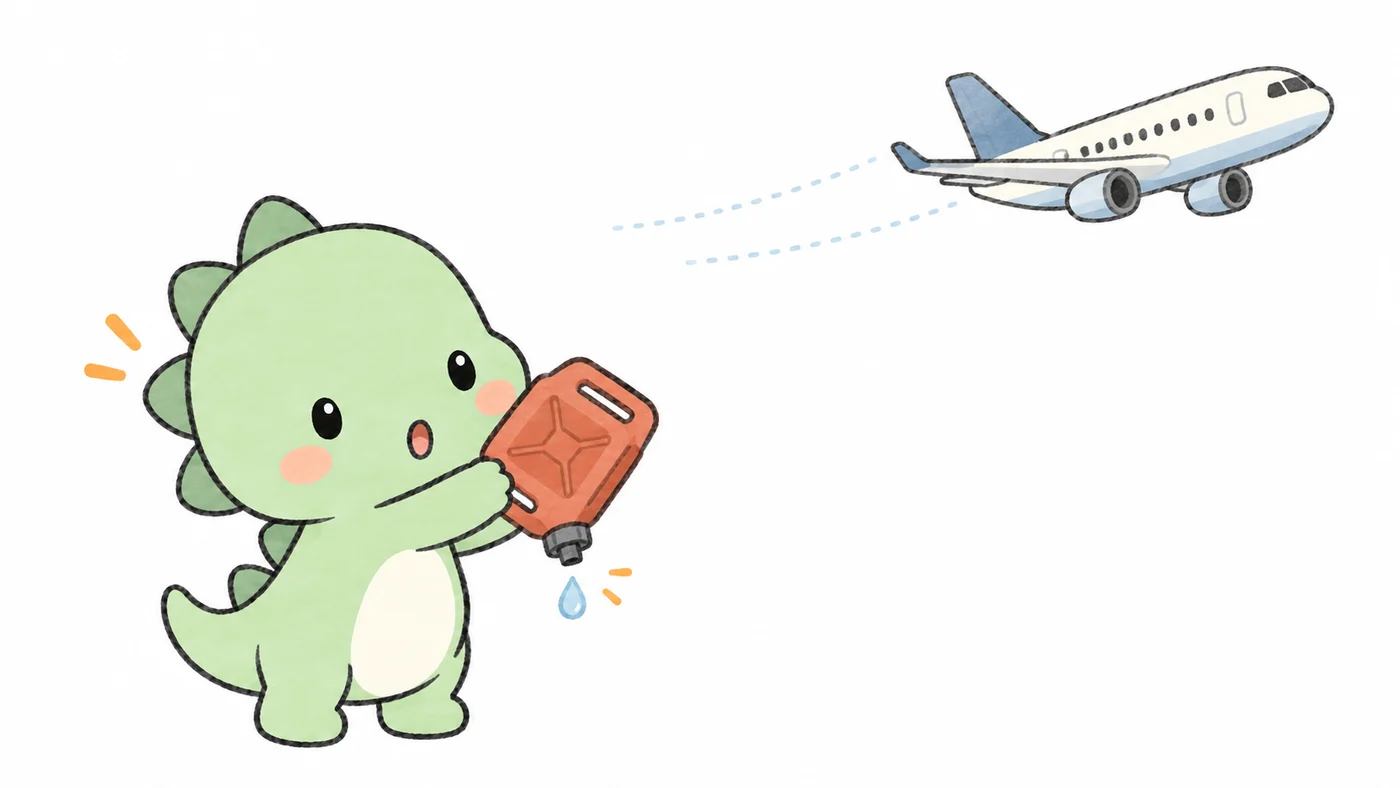
With no power, the plane glided for 17 minutes and landed at a former air force base at Gimli, Manitoba. None of the 69 people aboard died. The incident became known as the Gimli Glider.
Units weren't the only cause; the broken gauges and the airline's procedures and training were part of it too. But the board of inquiry did recommend converting Air Canada's whole fleet to metric, on the grounds that a fleet using a mix of units was more dangerous.
In daily life, the worst a Canadian's unit mix-up usually does is burn a tray of cookies. That time it nearly cost a plane.
How do you say and write these units in English?
Back to the English itself.
In compound adjectives, the unit takes no s. A screen is 15 inches, but before a noun it's a 15-inch screen:
- a 65-inch TV
- a 20-foot container
- a 1,200-square-foot house
- The ice is two inches thick. (No noun follows, so inches keeps its s.)
It's the same rule as a five-year plan; there's more in Why a five-year plan, not five-years plan.
Height often uses foot. 5'10" is read five foot ten, or just five ten. He's six foot two is ordinary spoken English, and foot without the s is fine here.
Abbreviations don't always match the word. lb is read pound and oz is read ounce. lb abbreviates the Latin libra, and oz comes from the Italian onza, which is why the letters don't fit the English words. km/h is read kilometres an hour.
2×4 is read two-by-four. The 2×4 in the chart's "snow, a TV, or a 2×4" is a piece of lumber, and the word is a noun too: a two-by-four. A real 2×4 actually measures 1.5 × 3.5 inches. The name is its size before planing.
Canada spells it metre, litre, kilometre. That's -re as in Britain, against American meter, liter, kilometer. Neither is a typo; see British vs American spelling.
Kilometre has two stress patterns. Dictionaries list stress on either the first or the second syllable. Wikipedia says broadcasters such as the BBC, CBC and ABC generally prefer the first, the same rhythm as kilogram. You'll hear both.
Why can you answer "how far" with a time?
The funniest box on the chart is "long distance → Time," and the extended edition adds "about 4 hours."
This habit isn't only Canadian. English often gives distance in time:
- It's a five-minute walk from the hotel.
- It's about four hours by car.
A five-minute walk drops the s by the same rule. You can also say five minutes' walk, with the apostrophe after the s.
So if someone asks How far is it?, About four hours is a normal answer. In a country this big, it's a more useful answer than kilometres.
How big are these units, really?
If you'd like the actual sizes behind the charts:
| Imperial | Roughly |
|---|---|
| 1 inch | 2.54 cm |
| 1 foot (12 inches) | 30 cm |
| 1 mile | 1.6 km |
| 1 pound | 0.45 kg |
| 1 gallon (US) | 3.8 litres |
| 1 square foot | 0.09 square metres |
| 350°F | 177°C |
Note the "US" on the gallon. An imperial gallon is 4.55 litres, about a fifth bigger, so the mpg you discuss with your dad on the extended chart depends on whose gallon he means.
Before you laugh too hard
By now it's hard not to laugh at Canadians.
But the British drive in miles, fill up in litres, drink beer in pints and may well give their weight in stone. Americans, proud holdouts, buy soda in two-liter bottles.
Draw those as flowcharts and they wouldn't be much shorter than Canada's.
Don't use this chart as a rulebook
- It's a joke. Take the Fahrenheit pool: we found no poll supporting that branch, so it stays a widely shared meme.
- "Distance in time" and "kilograms only when very heavy" are exaggerations. Angus Reid says Canadians have moved to kilometres for travel distance.
- Regions differ a lot. Wikipedia notes that homes in English Canada are built and sold in imperial, and in Quebec in metric. The chart is basically an English Canadian view.
- The two polls aren't directly comparable. Oven Fahrenheit going from 76% to 59% involves different pollsters and questions, so it can't be read as a 17-point drop in five years.
- Age matters, clearly. In 2022, 71% of people aged 18–34 gave height in feet and inches, against 88% of those 55 and over. In 2017, 48% of 18–34s said they knew imperial well, against 98% of those 55 and over. This chart has an expiry date.
Conclusion
In 1970, a Canadian white paper worried about becoming an imperial island in a metric world. More than fifty years later, it's an island where both systems live side by side, and the islanders all know when to switch.
Next time a Canadian says they live nearby, ask how many hours.
For how to convert the numbers themselves, read English number formats. For why units drop the s before a noun, read a five-year plan. For more British and American differences, read British vs American vocabulary.