
All articles · Published 2026-10-16
Color Idioms in Business English: A Green Room Isn't Green, and "In the Red" Isn't a Good Day on the Market
A green room is a backstage lounge, red tape is bureaucracy, a blue-chip stock is a safe bet and a pink slip means you've been let go. Business English is full of color words whose meaning you can't see in the color. Starting from a reader's report, this post sorts more than a dozen common ones into four groups — money, work, permission and paperwork, and the gray zone — traces each color back to the object it came from (ink, ribbon, poker chips, shirts, paper), and separates the origins that are on record from the ones that are just good stories. And honestly: the TOEIC rarely tests these, but if you read English business news or work in English, you are likely to meet them.
A reader's report: is a green room green?
A reader flagged one of our Part 4 questions with this comment:
這個詞是「後台休息室」的意思,不是「綠色的房間」
("This means a backstage lounge, not a room that is green.") The talk was a briefing for volunteers at an awards ceremony, and it included the line they will need escorting from the green room. The reader was right, and we have fixed the translation.
A green room is the room in a theater or TV studio where performers and guests wait before they go on. It doesn't have to be green, and many aren't.
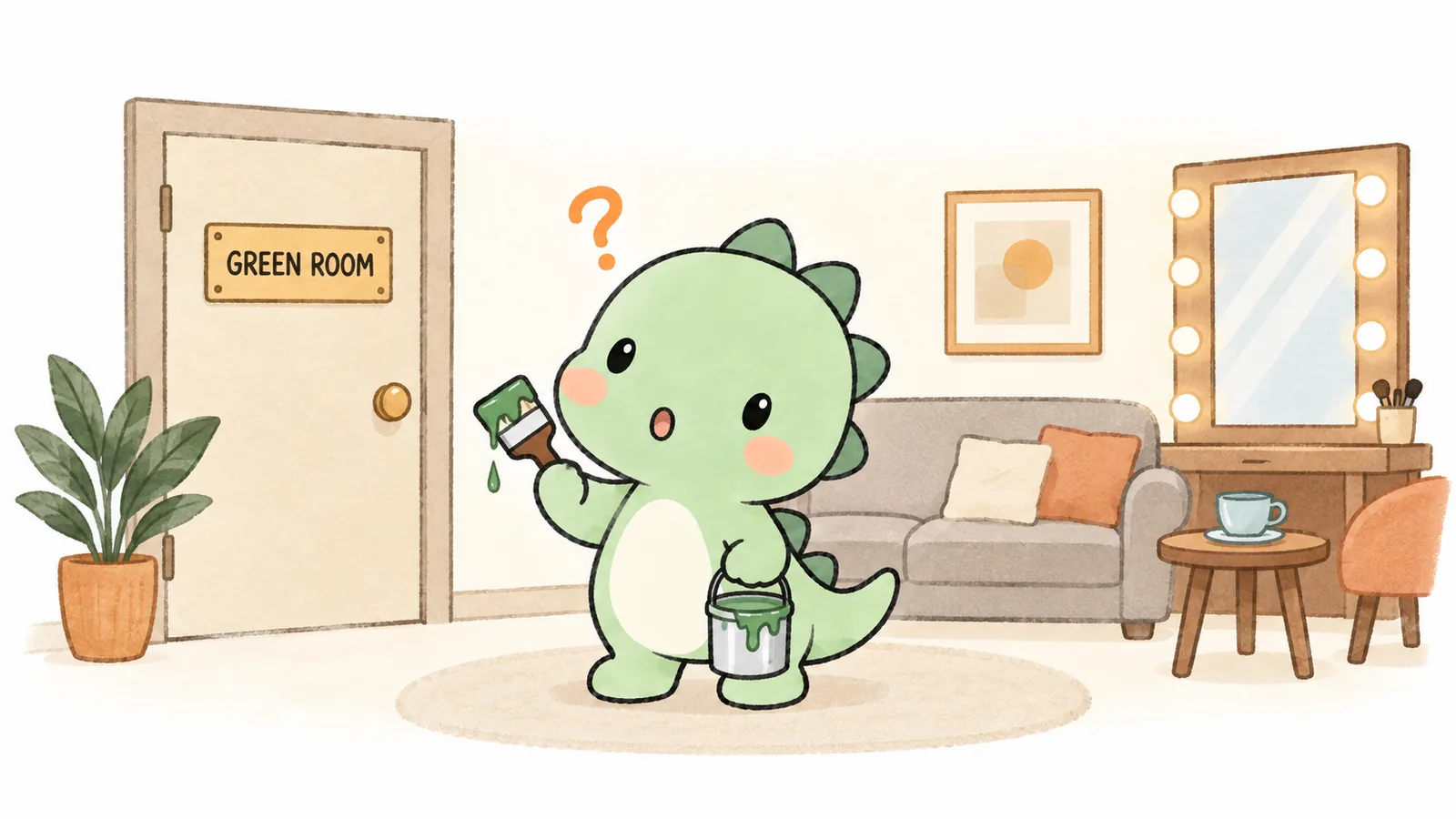
The word is old. The English playwright Thomas Shadwell's comedy A True Widow, first performed in 1678, has the line in a green Room, behind the Scenes — but with "a", that could simply mean a room painted green. By 1701, when Colley Cibber published his play Love Makes a Man, the Green-Room is clearly the name of the room backstage.
Why green? Nobody has settled it. The etymologist Michael Quinion (World Wide Words) lists the main theories:
- the room was painted green — but the early examples come from more than one theater, which makes one theater's paint job an unlikely source;
- green rested the actors' eyes after the glare of the stage — but stages then were lit by candles, so there wasn't much glare;
- the stage was at one time covered with green baize;
- the theater historian William J. Lawrence speculated in 1935 that it may have grown out of the earlier name scene room by a swap of words.
Each has its supporters; none can be proven. All we can say is that green walls may have less to do with it than you'd think.
The word is still very much alive. Talk-show guests wait in the green room, and the World Trade Organization's website explains that a WTO "Green Room" meeting is a small-group process in which heads of delegation seek consensus informally under the chairmanship of the Director-General — a name it says comes from British theater.
Why can't you guess these from the color?
The green room is not alone. Business English has a whole set of color words whose meaning has little to do with the color.
The reason is often simple: the color once pointed at a real object. Red ink in a ledger, red ribbon around official papers, blue chips at a poker table, white shirts on office clerks, the white cover of a government report. Then the object left the scene, or people forgot about it, and the color stayed in the phrase.
Here are more than a dozen common ones, in four groups.
Money: in the red, in the black, blue-chip
| Expression | Meaning | Where the color came from |
|---|---|---|
| in the red | losing money, in debt | losses written in red ink in the ledger |
| in the black | profitable | profits written in black ink |
| blue-chip | top-quality, reliable | the highest-value poker chip was blue |
In the red / in the black. Bookkeepers once entered losses in red ink and profits in black. The earliest printed example the Phrase Finder (Gary Martin's phrase-origins site) gives is from 1907: Montgomery Rollins's Money and Investments, which says that it was formerly customary, and still is with some bookkeepers, to enter a loss in red ink, "from whence arose the term 'in the red'". Why red in particular, nobody can say for sure.
There is a trap here for readers from parts of East Asia. In Taiwan, mainland China and Korea, a red stock price means it went up. A screen full of red is good news there. But when an English headline says Stocks closed in the red, the market went down. The color means the opposite.
The good news is that many of those readers already know the metaphor. In Japanese, 赤字 akaji ("red characters") means a deficit — a sense on record since the Taishō period (1912–1926) and linked to the same practice of writing losses in red — and Chinese borrowed the word from Japanese: 財政赤字 is a budget deficit. In the red and akaji come out of the same bottle of red ink.
Blue-chip. Poker chips usually come in white, red and blue, and in the American tradition blue is worth the most. Wall Street borrowed the image for the priciest, steadiest stocks: blue-chip stocks. Today it can describe any first-rate company or customer: a blue-chip client.
Dow Jones has a story about it. In the 1920s, one of its employees, Oliver Gingold, was standing by the stock ticker at a brokerage, noticed several trades at $200 or $250 a share or more, and said he was going back to the office to write about "these blue-chip stocks". That is company folklore. In 2007 Fred Shapiro of Yale posted earlier examples to ADS-L, the American Dialect Society's mailing list, including an 1892 Los Angeles Times report from the trading floor in which a broker says we are playing with blue chips only today. So even if Gingold said it, he wasn't the first.
Work: white-collar, blue-collar, pink slip, red-eye
| Expression | Meaning | Where the color came from |
|---|---|---|
| white-collar | office or professional work | the white shirt collars of clerks |
| blue-collar | manual or trade work | the blue work shirts of manual workers |
| pink slip | (US) a notice of dismissal | the color of the notice (origin uncertain) |
| red-eye | an overnight flight | the red eyes of tired passengers |
White-collar / blue-collar. You will often read that the writer Upton Sinclair coined white-collar, but a 2012 Slate explainer by Forrest Wickman found something earlier: in 1910 a weekly paper in Norfolk, Nebraska, praised a homesteader who had left a cheap, white-collar job. Blue-collar came later: in 1924 the Alden, Iowa, Times suggested that if professions and office positions could be called white collar jobs, the trades could be called blue collar jobs.
Chinese translated both terms directly (白領, 藍領), so many readers know them already. The extension worth learning is white-collar crime — embezzlement, fraud, insider trading — a term the sociologist Edwin Sutherland defined in 1939.
Pink slip. In the US, a pink slip is a notice of dismissal; to get a pink slip is to be laid off. According to The New York Times, the editors of the Random House dictionary have traced this use back to at least 1910. Why pink? One theory says a vaudeville booking office sent its cancellation notices on pink paper; another points to forms made in triplicate, one copy of which was often pink. Both are only possibilities. And an American who mentions a pink slip may also mean the title document for a car, so let the context decide.
Red-eye. A flight that leaves at night and lands early the next morning, too short for a proper night's sleep, is a red-eye (flight). The color is in the passengers' eyes when they get off. A business traveler might say I took the red-eye to New York.
Permission and paperwork: greenlight, white paper, red tape
| Expression | Meaning | Where the color came from |
|---|---|---|
| green light / greenlight | approval, permission to go ahead | the green of traffic and railway signals |
| white paper | an official or authoritative report | the white cover of British government reports |
| red tape | bureaucracy, needless procedure | the red ribbon tied around official documents |
Green light. It comes from traffic lights, which is easy enough. The usage is what matters: as a noun, give / get the green light; as a verb, one word, greenlight: The board greenlit the project. Chinese 開綠燈 ("turn on the green light") uses exactly the same image.
White paper. The term comes from the British government, whose reports were named for the color of their covers; a white paper is usually shorter than a blue book. The Churchill White Paper of 1922 is an early example. In business today, a white paper is usually a report that lays out a problem and a solution — and many are, in practice, marketing documents.
Red tape. Tying official and legal papers with red tape was a real practice in England. Eliezer Edwards's Words, Facts and Phrases (1884) quotes a lost-property notice from the London Public Intelligencer of 1658: a little bundle of papers tied with a red tape had gone missing. The figurative sense came much later. The earliest fully figurative use the Phrase Finder has found is in Edward Bulwer-Lytton's 1838 novel Alice, or the Mysteries; Thomas Carlyle's writings then made it popular, and Dickens used it too: in David Copperfield (1850) he pictures Britannia bound hand and foot with red tape.
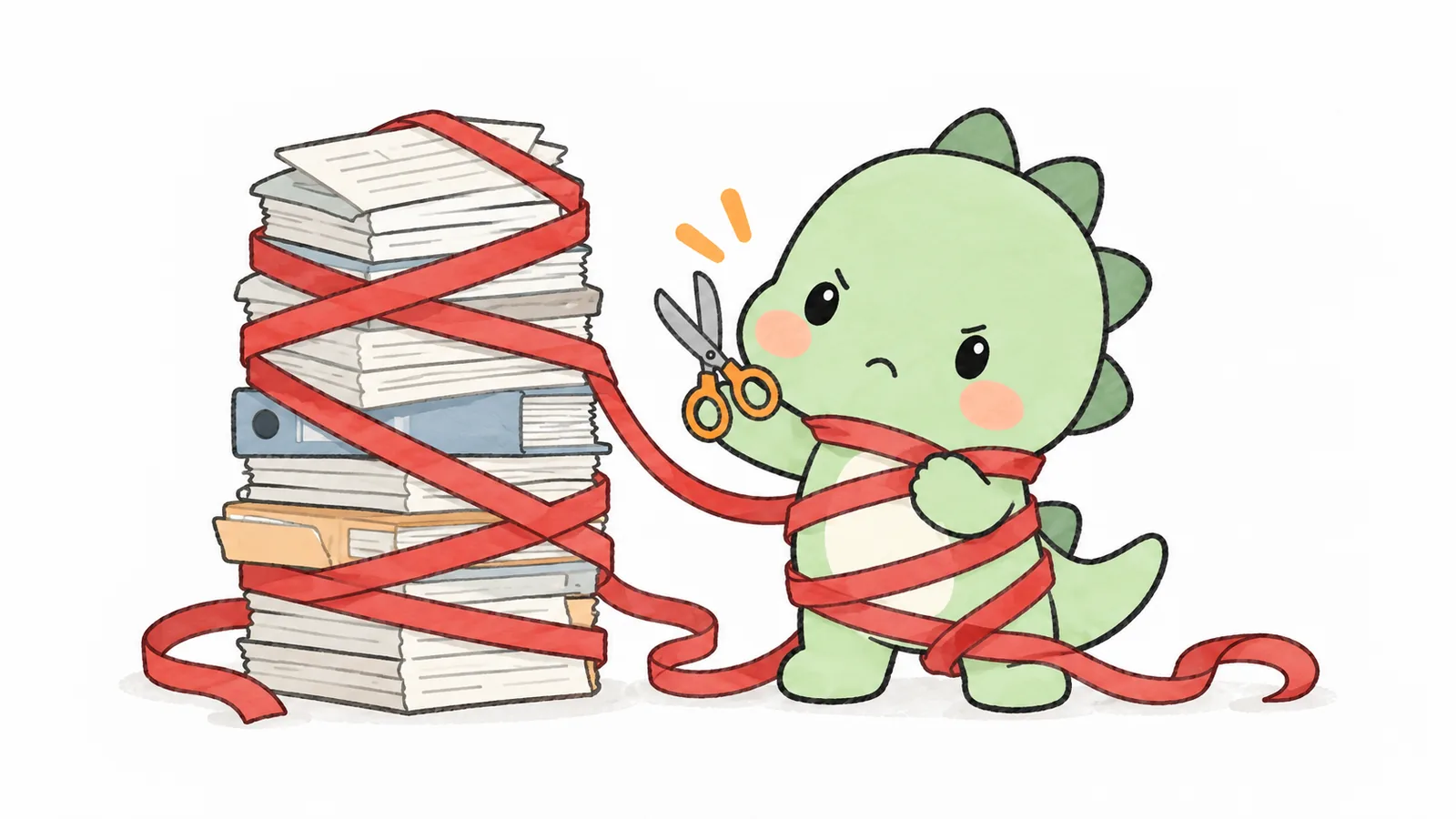
A common business collocation is cut through (the) red tape — get past the paperwork.
The gray zone: gray area, black market, white elephant
| Expression | Meaning | Note |
|---|---|---|
| gray area / grey area | something unclear, between right and wrong | the same image exists in many languages |
| black market | illegal trade | the same image exists in many languages |
| white elephant | an expensive possession that costs more than it's worth and is hard to get rid of | the easiest to misread |
Gray area and black market translate directly into many languages, so they are easy to remember. The only thing to watch is spelling: grey is British, gray American (see British vs. American spelling).
White elephant is the one to watch. It is not a pale animal; it is something costly to own and maintain and of little use: a stadium nobody fills, an airport without flights, a software system the company paid a fortune for and never uses. The earliest figurative use the Phrase Finder has found in English is in an 1851 letter by the English writer Geraldine Jewsbury (published in a collection of her letters in 1892).
Behind the phrase are the white elephants of Southeast Asia. In Thailand and Myanmar, a white elephant has long been regarded as sacred and auspicious, a sign of a ruler's justice and the kingdom's good fortune; Thailand still has an Order of the White Elephant. English books often tell a story: a king of Siam who wanted to ruin a courtier would give him a white elephant, which, being sacred, could not be put to work but had to be kept in style until it ate its owner into poverty. The story is widely repeated, but we could find no record naming which king gave one to whom, so treat it as a legend. The English sense, "a costly burden", comes from that outsider's picture of an animal too sacred to use and too costly to keep; it is not what a white elephant means in Thailand.
Will the TOEIC test these?
Honestly: not often.
We checked the official TOEIC Listening and Reading sample test from ETS. It contains no color idioms at all. The only colors appear in questions 196–200, where a customer orders paint: the options are paint names like Caspian Blue and Misty Gray, and the e-mail says some samples looked too green on the walls — real colors, every one.
We also searched all the reader-visible English in our own question bank (passages, questions, options and listening transcripts, each distinct text counted once — about 62,000 pieces of text):
- green room appears in 2 sets: the Part 4 awards briefing from the report above, and a Part 7 article about a recording studio (a green room for guests);
- red tape, blue-chip, in the red, pink slip, white elephant, red-eye, and white paper in the policy-report sense: 0 each;
- instead there are a few phrases that look like idioms but are plain colors: a microphone where A green light means good, a red flag on a quay office that means no sailings, and Drill bits are kept in the red case. — the drill bits are in a red box, and nobody is losing money.
So the value of this post is not points on the test. The TOEIC is more likely to catch you with everyday words that change meaning at the office, like sheets and outstanding (we collected those in Office words that change meaning). Color idioms are the next layer: they show up in English business news, annual reports, and e-mails from colleagues abroad.
Other languages do this too
English is not unusual here. Plenty of languages use colors for things that aren't colors, and sometimes they share an image with English:
- Chinese 開綠燈 and English greenlight are the same traffic light;
- Japanese 赤字 and English in the red are the same red ink;
- Korean, on the other hand, usually calls the green traffic light 파란불, a "blue light", and its figurative "good sign", 청신호, is literally a "blue signal";
- and in Taiwan, mainland China and Korea, red on a stock screen means the price went up — the reverse of in the red.
Shared images make some of these idioms free. The ones that aren't shared are the ones to learn.
A word of warning: many color origins were filled in later
- "First known use" keeps moving earlier. As more old newspapers are digitized, dates get pushed back; the Wall Street sense of blue-chip, long credited to a remark in the 1920s, has turned up in an 1892 newspaper. Every date here means "earliest found so far."
- Many "why this color" questions have no answer. Why red ink for losses, why green for the green room, why pink for the pink slip — none is settled.
- A good story is not a source. The king of Siam's white elephants and Gingold coining blue-chip both belong here.
- Some terms are regional. The pink slip is mainly American; grey and gray are British and American spellings; a white paper means something different in government and in business.
- Context can turn an idiom back into a color. A green light on a microphone is just a green light, and in the red case is just a red case. Check whether it's an idiom before applying the idiom's meaning.
Conclusion: colors as leftovers
Many of these color words have outlived the object they named. Ledgers are mostly no longer kept by hand, most documents are no longer tied with red ribbon, stocks are not poker chips, and office workers don't all wear white shirts. The objects moved on; the colors stayed in the words, like a layer of soil at a dig.
So the next time a color turns up in English, don't picture the color first. In the green room, there's no need to look for green walls.
Handy 990's Phrase Practice includes red tape, get the green light, golden handshake and red herring: each question puts the phrase back into a sentence and asks you to pick the right one. If a question or translation looks wrong, tap "Report a problem" — that is how the report at the top of this post reached us. In the same series, Office words that change meaning covers everyday words like sheets and outstanding that mean something else at work, and British vs. American spelling explains why grey and gray are both right.