
All articles · Published 2026-10-18
Oversee vs. overlook: English words that are their own opposites, and why oversight means both supervision and a mistake
"The committee has oversight of the budget" means the committee watches the money; "The missing invoice was an oversight" means nobody noticed it was missing. Same word, opposite jobs: one sentence has someone watching, the other has nobody seeing. Words like this are called contronyms. This post starts with oversee and overlook — four hundred years ago oversee could mean "pretend not to see" and overlook could mean "supervise" — then looks at how cleave, fast, sanction, dust and left grew opposite meanings, and ends with how to tell them apart on the TOEIC.
One oversight with someone watching, one with nobody seeing
Two sentences:
- The audit committee has oversight of all spending.
- The missing signature was an oversight.
Both use the same word. The Cambridge Dictionary lists both meanings: "a mistake made because of a failure to notice something", and "responsibility for a job or activity and for making sure it is being done correctly". In the first sentence somebody is checking. In the second, the somebody who was checking didn't see.
This is not an obscure word game. Both meanings turn up in the same kinds of places: audit reports, regulatory filings, customer-service apologies. Regulatory oversight is supervision by a regulator; due to an oversight on our part means "because we made a mistake". If you read business English, you are likely to meet both.
Its two relatives make things worse. Oversee and overlook both break down into "over" plus a verb of looking, and on paper they are nearly the same word. Today they are far apart: oversee means supervise, while overlook usually means fail to notice — or, when a building does it, have a view of something below.
So why does one of these near-twins do the watching and the other do the missing?
Oversee and overlook: four hundred years ago, the meanings weren't sorted yet
Because they didn't always divide the work this neatly.
Oversee goes back to Old English ofersēon, which Wiktionary glosses as both "to observe, oversee" and "to overlook, neglect". Both meanings were there in Old English already.
In 1590 the poet Edmund Spenser published the first three books of The Faerie Queene, and the one poem uses oversee both ways. In Book I, Canto IX, the young Arthur recalls how Merlin came to visit him, with the task "Tutours nouriture to ouersee" — to supervise how his tutor was bringing him up. In Book II, Canto IX, the fairy knight blushes in private, and she sees it, "Dissembled faire, and faynd to ouersee" — she pretended not to notice. Same poet, same poem, same word: once to watch closely, once to look away on purpose.
Overlook was the same. In the first scene of Shakespeare's All's Well That Ends Well, the Countess introduces Helena, the only child of a famous physician, left by her father "bequeathed to my overlooking" — placed in my care. That overlooking is not missing anything. It means supervision, looking after.
Over time the two words divided the work. Wiktionary now labels overlook's "to supervise" sense archaic and oversee's "to fail to see" sense obsolete. In the Cambridge Dictionary's modern definitions, oversee is "to watch or organize a job or an activity to make certain that it is being done correctly"; overlook is "to provide a view of, especially from above", "to fail to notice", and "to forgive or pretend not to notice".
| Word | Today | Once also meant, no longer used |
|---|---|---|
| oversee | supervise | fail to see, pretend not to see (as in Spenser) |
| overlook | fail to notice; have a view of; let something pass | supervise, look after (as in Shakespeare) |
| oversight | supervision, and also a mistake | — both meanings still in use |
How can over point both ways? Because over itself has two directions: "above" and "past". Looking down from above is supervising; letting your eyes pass over something is missing it. Wiktionary's definition of overlook says exactly that: "to look over and beyond (anything) without seeing it".
Oversee and overlook each kept one direction. The noun oversight, from the same family, kept both.
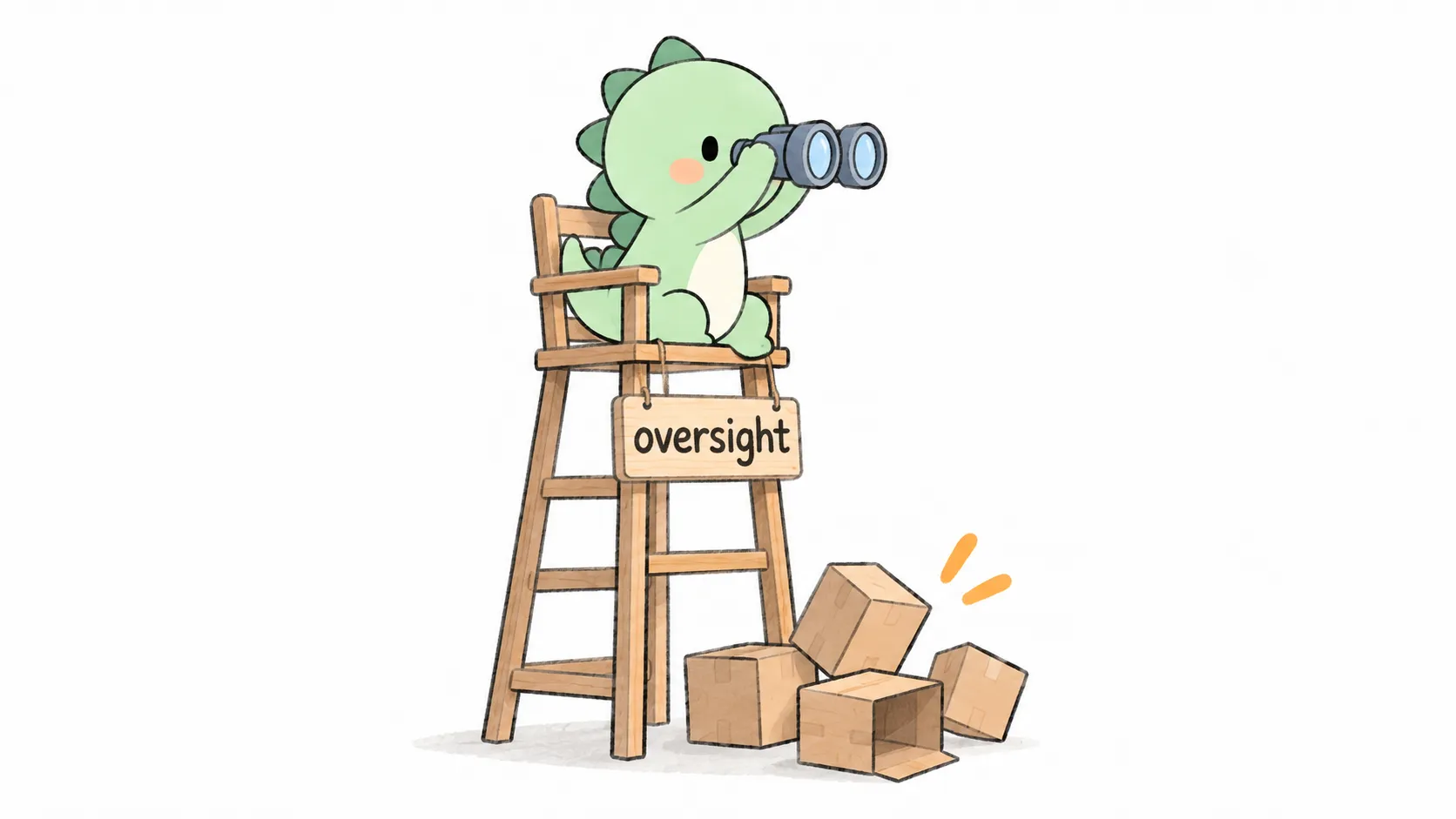
Grammar gives you a small clue. Cambridge marks the "mistake" sense as a countable noun (an oversight) and the "supervision" sense as uncountable. An oversight or it was an oversight almost always means something went wrong; oversight of or regulatory oversight means somebody is in charge.
Do words like this have a name? Contronyms
Yes — several.
The most common is contronym. According to the research collected on the Word Histories website, the word was proposed by Jack Herring of Arizona State University in the February 1962 issue of Word Study, a magazine published by Merriam-Webster; the Chattanooga Daily Times reported his suggestion on 8 February 1962. His examples were fast, scan and cleave. The word is built from contra- ("against") and the -onym of synonym and antonym.
Two years earlier, Joseph T. Shipley had used another name in Playing With Words (1960): autantonym, "a word that is its own opposite". Other names include auto-antonym, antagonym and Janus word, after Janus, the Roman god with two faces, one looking forward and one looking back.
Many names, one idea: a word with two faces.
How does a word end up meaning its own opposite? Three roads
These words didn't arrive by one route. Roughly, they took one of three roads.
Road one: two different words collide in one spelling
Cleave is the classic. It means both "to split" and "to cling". These were originally two different Old English verbs: the splitting one comes from clēofan, the clinging one from the clifian group. Over the centuries they ended up spelled the same. A butcher's chopper is a cleaver; and in the King James Bible, Genesis 2:24, a man shall leave his father and mother and "cleave unto his wife".
Let is another. Today let means "allow", but English once had a second verb let, from a different source, meaning "hinder". That "hinder" let has all but vanished from everyday English, but it survives on the tennis court: a serve that clips the net and still lands in is a let — the net got in the way, so the serve is replayed.
Road two: one meaning wanders off and splits in two
Fast first meant "firm, secure". You can still hear it in hold fast, stuck fast and in fasten. According to Wiktionary, the "quick" meaning apparently appeared first in the adverb: doing something firmly and vigorously slid into doing it quickly — compare run hard. So fast now means both "not moving at all" and "moving at speed".
Sanction comes from Latin sānctiō, "decree". Today it means both "approval" (the plan has the sanction of the board) and "penalty" (economic sanctions). One handy way to hold onto it: a law does two things at once — it says what is allowed, and what happens if you don't comply. Wiktionary's third sense of sanction is exactly that: "a law, treaty, or contract, or a clause within a law, treaty, or contract, specifying any of the above".
Weather as a verb means both "come through" (weather the recession) and "be worn down by the elements" (weathered wood). Both start from "be exposed to the weather": either the weather wears you down, or you outlast the weather.
Left means both "remaining" (two seats left) and "gone" (she left the office). Old English lǣfan goes back to a Germanic verb meaning "to let stay". The seats that are left are the ones made to stay; and when a person leaves a place, you can think of the place as what gets left behind — the person goes, the place stays.
Screen was first a partition, something that blocks things from view. Later the surface that films are projected onto was also a screen. So screen a film means show it, and screen the bed from view means hide it; and since a sieve is a screen too, screen applicants means filter them.
Oversight belongs on this road as well: looking from above split into supervising on one branch and missing on the other.
Road three: a noun turned verb can mean "add it" or "take it away"
English happily turns nouns into verbs, and it doesn't tell you which direction to go.
Dust: dust the shelves means wipe the dust off; dust the cake with icing sugar means put a layer of powder on. The 1963 children's book Amelia Bedelia built a joke on this: the literal-minded housekeeper is told to dust the furniture, so she sprinkles dusting powder all over it.
Seed: seed the lawn means sow seeds on it; Wash, seed, and cut the pepper into small pieces (an example sentence in the Cambridge Dictionary) means take the seeds out.

And a few small words
Even the shortest words do it. The alarm went off at six means the alarm started; The lights went off means they stopped. The stars are out means you can see them; The lights are out means they aren't shining. The Cambridge Dictionary lists both pairs of meanings.
Here they are in one table:
| Word | Meaning one | Meaning two | Which road |
|---|---|---|---|
| oversight | supervision | a mistake | one meaning split |
| sanction | approval | penalty | one meaning split |
| cleave | split | cling | two words collided |
| let | allow | hinder (a let in tennis) | two words collided |
| fast | firmly fixed | quick | one meaning split |
| weather | come through | wear down | one meaning split |
| left | remaining | gone | one meaning split |
| screen | show | hide; filter | one meaning split |
| dust | remove dust | sprinkle with powder | add or take away |
| seed | sow seeds | remove seeds | add or take away |
How do these words show up on the TOEIC?
First, an honest report: in ETS's published TOEIC Listening and Reading sample test, we found no oversee, overlook, oversight or sanction. A few words from the table do appear, in their plainest meanings. Option (B) of Part 1, question 2 is A woman is dusting a television screen. — wiping dust off a TV (the answer to that one is (D)). Two words that have another face elsewhere, in one short sentence, both on their best behaviour.
Our own question bank is livelier. We scanned all the text readers actually see in Parts 1 to 7 — passages, scripts, question stems and options:
- Dust shows up both ways: Part 1 has A shelf is being dusted with a cloth., and a Part 4 advertisement for a chocolate workshop mentions cocoa-dusted hands.
- Screen shows up three ways: a private screening is a film showing; airport security screening and health screening are checks; and an orchestra's audition notice says the first two rounds are played behind a screen (also screened), with only the final round unscreened — the panel finally gets to see who is playing.
- Overlook appears 6 times in passages, scripts and question stems: 3 times as "have a view of" (Their rooms overlook the courtyard, a rooftop terrace overlooking the harbor, a museum café that overlooks the main hall) and 3 times as "fail to notice" (a tiny, overlooked detail, overlooked local issues, and a cost frequently overlooked at the point of purchase). Not once does it mean supervise.
- Oversee means supervise every time.
- Oversight appears 4 times in passages and options, all meaning supervision (financial oversight, daily oversight, site oversight). The "mistake" meaning shows up exactly once — as a wrong answer.
That question is worth a look. It is a garden shop's apology letter: a cold snap has halted all deliveries, and the customer's ferns will arrive about five days late. The letter says:
To make up for the [3], we have included a digital care guide and a coupon...
The options are confusion, inconvenience, expense and oversight; the answer is inconvenience. Why not oversight? Because oversight would mean "our mistake", and the delay was caused by the weather — the shop didn't miss anything. Choosing it would make the shop apologise for an error it never made.
How do you tell which meaning it is? Look at the company it keeps
There is no trick to contronyms, only one rule: the context decides. For the ones you are likely to meet on the TOEIC, though, the clues are clear.
- Oversee: in today's business English it means supervise. It takes a job, a team, a budget or a building project: oversee the project, oversee construction.
- Overlook: check the subject first. If the subject is a room, a terrace, a hotel or a café and the object is a place, it means have a view of. If the object is a detail, an error, a cost or a problem, it means fail to notice. We'll overlook it this time means "we'll let it go". In modern business English it almost never means supervise.
- Oversight: with an, due to an, or it was an ... on our part, it is a mistake. Followed by of, after regulatory or financial, or inside under the ... of, it is supervision.
- Sanction: impose sanctions on, economic sanctions, and the plural in general usually mean penalty. Official sanction or sanctioned by the committee usually means approval. The verb, though, can go either way, so in a sentence like the league sanctioned the club only the surrounding text tells you whether the club was approved or punished.
- Weather: weather the storm, weather the downturn — come through it. Weathered and weathering applied to wood, stone or paint — worn by the elements.
As for table, which means opposite things in Britain ("bring up for discussion") and America ("set aside"), our posts on office words that change meaning and British vs. American vocabulary have already covered it — including the time it set British and American staff officers against each other.
Your language probably does this too
Most languages have a few words like this, and the way to read them is always the same: you let the situation choose. One common family is verbs whose direction isn't built into the word. English rent is one: I rent a flat (I pay for it) and we rent rooms to students (they pay us) use the same verb, and only the rest of the sentence tells you who is paying. Many other languages split "lend" and "borrow" or "rent" and "rent out" into separate words, or mark the direction with a small helper word.
Some languages go further and make a whole phrase depend on the speaker's wishes. In Chinese, the linguist Zhu Dexi showed in 1959 that adding "not" to "almost" sometimes changes nothing and sometimes flips the meaning, depending on whether the speaker wanted the event to happen.
Identical words, meaning chosen by context — the same thing oversight does.
As usual, "opposite" isn't all that precise either
A few things should be said plainly:
- Many contronyms are only roughly opposite. Dusting off and dusting on both involve powder; "remaining" and "gone" are not strict antonyms either. Contronym lists online vary wildly in length because people draw the line for "opposite" in different places.
- The old meanings won't be on your test. Spenser's and Shakespeare's usage is history, not exam material. Reading overlook as "supervise" on the TOEIC will only get you a wrong answer.
- Cleave meaning "cling" is now rare, mostly found in the Bible and in literary writing. A cleave in business English is almost certainly not that one.
- Some of these origin stories come with an "apparently". Wiktionary says fast "apparently" moved from "firm" to "quick" via the adverb; "a law both permits and punishes" is a memory aid for sanction, not a precise etymology; and "the place is what gets left behind" is just one way to picture left.
- Our bank's counts only describe our bank. None of the four words appears in the official sample test, so we can't say the TOEIC "often" tests them; what we can say is that they are real words of real business documents.
- The name contronym dates from 1962; the thing itself is much older. Herring only gave it a memorable label.
Conclusion: the person in charge of oversight fears an oversight most
If you remember one line from this post, make it this one:
The person in charge of oversight is the one who gets blamed for the oversight.
The person whose job is supervision is often the one who takes the blame for the mistake. It's not just a tongue-twister; it is the two faces of oversight in one sentence. Looking down from above, you might see everything clearly — or you might look straight past the one thing that matters.
Spenser put both faces into a single poem in 1590. More than four hundred years later, they still share a single audit report.
Handy 990's Vocabulary Practice includes both oversee and overlook. Long-press any word in a question to look it up; the dictionary lists every sense together, not just the first. In the same series, office words that change meaning covers outstanding, charge and the other words that change meaning at work, and British vs. American vocabulary covers table, the word that means opposite things on each side of the Atlantic.