
All articles · Published 2026-09-24
Bored or boring? How to choose between -ed and -ing adjectives: one question that settles it every time
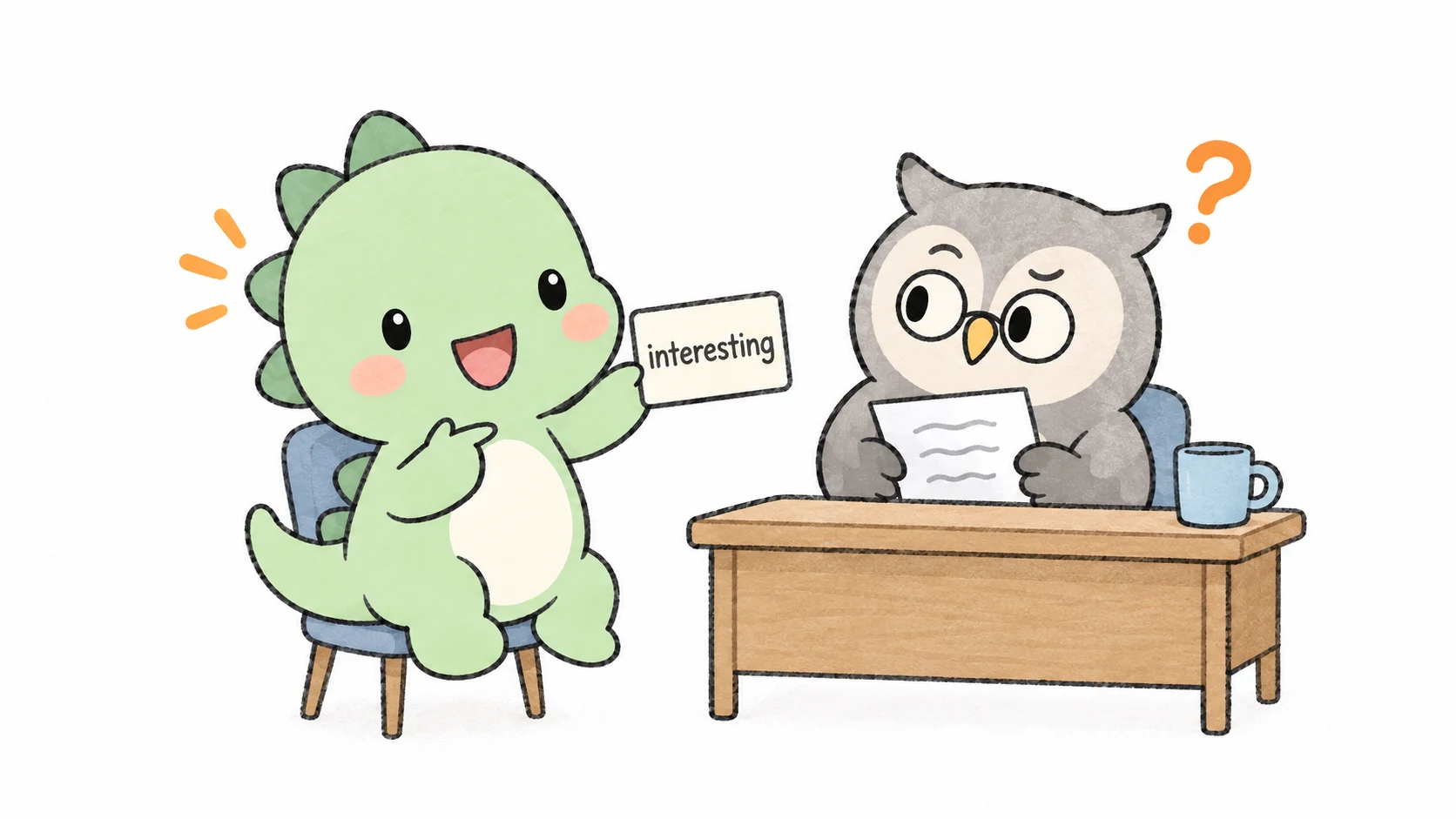
Tell an interviewer "I'm very interesting in this position" and what they hear is "I am a fascinating person." The -ed/-ing adjective pair (bored/boring, interested/interesting, exhausted/exhausting) trips up learners everywhere, because many languages use one word for both sides of a feeling. This piece teaches a single test — who is doing the feeling? — works through question 131 of the official TOEIC sample test, and ends with a table of common pairs, the prepositions that follow them, and the exceptions that refuse to cooperate (including "experienced," from the very same test e-mail).
Getting the first sentence of the interview wrong
Picture an English-language job interview. You have prepared for weeks. You sit down and say, warmly:
I'm very interesting in this position.
You meant "I'm very keen on this job." The interviewer heard "I am a very interesting person in this position" — an unprompted pitch for your own charm. A polite interviewer lets it pass. A playful one says, "Are you? Tell me more."
The same slip in a different room is worse. Someone at a party asks how your weekend was, and you sigh, I was so boring. You meant "I was bored out of my mind." What they heard was "I am a tedious person." The sentence is perfectly grammatical. You have simply volunteered a confession nobody asked for.
The words you wanted were interested and bored. One suffix, and the meaning flips.
Why is this so easy to get wrong?
Because plenty of languages never make you choose.
In Chinese, 無聊 covers both "I'm bored" and "he's boring"; the listener sorts it out from context. Japanese 退屈 works the same way: 私は退屈だ is "I'm bored," 退屈な会議 is "a boring meeting." Korean 지루하다 and Vietnamese chán do double duty too. The word describes the feeling, and whether you are the one feeling it or the one causing it is left for context to settle.
English does not allow that. Whenever an adjective describes an emotion, English makes you decide first: is this person (or thing) the one who feels it, or the one who causes it? Decide that, and the suffix decides itself.
One question settles it: who is doing the feeling?
- -ing goes on whatever causes the feeling. It makes other people feel that way.
- -ed goes on whoever has the feeling. The feeling is in them (usually a person).
| Verb | -ing (causes the feeling) | -ed (has the feeling) |
|---|---|---|
| bore | boring | bored |
| interest | interesting | interested |
| tire | tiring | tired |
| exhaust | exhausting | exhausted |
| frighten | frightening | frightened |
| annoy | annoying | annoyed |
| surprise | surprising | surprised |
| excite | exciting | excited |
| confuse | confusing | confused |
| disappoint | disappointing | disappointed |
| embarrass | embarrassing | embarrassed |
| satisfy | satisfying | satisfied |
| overwhelm | overwhelming | overwhelmed |
Some languages do mark the "causes it" side, just in a different place. Chinese adds 令人, "makes people": 令人失望 is disappointing, and the everyday 累人, "tires people," is tiring. Thai puts น่า in front: เบื่อ is bored, น่าเบื่อ is boring. If your language has a marker like that, it lines up with English -ing.
When you are unsure, rephrase the sentence as "makes people " or "feels ":
- The meeting was ___. The meeting makes people bored → boring.
- Everyone at the meeting was ___. Everyone feels bored → bored.
Why does English split them? Because the verb points the other way
In many languages, the person with the feeling stands at the front of the sentence: I have an interest in this book.
The English verb interest runs the other way: The book interests me. The book is the subject; the person feeling it is the object. Bore, tire, exhaust, frighten, surprise and confuse all work like this — each one means "make somebody feel something":
- The meeting bored me.
- The trip exhausted everyone.
Once you see which way the verb points, the two adjectives stop needing to be memorized. The -ing form is active: the meeting is boring — it is doing the boring. The -ed form is passive: I was bored (by the meeting) — I am the one it was done to.
Linguists call these psych verbs. In a classic paper, Belletti and Rizzi (1988, Natural Language & Linguistic Theory) sorted them by where the person with the feeling ends up in the sentence. Two of their classes matter here: verbs where the person feeling is the subject, like fear (I fear dogs), and verbs where the person feeling is the object, like frighten and worry (Dogs frighten me). Run down the table above and you will notice that almost every verb with an -ed/-ing pair belongs to the second group.
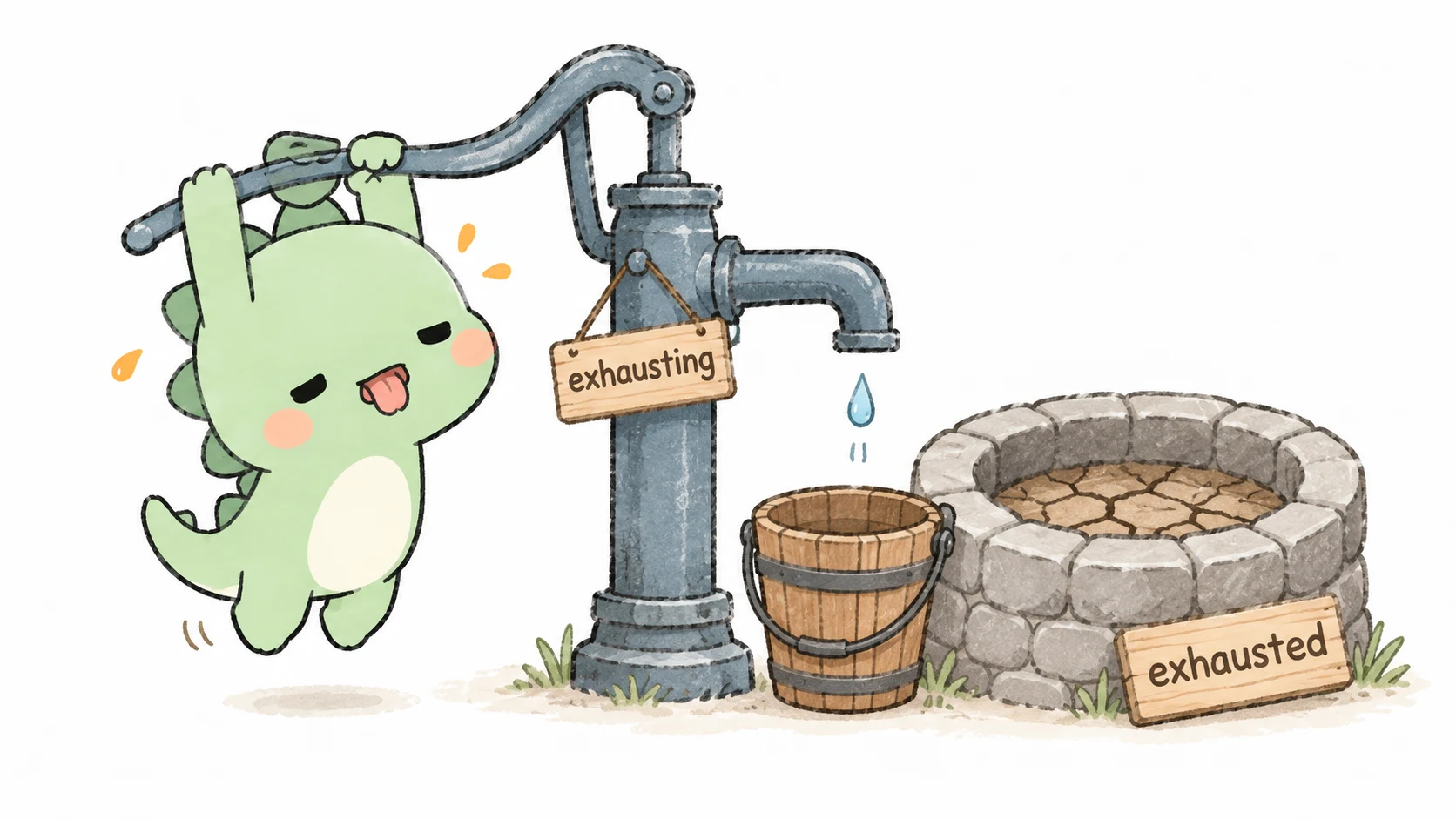
While we are here, exhaust comes with a picture worth keeping. It is from Latin exhaurire, built on haurire, "to draw up (water)." According to the Online Etymology Dictionary, when exhaust entered English in the 1530s it meant "to draw off, use up completely"; the sense "to tire out" arrived in the 1630s. So exhausted is a well that has been pumped dry, and exhausting is the pump. A car's exhaust pipe (recorded by 1849) is named for the same idea: it draws off the spent steam and gas.
How does the TOEIC test it? Question 131 of the official sample test
In the official TOEIC Listening and Reading sample test published by ETS, the first Part 6 passage is an e-mail to a company's project leads. Its first sentence has a blank:
In the coming weeks, we will be organizing several training sessions for ------- employees.
(A) interest (B) interests (C) interested (D) interesting
This is the classic TOEIC word-form question: four options built on one root, differing only in the ending. It takes two steps:
- Look at the position. The blank sits between for and the noun employees, so it needs an adjective to describe that noun. (A) and (B) are out.
- Ask: who is doing the feeling? The employees are the ones interested in the training; the feeling is theirs → interested.
The official answer is (C). Choose (D) and the sentence announces training sessions "for several fascinating employees" — as if the company were running a special course for its funniest staff.
The TOEIC loves exactly this kind of item, where two adjectives both look like they fit. Ask who is doing the feeling, and interesting never gets a chance to lure you away.
Which prepositions follow -ed adjectives?
Part 5 has a second way to test these words: the blank is not the adjective but the preposition after it. The common combinations:
| -ed adjective | Usual preposition | Example |
|---|---|---|
| interested | in | She is interested in the position. |
| satisfied | with | Clients were satisfied with the results. |
| disappointed | with / in / by | We were disappointed with the delay. |
| excited | about | The team is excited about the launch. |
| concerned | about | Residents are concerned about the noise. |
| surprised | at / by | He was surprised at the price. |
| bored | with | Staff were bored with the routine. |
| impressed | with / by | The judges were impressed by her design. |
Try it: four Part 5 questions from the question bank
These four are real Part 5 items from the Handy 990 question bank, trimmed to two options each:
- Customers were ___ by the long wait times at the call center during the holiday season. (frustrating / frustrated)
- The seasonal sale attracted a ___ number of first-time shoppers to the flagship store. (surprised / surprising)
- Reporters found the executive's explanation ___ and asked no further questions. (convinced / convincing)
- The ___ guests praised the staff for handling their complaints so professionally. (satisfying / satisfied)
Answers:
- frustrated. The customers are the ones who got frustrated waiting. The by is a clue as well: the long waits did it to them.
- surprising. A number cannot be surprised. It surprises people. A surprising number of is a very common TOEIC combination.
- convincing. This is the one people miss. After find, the pattern "object + adjective" describes the object: the explanation convinced the reporters. Write convinced and you are saying the explanation itself was persuaded of something.
- satisfied. The guests are the ones who are satisfied. Satisfying guests would describe the guests the way you might describe a good meal.
Not just feelings: -ing does it, -ed has it done to it
"Who is doing the feeling?" is a special case of a bigger rule: an -ing adjective means the noun is doing the action; an -ed adjective means the action has been done to the noun. Business documents on the TOEIC are full of these:
| -ing (the noun does it) | -ed (it is done to the noun) |
|---|---|
| existing customers (the customers exist) | the attached file (the file has been attached) |
| remaining seats (the seats remain) | a revised schedule (the schedule has been revised) |
| rising costs (the costs are rising) | a scheduled meeting (the meeting has been scheduled) |
| a leading supplier (the supplier leads) | a detailed report (the report has been detailed) |
| the following items (the items follow) | limited seating (the seating has been limited) |
The official sample test is full of them too. Question 103 has continuing education right in the sentence (education that continues). And the answer to question 101 is complicated: "many modern mobile devices are often unnecessarily ------- ." A phone does not feel complicated. It has been made complicated, so it takes -ed.
This is English, so the rule has rebels
Some -ed adjectives aren't passive. Go back to the e-mail from question 131: a few lines later it mentions less experienced staff and experienced project leaders. Experienced doesn't mean "having been experienced." It means "having experienced a lot" — even though experience normally takes an object. Retired employees, fallen leaves, grown children and a developed country (compare a developing country) aren't passive either, for a different reason: here the verbs are used without an object (the employees retired, the leaves fell, the children grew, the country developed), so the -ed form means "has already done it," not "has had it done to it."
-ing is perfectly fine for people. An interesting speaker and a boring colleague are normal English. I'm boring isn't a grammar mistake either. It is just an introduction you probably didn't mean to give.
Some -ing forms have been pushed aside by other words. Something that frightens you is usually scary; scaring is rarely used as an adjective. Something that delights you is delightful or pleasant; delighting is almost never seen. The -ed half (scared, delighted, pleased) carries on as normal; the other half has been taken over by a word ending in -y, -ful or -ant.
Tired isn't always about being tired. A tired argument is a stale, worn-out one. Nobody in that phrase is sleepy.
And boring isn't always dull. The oldest meaning of bore is "to drill a hole," which is why a tunnel boring machine is a tunnel-drilling machine, not a very dull one. Whether the "tedious" sense grew out of drilling (on and on and on, until you can't stand it) is unsettled: the Online Etymology Dictionary notes that the OED has doubts, and that early evidence points instead to a French connection.
Conclusion: the two tribes
The "tedious" sense is surprisingly young. According to the Online Etymology Dictionary, bore meaning "be tiresome or dull" is first recorded in 1768 and was still a vogue word around 1780; bored is first recorded in 1823, boring in the sense of "dull" in 1840, and boredom not until 1845.
The 1823 citation the Online Etymology Dictionary gives for bored is Lord Byron, Don Juan, Canto XIII, stanza 95:
Society is now one polished horde,
Formed of two mighty tribes, the Bores and Bored.
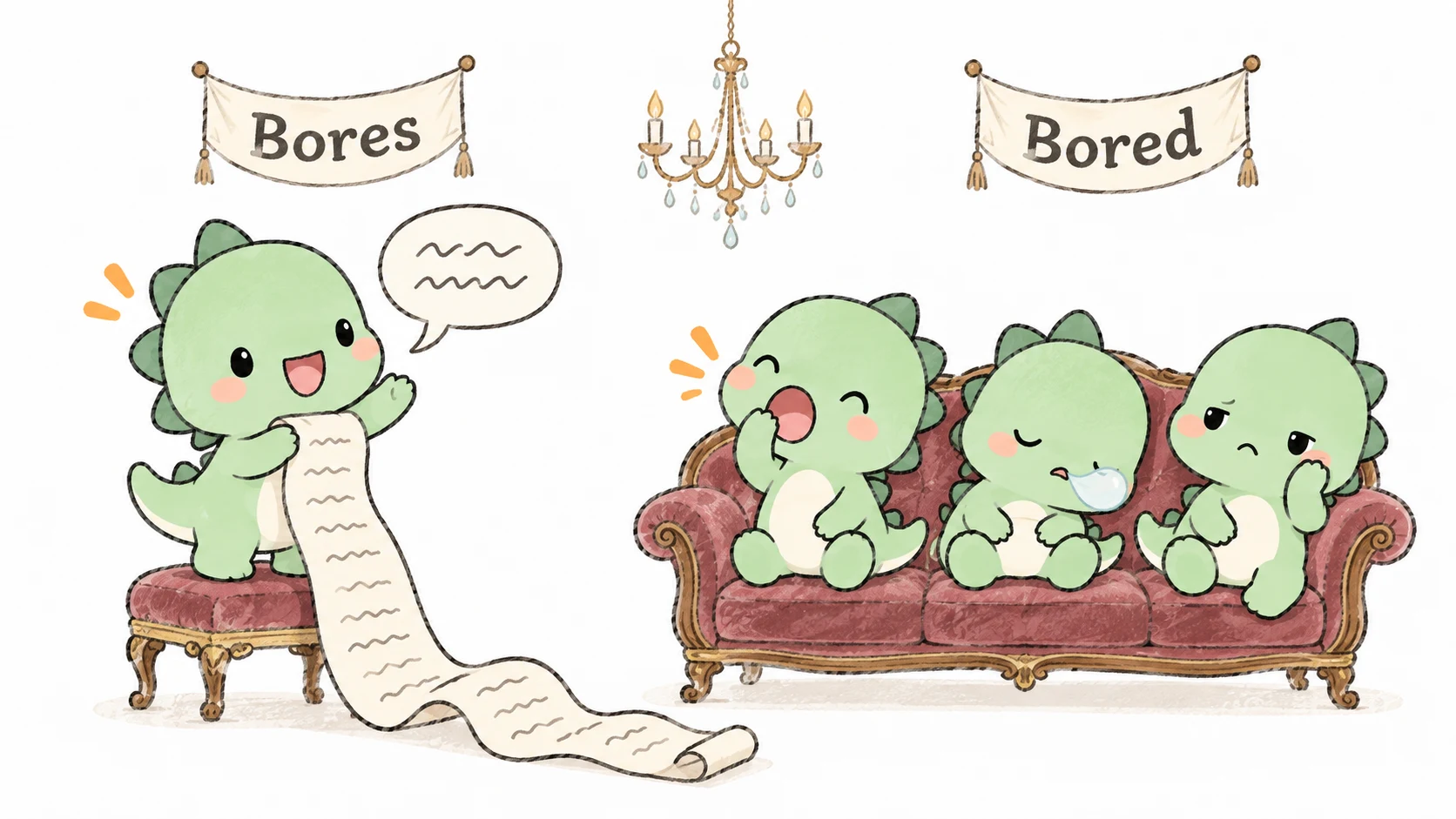
Two hundred years later, both tribes are still going strong. All this article can do is make sure that when you introduce yourself, you join the right one.
At your next interview, say:
I'm very interested in this position.
That gives the interviewer the chance to discover, on their own, that you are actually quite interesting.
Chapter 28 of the Grammar book in Handy 990, "The words that stick to things," covers the same pair as a feeling that one side sends and the other catches, with a section check at the end. The word-form questions in Part 5 practice bring the -ed/-ing pair up again and again. In the same series, Everyday English words that change meaning at the office covers another "I thought I knew that word" trap, and wind and wind covers two different words that happen to be spelled alike.