
All articles · Published 2026-10-14
Where do English irregular verbs come from? went didn't start out as the past tense of go
The past tense of go is went, and the two words look nothing alike — because went was originally the past tense of a different verb, wend, and go only took it over some five hundred years ago. This post is about where irregular verbs come from: sing, sang, sung follows a rule older than -ed; a 2007 paper in Nature calculated that the rarer a verb is, the faster it turns regular; and snuck is moving the other way. At the end: the past participles you meet most in TOEIC reading, and pairs like found and founded that are easy to misread.
Why is went the past tense of go?
When you learn the irregular verb table, go, went, gone is usually one of the first rows. It is also the least logical one: went doesn't even have a g in it.
You're right that it makes no sense, because went didn't start out as the past tense of go.
English has a verb you rarely see today: wend. In Old English it was wendan, and it meant "to turn"; later it also came to mean "to go, to make your way". Today it survives mostly in the phrase wend your way. Its past tense was went — the same pattern as send/sent, spend/spent and lend/lent.
And go had a past tense of its own. In Old English it was ēode, which became forms like yode and yede in Middle English. According to Wiktionary's etymology of go, this yode was replaced by went in the 15th century. From then on went belonged to go, and wend later switched to a regular past, wended.

When one word's inflected form is supplied by a different word, linguists call it suppletion — a term the German linguist Hermann Osthoff coined in 1899. English has a few more:
- be: be/been, am/is and was/were come from three different ancient roots, glued together into one verb.
- good, better, best: better doesn't share a root with good. The same goes for bad, worse, worst.
Notice where suppletion turns up: overwhelmingly in a language's most frequent words — go, be, good, bad. Why? Hold on to that question; we'll come back to it.
sing, sang, sung: irregular verbs follow a different rule
went is the extreme case. Most irregular verbs are not that wild. sing/sang/sung, drink/drank/drunk, drive/drove/driven — they don't change at random. The vowel is what changes.
That's no accident. English is a Germanic language, and Germanic verbs fall mainly into two big classes:
- Strong verbs show the past by changing the vowel in the middle of the word, as in sing/sang/sung. This vowel alternation is called ablaut, and it goes back beyond Germanic to Proto-Indo-European.
- Weak verbs add a dental consonant (d or t) at the end — today's -ed.
So "irregular verbs" are not verbs without a rule. They follow an older rule that later lost out. The strong verbs come in seven classes, each with its own vowel pattern; drive/drove/driven and ride/rode/ridden belong to the same class, which is why they look so alike.
"Irregular" and "strong" aren't quite the same thing, though. bring/brought, think/thought, keep/kept and send/sent are actually weak verbs: they do have the dental ending, d or t, but they also changed the vowel (keep/kept) or turned a final d into t (send/sent), so they end up in the irregular table today. went itself is one of these: it is the weak past of wend, which makes it a little more "regular" than sang.
Why are the most common verbs the most irregular?
In 2007, Erez Lieberman, Jean-Baptiste Michel, Joe Jackson, Tina Tang and Martin Nowak at Harvard published a paper in Nature (vol. 449), "Quantifying the evolutionary dynamics of language", that measured exactly this.
They took 177 irregular verbs from Old English (all still in use) and followed them forward: by Middle English 145 of them were still irregular, and today only 98 are. The rest went regular. help used to have the past holp and the past participle holpen (the King James Bible of 1611 still has thou, LORD, hast holpen me in Psalm 86:17); climb used to have clomb. Today they are helped and climbed.
They then measured each verb's frequency in a 17.9-million-word corpus (CELEX) and found a strikingly neat relationship: irregular verbs regularize at a rate inversely proportional to the square root of their frequency. Put another way, a verb that is used 100 times less often regularizes 10 times as fast.
The paper also estimated half-lives — how long it takes for half of a group of irregular verbs to go regular:
| Frequency (share of all verbs) | Examples | Half-life |
|---|---|---|
| 10⁻¹–1 | be, have | 38,800 years |
| 10⁻²–10⁻¹ | come, go, know, take | 14,400 years |
| 10⁻³–10⁻² | begin, drive, write | 5,400 years |
| 10⁻⁴–10⁻³ | arise, sing, swim | 2,000 years |
| 10⁻⁵–10⁻⁴ | bid, dive, tread | 700 years |
| 10⁻⁶–10⁻⁵ | bide, chide, slink | 300 years |
At 38,800 years, be and have are as good as permanent. That answers the question from earlier. The explanation linguists give is that rare irregular verbs are harder to learn and quicker to be forgotten. went is said and heard every day; a child has heard it countless times before starting school, so it can't be forgotten. A rarely heard old form only needs one generation that never quite learned it, and -ed moves in. As the paper points out at the start, fewer than 3% of modern English verbs are irregular, yet the ten most common verbs — be, have, do, go, say, can, will, see, take, get — are all irregular.
The paper ends with a prediction: the next verb to go regular is likely wed. It is the rarest of all modern irregular verbs, at only 4.2 uses per million verbs, and wedded is already replacing wed in many contexts. The authors couldn't resist a joke: now is your last chance to be newly wed; the married couples of the future can only hope for wedded bliss.
Retired forms sometimes survive inside adjectives. The wrought in wrought iron is the old past participle of work; molten is the old past participle of melt; and sodden is the old past participle of seethe, "to boil".
The other direction: snuck and dove
The overall trend is fewer irregular verbs, but a few words go the other way. Lieberman's paper admits as much in a playful line: for every sneak that snuck in, there are many more flews that flied out. The joke is flied: in American baseball, fly in the sense of "hit a fly ball" really is a regular verb, and its past tense is flied.
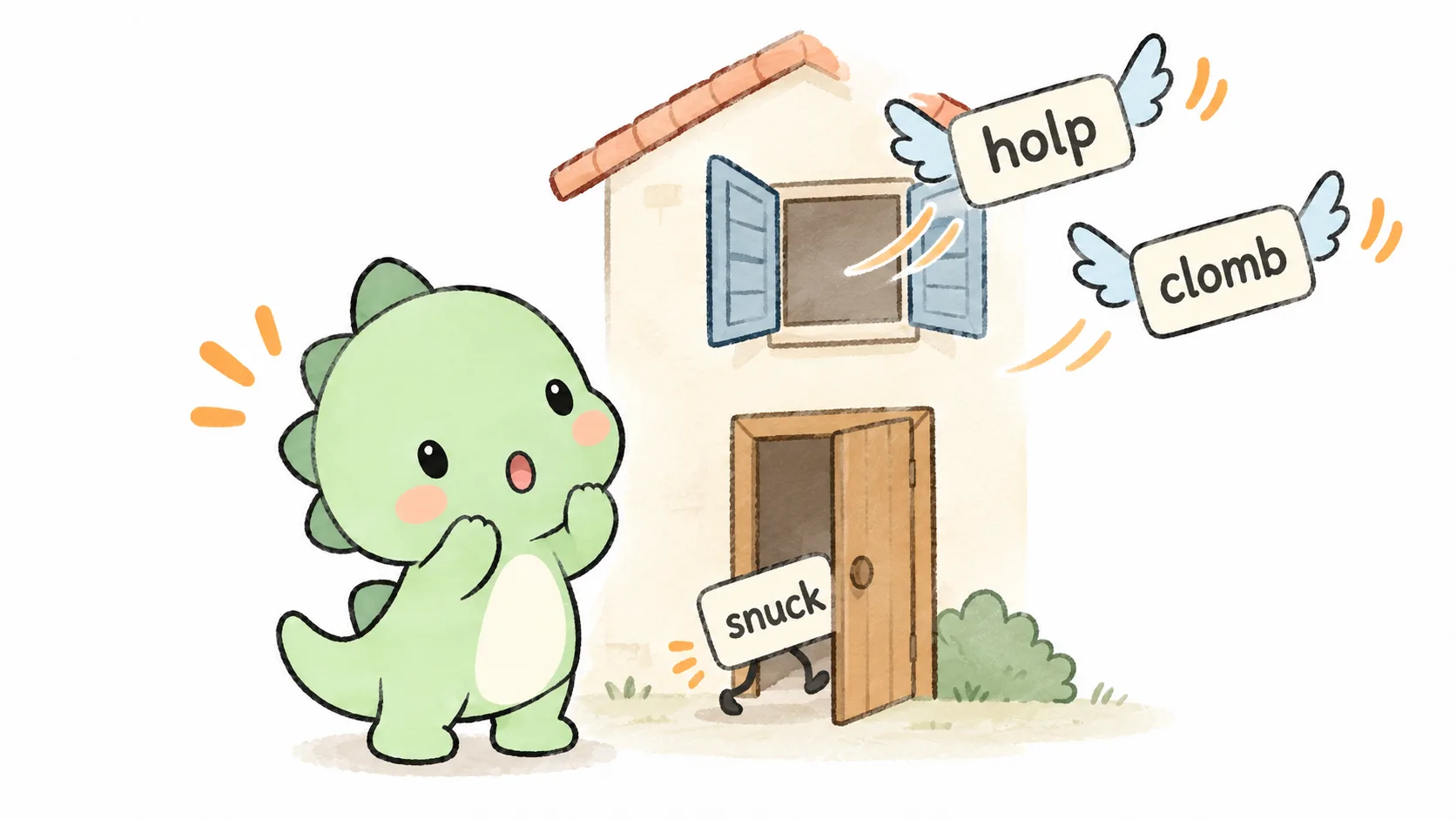
- sneak → snuck: in modern English, sneak started out regular, with the past sneaked. snuck came later; the evidence collected by the Grammarphobia blog puts its earliest known appearance in print in an 1887 New Orleans weekly. In the American English books of Google Books Ngram, snuck overtook sneaked around 2007, and by 2018 it was used nearly twice as often; in British English books, sneaked was still ahead in 2019.
- dive → dove: Wiktionary's usage note says dove is found chiefly in North America, alongside the regular and earlier dived; in British English the standard past tense is still dived.
One more pair is a US/UK difference rather than one form replacing another: learned and learnt are both correct. In Google Books Ngram for 2010 to 2019, learnt appears about 10.8 times per million words on average in British English books, but only about 2.6 times in American English books. ETS's sample test uses American spelling (color, center, organization), so learned is the consistent choice when you write; but don't mistake learnt for a typo.
Does the TOEIC test irregular verbs?
Let's be honest first. In ETS's published TOEIC Listening and Reading sample test, only one of the five Part 5 sample items has a verb form as its answer — item 101 — and that answer is complicated: a regular verb (item 103 is also a word-form item, but its answer is the adverb regularly). No item in the sample asks you directly how to spell went or gone.
But irregular past participles are everywhere, and you need them to understand the sentences. The sentence in item 105 is All clothing sold in Develyn's Boutique is made from natural materials — two past participles, sold and made, in one sentence.
The most instructive word in the sample is found. In item 78, option (C) is He has found what he was looking for: the past participle of find. In item 151, the correct answer (C) is It was founded 40 years ago: the past participle of a different, regular verb, found ("to establish"); option (A) in item 40, It was recently founded, is the same verb. found is both the past tense and past participle of find and the base form of another verb, and the same sample test uses both.
This kind of collision — an irregular form that happens to be another verb — is an easy place for TOEIC readers to misread:
| If you see | It may be a form of this verb | Or it may be another verb |
|---|---|---|
| found | past tense and past participle of find | the base form of found ("establish"); past tense founded |
| saw | past tense of see | the base form of saw ("cut with a saw"); past tense sawed |
| fell | past tense of fall | the base form of fell ("cut down"); past tense felled |
| lay | past tense of lie ("recline") | the base form of lay ("put down"); past tense laid |
| wound | past tense of wind ("coil", "wind up") | the base form of wound ("injure"); past tense wounded |
We also counted our own reading bank in Handy 990 (about 5,700 questions, counting only the text a reader sees: questions, options and passages). Among the verbs whose past participle differs from the past tense, apart from been (445 times), the most frequent are written (122 times), taken (98), given (90), done (75) and chosen (43). Meanwhile arisen, undergone, overseen and forgone, which often turn up on "must-know TOEIC verbs" lists, don't appear in our bank even once. This is our bank, not ETS's exam; but it's a reminder that before you memorise rare verbs, the common ones should come without thinking.
Some Part 5 items in the bank test exactly this:
- Since the program began, neighborhood recycling rates ___ steadily. The answer is have risen, not rose: "since + a starting point in the past" usually calls for the present perfect, and the past participle of rise is risen.
- Reservations ___ online or by phone up to thirty days in advance. The answer is can be made; one option is can made, waiting for you to put a past participle straight after a modal.
- The vendor sent a ___ apology after the shipment arrived two weeks late. The answer is written: a past participle used as an adjective.
A short list worth knowing cold — every one of these has a past participle that differs from its past tense:
| Base form | Past tense | Past participle | A TOEIC-style example |
|---|---|---|---|
| write | wrote | written | a written apology |
| take | took | taken | has taken effect |
| give | gave | given | was given a raise |
| choose | chose | chosen | has been chosen |
| show | showed | shown | as shown in the chart |
| rise | rose | risen | prices have risen |
| fall | fell | fallen | sales have fallen |
| begin | began | begun | construction has begun |
| withdraw | withdrew | withdrawn | the offer was withdrawn |
Your language may have nothing like this
Many languages, including English, change the verb itself to show the past. Some don't do it at all. In Chinese, Vietnamese and Thai, a verb doesn't change form for tense: past time is shown with a separate word, or simply by saying when.
If that's your language, irregular verbs are pure memorisation: there's nothing in your own grammar to lean on. Native English-speaking children memorise them too — but they hear went every day, far too often to forget it; a learner meets it much less often.
The good news is that Lieberman's law is on your side: the most common verbs are mostly the irregular ones. The verbs you have to memorise are the ones you meet most often, so each one you learn pays off again and again.
Don't hold a funeral for wed just yet
A few things to be clear about:
- Half-lives are estimates, not a timetable. Lieberman and colleagues had just three snapshots — Old English (around AD 800), Middle English (around 1200) and Modern English — and the dates themselves are approximate; they estimated Old English frequencies from modern ones; and the 38,800 and 14,400 years are extrapolations, because no verb that common changed at all within the period the data covers.
- The wed forecast is only a forecast. The paper says "likely".
- Ngram counts books, not speech. Written English is more conservative than spoken English; snuck may have won in speech earlier, or may not have — Ngram can't tell us. And 1887 is only the earliest appearance in print found so far, not the year people started saying it.
- "Strong" and "irregular" are not the same thing. As mentioned above, bring, think and keep are irregular weak verbs; and many Old English strong verbs are completely regular today.
- Our bank's counts describe our bank. They show which words are common in it; they can't tell you what ETS will test.
Conclusion: went is a borrowed coat
Next time you recite go, went, gone, picture this: some five hundred years ago, go lost its old past tense, borrowed a coat from wend next door, and never gave it back. wend had to make do with a plain, regular wended.
Irregular verbs aren't English being difficult on purpose. They are the remains of an older rule, and the ones that survive are mostly the most common words — the ones least likely to be forgotten.
So the next time you get went right, consider this: that borrowed word has been the past tense of go for more than five hundred years and has never been replaced by goed — because it's used far too often for anyone to get the chance to forget it.
Handy 990 doesn't have a dedicated irregular-verb drill yet; but in Vocabulary Flashcards, an irregular verb lists its forms under its verb sense — for example, withdraws · withdrew · withdrawn · withdrawing. In the same series, wind and wind explains why wound is both the past tense of wind and a word for an injury — and, as it happens, wend and wind ("to coil") share the same ancient root; bored or boring? covers past participles used as adjectives, including complicated in item 101 of the sample test.