
All articles · Published 2026-10-22
How to address someone in an English email: Dear Mr. Chen or Dear Wei-Ming — and which of your names is the "first name"?
Writing to a client in English, do you open with Dear Mr. Chen or Dear Wei-Ming? Why is "Mr. Wei-Ming" wrong, and what do you write when you don't know the person's name or can't tell whether they're a man or a woman? This post starts from one email in the official TOEIC sample test and works outward: first name and last name have nothing to do with which name comes first, in English business writing Mr./Ms./Dr. go with the family name, when you can switch to first names, how to choose between Best regards and Sincerely, and why some people write their family name in capitals, as in CHEN Wei-Ming — plus how names from East and Southeast Asia actually behave in English.
In the official sample test, why does Arun Phan become Mr. Phan?
The last set in ETS's official TOEIC Listening and Reading sample test (questions 196–200) has three texts: a paint company's advertisement, an online shopping cart and a customer's complaint email. The email is signed:
Thank you,
Arun Phan
Question 199 asks: Which color does Mr. Phan indicate that he likes? Question 200 asks: What problem does Mr. Phan mention in his e-mail?
The writer signs as Arun Phan; the questions call him Mr. Phan — they take the last word of the signature.
That isn't a one-off. We counted every "Mr./Ms. + name" in the whole sample test, graphics included: 22 of them, from Hello Mr. Lee at the start of a Part 4 phone message to Ms. Ohta on the programme in question 82. Wherever the test also gives the person's full name, the title goes with the family name; not one of the 22 is "Mr. + given name". The text-message chain in questions 152–153 works the same way: the screen shows SAM BACH and AKIRA OTANI, and the questions ask about Mr. Bach and Mr. Otani.
If you can't tell at a glance that Phan is the family name and Arun the given name, then when question 200 asks what Mr. Phan complains about, you first have to hunt through three texts to work out who he is. So this post answers a question that sounds basic and trips up a lot of people: in English, which of your names is the family name, and which is the given name?
Is your "first name" the name that comes first?
No — and it's a very common mix-up.
In English, first name means your given name and last name means your family name. They're called first and last only because English puts the given name first and the family name last: in Arun Phan, Arun comes first and Phan comes last.
But "comes first" and "is the given name" are two different things. In the Chinese name 陳偉明 (Chen Wei-Ming), the character that comes first, 陳 (Chen), is the family name. So when someone asks "What's your first name?", the answer is Wei-Ming, not Chen.
To get around the first/last trap, official forms often prefer words that don't depend on order:
| Term | Meaning | Where you'll see it |
|---|---|---|
| first name / given name / forename | given name | forms, sign-up pages, plane tickets |
| last name / surname / family name | family name | forms, passports, visas |
| full name | the whole name | all sorts of forms |
| middle name | a second given name (common in English-speaking countries, absent in many others) | US forms |
Passports follow the same logic. Taiwan's Bureau of Consular Affairs, for example, says the romanised name goes "family name first, given name after", with a comma after the family name and, as a rule, a hyphen between the syllables of the given name. So a Taiwanese passport for 陳麗玲 reads CHEN, LI-LING — the comma means "the family name is in front of me".
Does Mr. go with the family name or the given name?
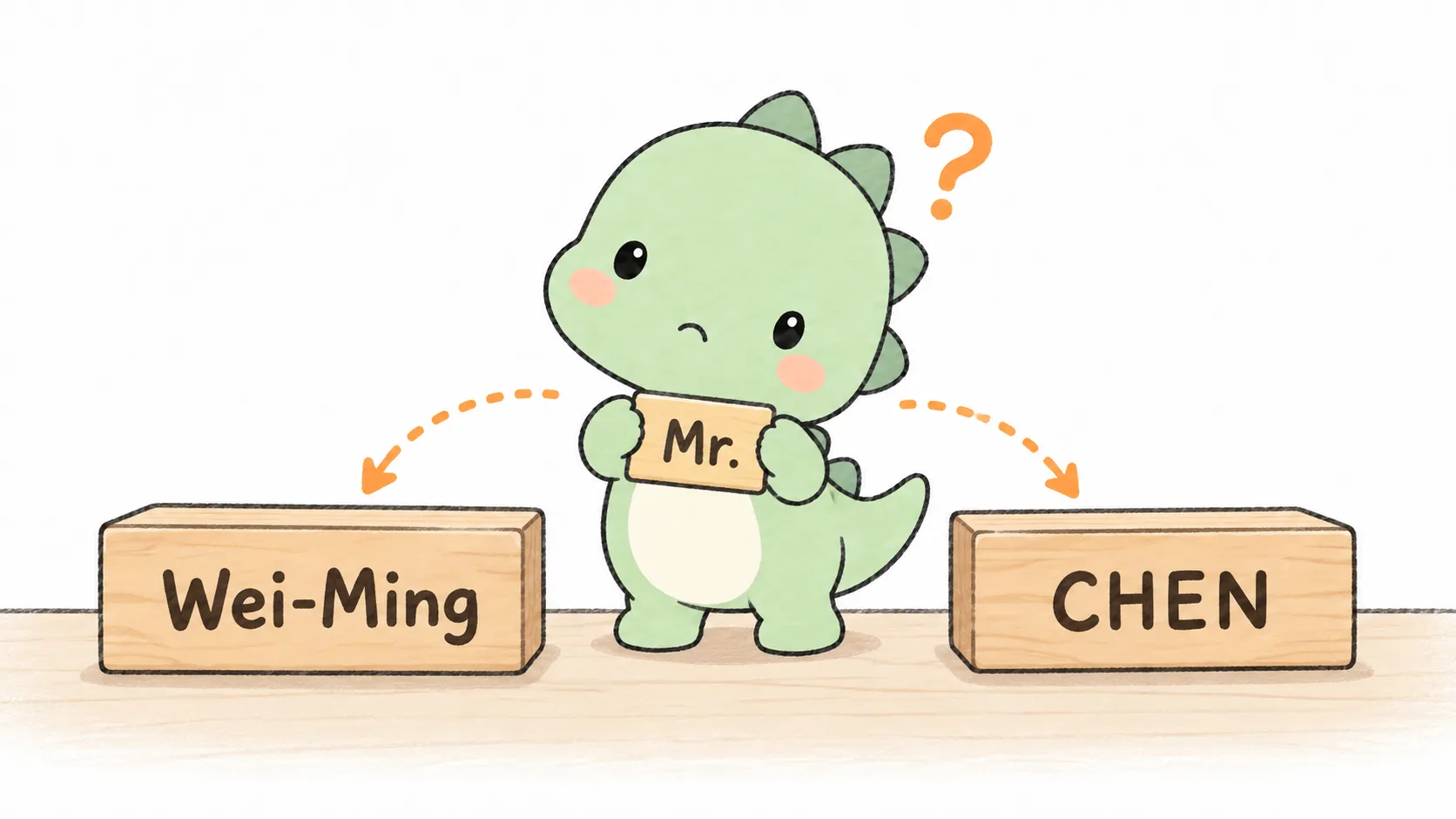
The family name. In English business writing, Mr., Ms., Mrs. and Dr. go with the family name:
- Wei-Ming Chen → Mr. Chen ✅, not Mr. Wei-Ming ❌
- Arun Phan → Mr. Phan ✅, not Mr. Arun ❌
- Dr. is no different: Dr. Sandra Kim is Dr. Kim, not Dr. Sandra
The Purdue Online Writing Lab (Purdue OWL) puts it plainly in its guide to business letters: use the "personal title and last/family name" in the salutation, as in Dear Mr. Smith.
In several places in Asia you may be used to something else — a cram-school teacher called Miss Amy, a colleague called Mr. Kevin. That's a perfectly good local habit in your own language. In an English business email, though, Dear Mr. Kevin makes the reader pause for a second, because they expect a family name after Mr.
What about Ms., Mrs. and Miss? In short: when you don't know someone's marital status, or they haven't said what they prefer, use Ms. There's a story behind Ms. too — it isn't actually short for anything — which we told in TOEIC Part 7 abbreviations.
What if you don't know their name, or can't tell whether they're a man or a woman?
There are three situations.
You don't know who will read it. The traditional openings are Dear Sir or Madam and To whom it may concern. The Cambridge Dictionary defines to whom it may concern as something you write at the start of a formal letter or notice when you don't know exactly who it should go to. Many people find both a little old-fashioned and cold today. If you know the role or department, a job title usually reads more naturally: Dear Hiring Manager, Dear Customer Service Team.
You know the name but can't tell the gender. An email signed Alex Kim or Jordan Lee doesn't tell you whether to write Mr. or Ms. Don't guess: write the full name and drop the title — Dear Alex Kim. Purdue OWL's own example is Dear Chris Harmon, and it also mentions using a job title instead. The same trick helps people reading Asian names: a client who sees Yu-Ting Lin often can't tell either, and Dear Yu-Ting Lin is the safe choice.
You're writing to a group. Dear all, Dear team, Hello everyone — or, like the email in questions 131–134 of the sample test, simply To all Pak Designs project leaders:.
We counted the 1,788 Part 6 and Part 7 texts in our own question bank. In 422 of them the first line is a greeting starting with Dear, Hello or Hi:
| Opening | Texts |
|---|---|
| Dear + Mr./Ms./Dr. + family name (Dear Ms. Hartwell) | 169 |
| Hello, / Hi, (on its own) | 100 |
| Dear / Hello + a role, group or company (Dear Valued Customer, Dear Hiring Manager, Hi team) | 89 |
| Dear / Hi + given name (Dear Daniel, Hi Raj) | 61 |
| Dear + title + full name (Dear Ms. Patricia Huang) | 3 |
| Dear Sir or Madam / To whom it may concern | 0 |
Dear + title + family name is the largest group, about 40%; Dear Sir or Madam and To whom it may concern don't appear even once.
When can you switch to first names?
Your first email says Dear Mr. Chen, and the reply is signed:
Best,
Mark
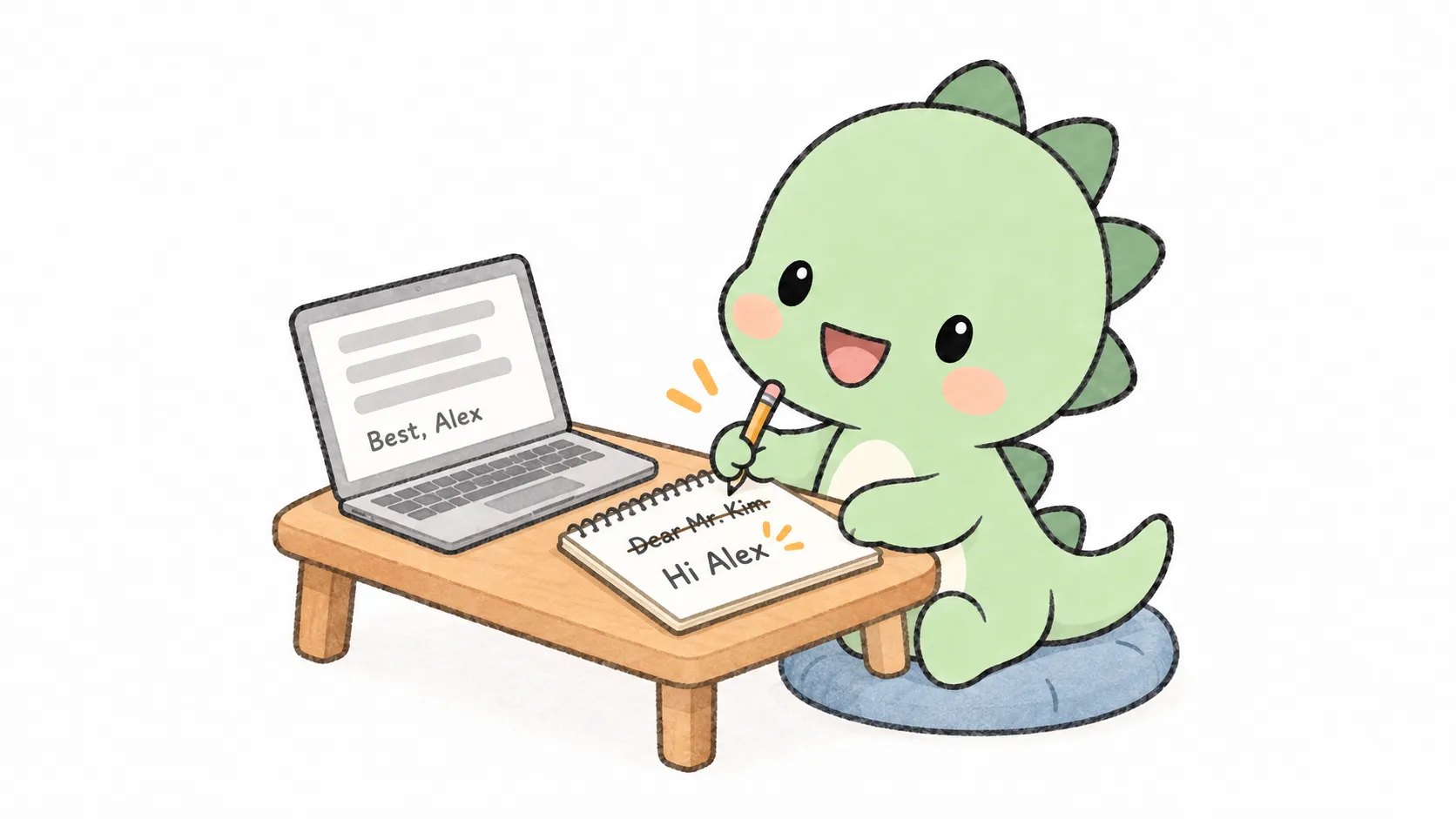
That's usually an invitation: he signed with his first name, so your next email can say Hi Mark or Dear Mark. Purdue OWL's version: if you know the person and normally call them by their first name, using just the first name in the salutation is fine.
The other way round, if they keep signing with their full name and keep calling you Ms. Lin, stay with Mr./Ms. + family name and don't be the first to switch. There's no single correct answer, but there is a safe habit: follow their signature.
Best regards or Sincerely?
Closings are more forgiving than openings. Two rules are enough:
- Yours faithfully is the formal British closing for letters that begin Dear Sir or Dear Madam, without a name (the Cambridge Dictionary labels it "mainly UK").
- Yours sincerely (Americans often write Sincerely or Sincerely yours) closes a formal letter to a particular person.
For everyday business email, Best regards, Kind regards, Regards and Best are all common, and between colleagues who know each other Thanks works too. Our question bank looks much the same. Matching the common closings found 401 texts:
| Closing | Texts |
|---|---|
| Thanks | 108 |
| Best regards | 73 |
| Thank you | 45 |
| Sincerely | 39 |
| Regards | 28 |
| Kind regards | 25 |
| Yours sincerely / Best | 21 each |
| Warm regards | 17 |
| Yours faithfully | 10 |
| Others (Best wishes, Many thanks) | 14 |
None of the 10 Yours faithfully letters opens with the recipient's name (Dear Trustees, Dear Member, Dear Recruitment Team…), exactly as the British rule above says. As for the three emails in the official sample test, every one closes with Thank you: two with Thank you, and one with Thank you for your support.
Why do some people write their family name in capitals?
CHEN Wei-Ming, YAMADA Haruo — you may have seen this on conference name badges or author lists.
It solves exactly the problem this post opened with: someone who sees Chen Wei-Ming can't tell whether Chen is the family name. Write the family name in capitals, and whichever order the name is in, the reader knows which part is the family name.
In an inter-ministerial agreement dated 25 October 2019, the Japanese government decided that from 1 January 2020 its official documents would, as a rule, romanise Japanese names family name first — and that where the family name needs to be clearly distinguished, it should be written entirely in capitals. The example in the agreement is YAMADA Haruo. Many countries' passports separate the two with fields instead, one for the surname and one for the given names; Taiwan's uses the comma mentioned above.
You don't need to sign your emails in capitals. But if your name often gets mixed up, writing Wei-Ming CHEN or CHEN Wei-Ming once in your email signature highlights the answer for the reader.
How do names from your part of the world work in English?
Asian names don't all follow the same rules, and they don't all break the English pattern in the same way:
| Names from | Order in the original | How people are usually addressed | What it means in an English email |
|---|---|---|---|
| China, Taiwan | family name first (Chen Wei-Ming) | by family name, or by an English name | Mr. Chen; many people also use an English given name, as in Kevin Chen |
| Japan | family name first (Yamada Haruo) | by family name + san | Mr. Yamada; both orders appear in English |
| Korea | family name first (Kim Min-su) | full name or given name + ssi / nim | Mr. Kim — though in a big office there may be several |
| Vietnam | family name first (Nguyễn Văn Minh) | by the given name: anh Minh | Mr. Minh is common in Vietnam; Mr. Nguyen follows the Western rule |
| Thailand | given name first (Somchai Jaidee) | by the given name, with Khun: Khun Somchai | Mr. Somchai is the Thai habit; Mr. Jaidee follows the Western rule |
A few of these deserve a sentence more:
- Japan. The 2019 government agreement above put the family name first in official English. In practice both orders still coexist — the TOEIC sample test itself writes AKIRA OTANI, given name first.
- Korea. Korean names are usually kept family-name-first in English (Ban Ki-moon, where Ban is the family name). Kim, Lee and Park together account for 44.6% of South Koreans (2015 census, as reported by the Korea Herald in 2017), so "Mr. Kim" in a large office may not narrow things down much — the given name helps.
- Vietnam. Nguyễn is by far the most common surname; estimates range from just over 30% of the population to two-fifths, the figure in the title of a 2020 Language Log post by Victor Mair. Vietnamese address each other by the last part of the name, even formally, and Vietnamese English-language media can do the same: Tuoi Tre News, reporting Pham Minh Chinh's re-election as prime minister in July 2021, calls him Chinh after the first mention. So both "Mr. Minh" and "Mr. Nguyen" are things you'll meet — the safest guide is how the person signs.
- Thailand. Thai surnames only became law in 1913, under King Vajiravudh (Baker and Phongpaichit, A History of Thailand, 2009). A later law forbids registering a new surname that duplicates an existing one, which is one reason Thai surnames are often long and nearly unique. People are addressed by their given name, and Thai English-language papers do the same: a Bangkok Post profile of Srettha Thavisin published on 22 August 2023, the day parliament voted him in as prime minister, calls him "Mr Srettha" throughout.
The practical advice is the same for everyone: pick one order and use it consistently in your signature, on LinkedIn and on your business card; use your passport spelling for flights and visas; and if people keep getting it wrong, write your family name in capitals once, or simply say "Please call me Wei-Ming". Being called Mr. Wei-Ming is not an insult — it's an opening.
How does the TOEIC use this?
The TOEIC won't ask you which part of a name is the family name, but it builds questions on it.
When Part 7 questions refer to people in a text, they often use Mr./Ms. + family name: the email is signed Jody Annesly, and question 178 asks Who most likely is Ms. Annesly? Multi-text sets need you to match people across texts: the shopping cart says Customer: Arun Phan, the email is signed Arun Phan, and question 199 asks which colour Mr. Phan likes — the answer takes a colour code from the email and matches it to a colour name in the cart. You need to know, the moment you see Mr. Phan, that he is the customer in the cart and the writer of the email.
We checked our own reading question bank too: of the "Mr./Ms./Mrs./Dr. + one name" cases where the same set also gives the person's full name — 306 of them — every one uses the family name, and not one uses the given name.
All the names in the official sample are written in English order, given name first and family name last — Akira Otani included. So a simple habit while answering: when you see a signature, mentally turn it into Mr./Ms. + the last word. When the question asks about Mr. Phan, you won't have to go back and look.
Names are the one place where exceptions outnumber the rules
What's above is the mainstream of English business writing, but names are the least obedient things in the world:
- Not every culture puts the family name last, and not every culture addresses people by it. Vietnamese and Thai people are usually addressed by their given names, even formally; Japanese, Korean and Chinese names put the family name first. When you write to them in English, "Mr. + family name" may not be what they're used to, and "the last word" may not be the family name — check how they sign.
- Some people have two family names. Spanish names often carry two (father's and mother's), and Mr. may go with both or with just the first.
- British English often drops the full stop. British writers put Mr Chen and Dr Kim; American writers put Mr. Chen and Dr. Kim. Both are correct.
- Some people don't want Mr. or Ms. at all. Some state a preference (pronouns, for instance) in their signature; just follow it. When unsure, the full name without a title is the safest choice.
- Company cultures differ a lot. Some companies use first names from the very first email; others stay with Mr./Ms. for years. Following the other person always beats applying a rule.
- Our question-bank numbers describe our question bank. The proportions describe the questions we wrote, not the distribution on the real TOEIC.
In short: find the family name first
The rule for addressing people in an English email really comes down to one line: Mr./Ms. go with the family name. Everything else — Dear Sir or Madam, Hi Mark, Best regards — is detail around that rule.
The hard part comes before it: looking at an Arun Phan, a Chen Wei-Ming and a Kevin Chen and working out which part is the family name. Get that right and you'll never write Dear Mr. Wei-Ming — and you won't still be searching three texts for Mr. Phan when you reach question 200.
As for Miss Amy from cram school — in your own language, let her stay Miss Amy. Just remember her family name when you write to her in English.
In Handy 990's Part 7 practice, long-press any word in a passage to look it up; in multi-text sets, the signatures and the Mr./Ms. in the questions are often what ties the texts together. Elsewhere in this series: TOEIC Part 7 abbreviations tells the stories behind Mr., Ms. and Mrs. themselves, and Everyday words that change meaning at the office covers the familiar words that take on new meanings in email and at work.