
All articles · Published 2026-10-02
Can you end a sentence with a preposition? Six school grammar rules that native writers break every day
"Never end a sentence with a preposition." "Never put an adverb between to and the verb." "Never start a sentence with And." You learned these rules — yet the official TOEIC sample test ends seven of its own questions with a preposition. This post traces six school rules back to where they came from: one is a poet's personal taste from 1672, one is a grammarian's "I should think" from 1770, and some are changing as we speak. Then it returns to the just now in a reader's report to show what a real grammar rule looks like, and which kind the TOEIC actually tests.
A reader's report: "Isn't has finished … just now correct too?"
In July, a reader tapped the report button in the Present Perfect unit of grammar practice. One of the blanks looked like this:
He ------- his homework just now.
finished/has finished/finish/finishing
The answer is finished. The reader wrote:
He has finished his homework just now should be correct
It's a good question, because the reader's instinct is half right. Michael Swan's Practical English Usage (3rd edition, 2005, Oxford) covers just in section 307, and one part of it deals with just now. When just now means "a few moments ago", it can go in two places:
- at the end of the sentence, usually with a past tense: I telephoned Ann just now.
- in mid-position, right next to the verb, with either a past tense or a present perfect: I've just now realised what I need to do.
So He has just now finished his homework works. As for He has finished his homework just now — present perfect with just now at the end — Swan says that position usually takes a past tense. Not never, but it isn't what most people write. The answer key stands. Still, the rule "just now always takes the past tense" tells only half of what real English does.
That is what this post is about. Many school grammar rules are simplified versions of real English. Simplifying isn't wrong — nobody can read all of Swan's thick usage guide in their first year of English. The trouble is that some rules are simplified too far, and some aren't grammar at all: they are one person's taste from a few hundred years ago, copied from textbook to textbook ever since.
Three kinds of "rule": real grammar, personal taste, usage in motion
Here is the conclusion up front. School rules fall roughly into three kinds:
| Kind | What it is | Examples | What happens if you break it |
|---|---|---|---|
| Real grammar | Native speakers follow it without thinking; breaking it sounds "not like English" | Tense matches the time words (ago takes the past tense); a/an follows the sound | Native speakers hear a mistake |
| Personal taste | One writer's or grammarian's preference, later treated as a rule | No preposition at the end; no split infinitives; no And at the start | Most people won't notice; a few editors will change it |
| Usage in motion | The old rule is still around, but real usage has moved the other way | Singular they; data is | Depends on where you write: some style guides have changed, some haven't |
The six rules below all belong to the last two kinds.
Rule 1: Can a sentence end with a preposition?
This rule has a known inventor. In 1672 the English poet John Dryden, in an essay called "Defence of the Epilogue", went after his predecessor Ben Jonson and quoted a line from Jonson's play Catiline (1611):
The bodies that those souls were frighted from.
Dryden's verdict: "The preposition in the end of the sentence; a common fault with him, and which I have but lately observed in my own writings." According to the linguist Geoffrey Pullum, Dryden then really did start revising the sentence-final prepositions in his own earlier work.
Why did Dryden think it was a fault? He never said. The most common guess is Latin: Latin prepositions can't go at the end of a sentence, and writers of his day treated Latin as the model of what a language should be. But English had been talking this way for centuries before Dryden, and it still does.
Ninety years later, Robert Lowth was fairer about it in A Short Introduction to English Grammar (1762). Ending with a preposition, he wrote, is "an idiom which our language is strongly inclined to; it prevails in common conversation, and suits very well with the familiar style in writing" — only in a solemn, elevated style is it more graceful to move the preposition forward. Notice that Lowth's own clause, which our language is strongly inclined to, ends with the preposition to.
There's also a story online about Winston Churchill: an editor moved a preposition away from the end of one of his sentences, and Churchill scribbled in the margin, "This is the sort of nonsense up with which I will not put" — mocking the rule with the clumsiest sentence imaginable. Sadly, it's made up. Quote Investigator traced the earliest version to the West Sussex Gazette in England in 1941, where the hero is an unnamed school English master; only in 1943 did a newspaper hang the line on Churchill. The story is false, but its point is true: dragging a preposition forward often sounds far worse than the original.
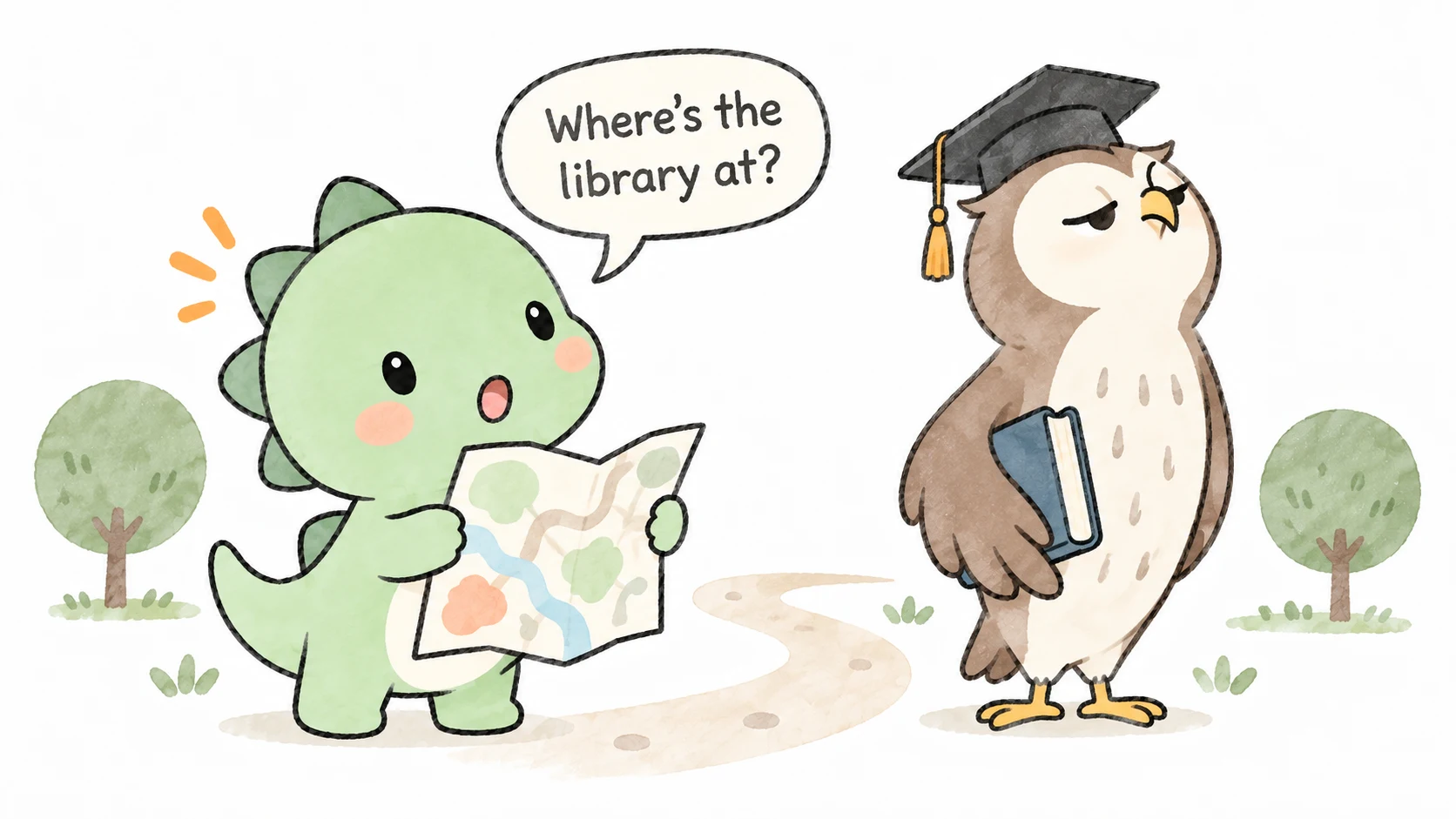
The rule also has a much better-known — and much ruder — joke. A young guy visits a friend at Harvard. They're supposed to meet at the library, but he gets lost, so he stops a student coming up the walkway:
"Hey man, where's the library at?"
The student turns up his nose:
"Here at Harvard, we never end a sentence with a preposition."
The young guy apologizes:
"Sorry, my bad. Where's the library at, asshole?"
The sentence no longer ends with a preposition. Rule observed.
Incidentally, what the Harvard student should have objected to wasn't the position but the at itself, which is redundant: where already means "at what place", so Where's the library? is enough. Where's … at? is common in speech, but you won't see it in formal writing.
The TOEIC sample test does it too
In ETS's official TOEIC Listening and Reading sample test, seven of the questions themselves end with a preposition:
- Question 33: What does the man ask the woman about?
- Question 36: What does the man ask about?
- Question 38: What is the conversation mainly about?
- Question 74: What kind of business does the speaker work for?
- Question 76: What does the speaker ask listeners to tell customers about?
- Question 79: What are the listeners asked to look at?
- Question 150: According to the article, where is Mr. Benavidez from?
That's not counting option (C) He has found what he was looking for. in Question 78, or the customer's e-mail in Questions 196–200: the paint was not the one I had asked for.
Try rewriting Question 74 to follow the "rule": For what kind of business does the speaker work? Grammatically fine — and it sounds like a court filing. ETS evidently thought so too.
Rule 2: Can you put an adverb between to and the verb?
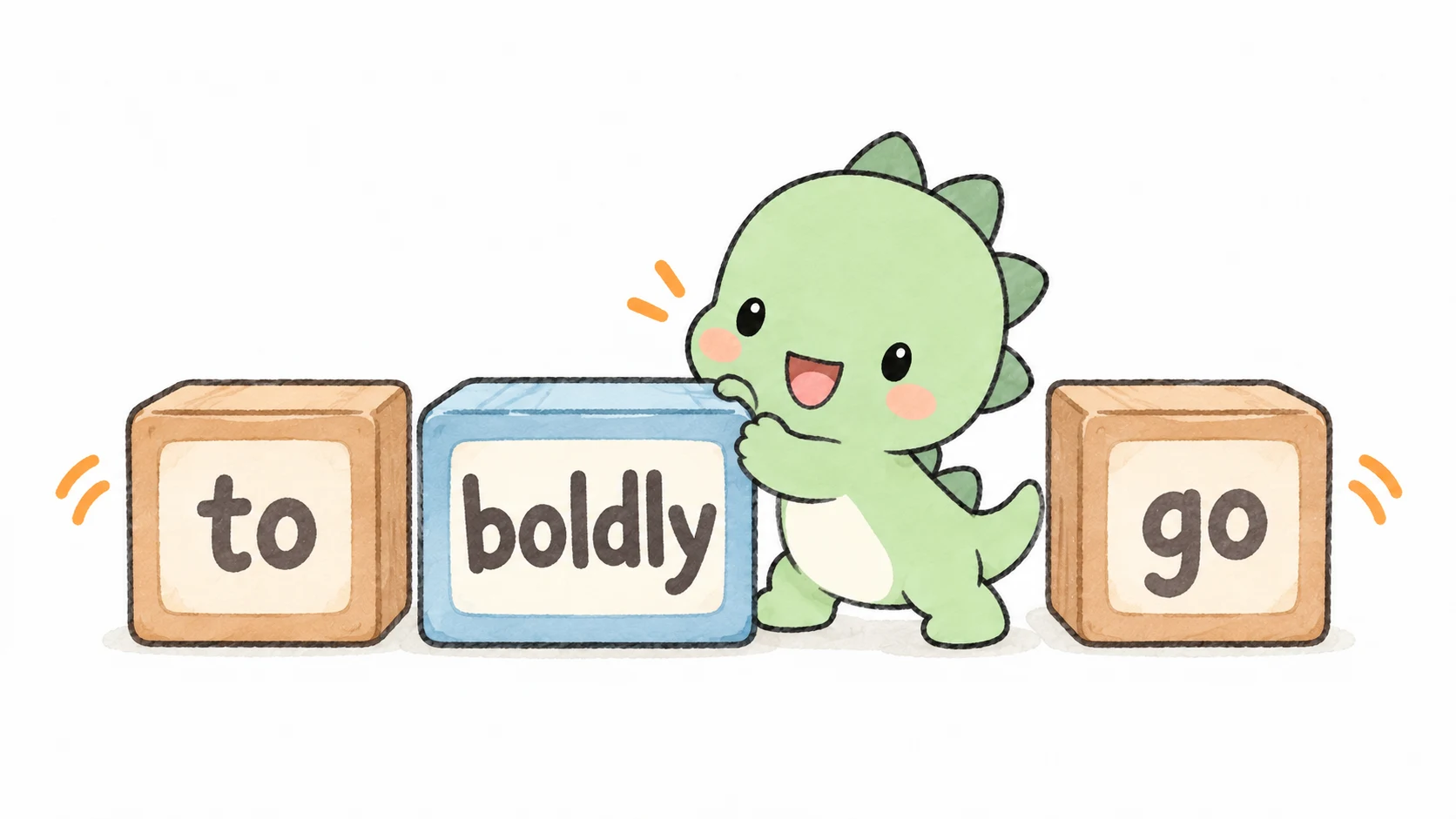
Putting an adverb between to and the base verb, as in to boldly go or to fully understand, is called a split infinitive. Plenty of people were taught not to do it.
The earliest public objection we can find is a reader's letter signed "P." in the American New-England Magazine in 1834, complaining about phrasings like to fully understand. For nearly a century after that, grammar books argued about it. In 1926 H. W. Fowler, in A Dictionary of Modern English Usage, sorted the English-speaking world into five classes: those who neither know nor care what a split infinitive is; those who do not know, but care very much; those who know and condemn; those who know and approve; and those who know and distinguish. The first class, Fowler said, were the happy ones.
In 1947 a copy editor at The Atlantic "corrected" a split infinitive in a manuscript by the detective novelist Raymond Chandler. Chandler wrote to the editor, Edward Weeks, and asked him to pass a message on to the proofreader:
when I split an infinitive, God damn it, I split it so it will stay split.
Sometimes not splitting simply doesn't work. Business news is full of this sentence:
Sales are expected to more than double next year.
Try moving more than out of the way: expected more than to double, or expected to double more than. The first changes the meaning; the second isn't a sentence. Here, splitting is the only normal way to say it.
The sample test contains no split infinitives — but it also has no question testing whether you may split one.
Rule 3: Can a sentence start with And, But, or So?
This rule most likely comes from school composition class: teachers worried that students would write fragments like "And then I went home.", so they banned the whole thing. The motive is understandable, but it isn't English grammar.
The Chicago Manual of Style (18th edition, 2024), the style guide most used in American publishing, includes the view of the usage writer Bryan Garner in section 5.209: treating sentences that begin with and, but, or so as errors has "no historical or grammatical foundation". Another authoritative usage guide, Fowler's (3rd edition), agrees, noting that the Oxford English Dictionary has examples of sentences opening this way going all the way back to the ninth century.
The sample test's listening scripts are full of them:
- Questions 38–40: I can't believe it! And the offices up there have amazing views of the city.
- Questions 41–43: So let's order the system with the largest screen that falls within that price.
- Questions 74–76: So I'm asking each of you to be in charge of one extra table tonight.
- Questions 80–82: But before we start, a few administrative details.
That last one has no main clause at all — it's a fragment. In composition class it would get a red circle; from a speaker opening a session, it's the most natural line in the world.
Rule 4: Must countable nouns take fewer, never less?
"Less with uncountable nouns, fewer with countable ones" — less water, fewer bottles. This rule's origin is even more of an accident than the others.
In 1770 Robert Baker wrote in Reflections on the English Language that less "is most commonly used in speaking of a Number; where I should think Fewer would do better." He added that No fewer than a hundred struck him as more elegant than No less than a hundred.
That's it. One man's "I should think", later copied into grammar books as iron law. And before Baker, less had been used with countable nouns for nearly nine hundred years: the earliest example in the Oxford English Dictionary comes from King Alfred's translation around the year 888, swa mid læs worda swa mid ma — "with less words or with more".
In 2008 the rule even reached Britain's biggest supermarket. Tesco's express checkouts said "10 items or less" and drew complaints about the grammar; on the advice of the Plain English Campaign, the signs became "Up to 10 items", which offends nobody.
This rule does differ from the first three in one way: in formal writing, many editors really will apply it. Use fewer for numbers of countable things (fewer complaints) and you'll never lose points in a formal e-mail. And in a few places even the strictest people accept less: units treated as a single amount, such as time, money and distance (less than ten dollars, less than three miles), and one less thing to worry about.
Rule 5: Can they only be plural?
What school teaches: for a singular person whose gender you don't know, use he or she. Every applicant must submit his or her résumé.
But English has been using they for a single person since the fourteenth century. Jane Austen's Mansfield Park (1814) has any body in their senses. It's the rule "always use he for the singular" that came later: the first grammarian known to recommend it explicitly was Ann Fisher, in the mid-eighteenth century.
Most of the major style guides have since moved. The Publication Manual of the American Psychological Association (7th edition, 2019) recommends singular they when gender is unknown; The Chicago Manual of Style advised avoiding it in formal writing in its 17th edition (2017) and endorsed it in its 18th (2024). Merriam-Webster also made they its 2019 Word of the Year.
For TOEIC takers there's an even more common "singular they": a company. In Questions 41–43 of the sample test, a man says:
You know our vendor has raised their prices, right?
Vendor is singular, yet it takes their. In Questions 77–79, about the agency Torland Advertising, every pronoun referring to the agency is them, their or they. Textbooks teach it for a company, but native speakers talking about a company are often thinking of "the people there", so they say they. When you listen to Parts 3 and 4, they may well be a single company — not necessarily several people.
Rule 6: Data is plural, so it must be data are?
Data is the plural of the Latin datum, so the strict rule says: The data are clear.
But Latin plurals borrowed into English are often used as singulars. The Guardian's style guide says data takes a singular verb even though it is strictly a plural, just like agenda — "no one ever uses 'agendum' or 'datum'." The AP Stylebook accepts both: singular when the data is treated as one body (The data is sound), plural when it means individual items. IEEE's journal editorial style requires the plural every time.
Three authoritative guides, three answers. This is what usage in motion looks like: nobody is wrong; the argument just isn't over yet.
Back to just now: what does a real grammar rule look like?
After all these rules that aren't rules, let's go back to the question from the top.
The just now rule is real grammar. The principle behind it: an English verb's tense has to agree with the time words in the sentence. Words that point to a moment in the past — an hour ago, yesterday, last year — take the past tense; words that stretch from the past up to now — since 2020, for ten years — take the present perfect. Just now at the end of a sentence points to "that moment a little while ago", so it usually takes the past tense. Native speakers don't need to memorise this; break it and it simply sounds "off" to them.
But even real grammar often reaches the textbook in simplified form. Swan says something else in the same section: when just means "a moment ago", British English allows both the past tense and the present perfect, preferring the present perfect for giving news (I've just had a brilliant idea.); in American English, the past tense is normal in every case (I just had a brilliant idea., He just went out.). The textbook rule "just takes the present perfect" is really a British preference.
Which kind does the TOEIC test?
As far as we can tell: real grammar, not these six rules.
We went through all 1,216 Part 5 questions in the Handy 990 question bank: 171 test verb forms, and 44 of those contain explicit time words — since it was launched two years ago, by the time the trucks arrive, at the start of next quarter — which are exactly the clues you use to pick the tense. That's the just now rule's family.
And the six rules above? The five Part 5 questions in the sample test cover word forms, a pronoun, a conjunction and vocabulary; none tests any of them. Our bank is the same: no Part 5 question asks you to choose between fewer and less, and none has an answer that depends on whether a preposition may end a sentence.
So the practical advice:
- On the test: don't decide a sentence is wrong because it ends with a preposition or starts with And. The sample test writes that way itself.
- When listening: they may be a company.
- In a formal e-mail: follow the fewer rule — it costs nothing. For the rest, choose whatever reads most naturally.
Even the rules about rules have exceptions
This post's three-way sorting is a simplification — just like the rules it criticises. A few things to be clear about:
- "Personal taste" doesn't mean nobody cares. Some companies, journals and examiners still edit by the old rules. If an exam you're preparing for includes writing and its scoring guide names a specific rule, following it is the safe choice.
- Swan says "usually". Present perfect with just now at the end of a sentence isn't strictly impossible, only uncommon; this post doesn't call it "wrong", only not what people normally write.
- The 44 is a rough number. We searched the question text with a list of time words: time expressions not on the list weren't counted, and not every counted question can be answered from its time words alone.
- Where the history is uncertain. Dryden never explained why he disliked sentence-final prepositions; "because of Latin" is only the most common guess.
Conclusion: the people who made the rules couldn't keep them
Dryden invented "never end a sentence with a preposition", then found it in his own writing too, and had to start revising his old work. Lowth wrote the fairest version of the rule, ending a clause with a preposition as he did so. The iron law of fewer started with Baker's "I should think".
School rules are like training wheels on a bicycle: very useful when you're starting out, because they keep you from writing anything wrong. But native writers took their training wheels off a long time ago. Next time you see What does the man ask about? on the TOEIC, don't doubt it — it isn't a mistake. It's simply how English works.

In Handy 990, Grammar Practice → Tenses → Present Perfect has fifty levels, and the just now sentence is in one of them; Chapter 16 of the Grammar book, Present Perfect, walks through the tense from the start, with a short quiz at the end of every section. In the same series, What is a linking verb? takes apart another rule that gets memorised so well it's overused, British vs. American English vocabulary lists the words the two sides say differently, and A unique or an unique? is a real grammar rule: it goes by the sound, not the letter.