
All articles · Published 2026-10-01
What is a linking verb? Adjective or adverb after look: the same look sometimes watches and sometimes just appears
A reader flagged one of our questions: "Doesn't look mean 'appear'? Then it should take an adjective." The rule they quoted is exactly right — the look in that question just isn't the "appear" kind. This post is about linking verbs (look, seem, become, remain …): a rope that ties a description back onto the subject. One quick test — swap in be — tells you whether a verb is describing its subject or doing something. Then we watch the official TOEIC sample test use both meanings of look inside a single conversation, sort out the five sense verbs that hold two jobs each, and end with feel badly, which even the dictionaries can't agree on.
A report: "Isn't look supposed to take an adjective?"
In August a reader tapped Report on a question in the Linking Verbs unit of our grammar practice. The question went like this:
Amara studied the shipping invoice for a long time. She looked ------- at every line item.
carefully / careful / carefulness
The answer is carefully. The reader disagreed:
Doesn't look mean "appear"? Then it should take an adjective — it only takes a noun if you add like.
Every part of that is true. When look means "appear", it takes an adjective; to follow it with a noun you usually need like first. It's the rule many teachers give, and this reader had it word for word.
The trouble is that the look in this question doesn't mean "appear". Put the two versions side by side:
- She looked carefully at every line item. She examined each item with care.
- She looked careful at every line item. At each item, she had a careful expression on her face.
The second one describes an actor. The camera cuts to line one: she looks careful. Cut to line two: still careful. But Amara isn't posing; she's working, running her eyes down the invoice one line at a time. Look at is an action, and an action is described by an adverb that says how it's done. Hence carefully.
That question is a trap on purpose. Five of the unit's fifty questions are built exactly like it: a verb that looks like a linking verb but is actually doing something. To get out of that trap, you first need to know what a linking verb does.
What is a linking verb? A rope tied to the subject
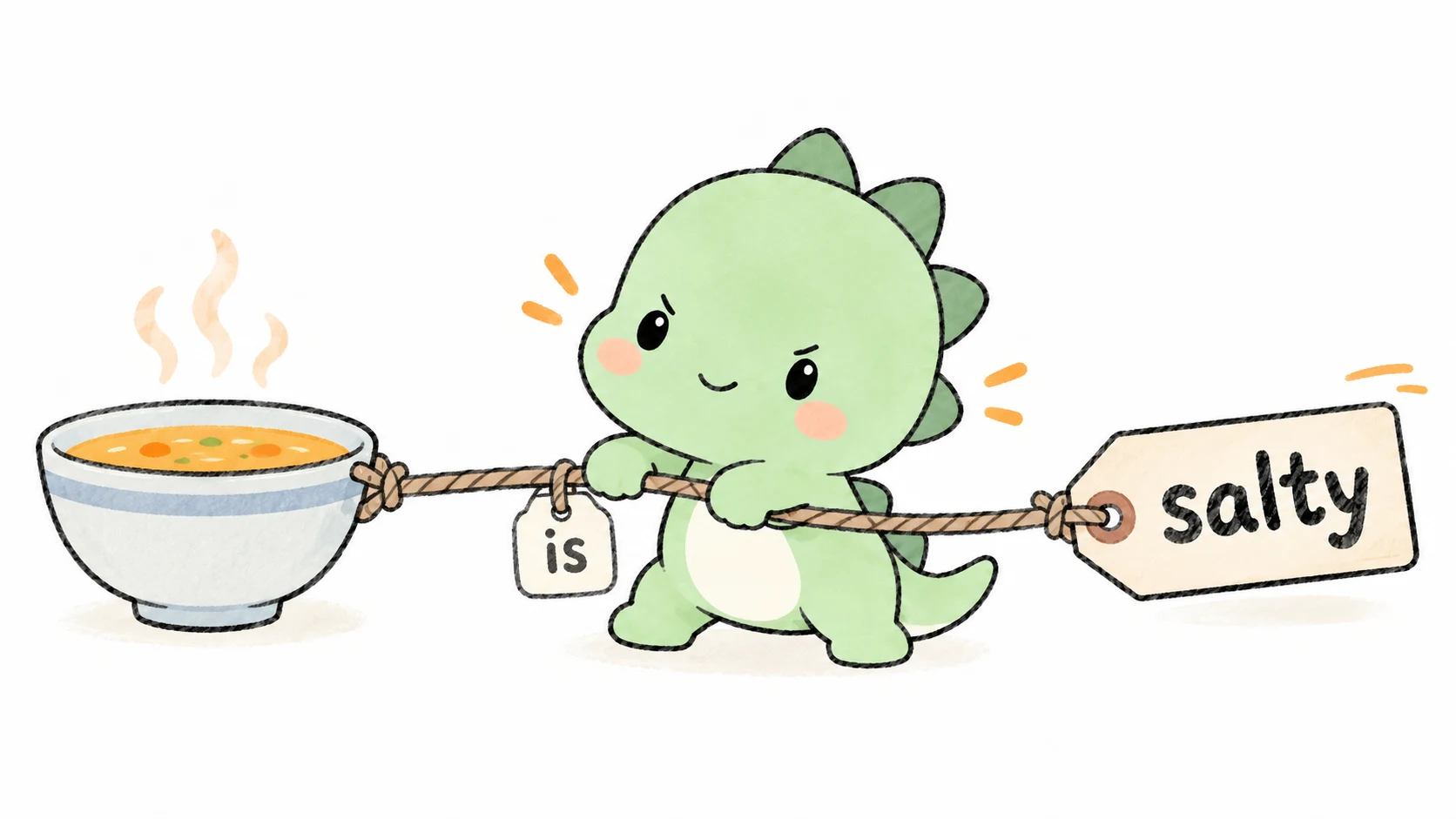
Most verbs do something: send an email, run a meeting, check an invoice. A linking verb does nothing at all. Its only job is to tie a description back onto the subject.
Grammar books call it a linking verb, or more formally a copula. According to the Online Etymology Dictionary, copula was being used in the 1640s for "a word that expresses the relation between subject and predicate", and in Latin it meant "that which binds: a rope, a band". The name fits perfectly:
The soup is salty.
Is has no meaning of its own. It's just a rope, with the soup tied to one end and salty tied to the other. The description that gets tied back is called the subject complement. It's usually an adjective, sometimes a noun — but not an adverb like carefully. An adverb can say how an action is done, or sharpen another description (unnecessarily complicated, as we'll see), but it can't describe a person or a thing on its own, and a linking verb has no action to describe.
Be is the basic linking verb; the others are the same rope with a little extra meaning attached. Quirk, Greenbaum, Leech and Svartvik's A Comprehensive Grammar of the English Language (1985, Longman) sorts them into two families:
| Family | Meaning | Common verbs | TOEIC-style examples |
|---|---|---|---|
| Current copulas | what the subject is like now | be, seem, appear, look, sound, smell, taste, feel, remain, stay, keep | The plan seems reasonable. Please remain seated. |
| Resulting copulas | what the subject turns into | become, get, go, grow, turn, prove, come, end up | Employees become eligible after one year. The tool proved useful. |
Both families take adjectives, because both do the same job: tie a description back onto the subject.
How can you tell? Swap in be
The fastest way to check whether a verb is linking is to replace it with is or was and see whether the meaning survives.
- The plan seems reasonable. → The plan is reasonable. Roughly the same. Linking verb, adjective.
- Her offer sounds fair. → Her offer is fair. Roughly the same. Linking verb.
- She looked careful. → She was careful. Roughly the same. Linking verb.
- She looked carefully at every line item. → She was carefully at every line item. Not a sentence. So this look isn't linking.
For the resulting family, swap in become:
- The passengers grew restless. → The passengers became restless. Fine.
- Mr. Ortiz grew tomatoes. → Mr. Ortiz became tomatoes.
The second swap gives itself away. The grow in grow tomatoes means "cultivate", an action; the tomatoes are its object, not a description of Mr. Ortiz.
There's an even quicker clue: look at what comes right after the verb. A linking verb goes straight to the description (looks tired, seems reasonable). If a preposition like at, for or into comes first, or an object does, the verb is most likely doing something: looked at the invoice, tasted the soup. (The one big exception is like: looks like rain is still a description.)
Five sense verbs, each with two jobs
The easiest ones to mix up are the five sense verbs — look, sound, taste, smell and feel — because every one of them holds down two jobs:
| Verb | Linking: describes the subject → adjective | Action: the subject does something → an adverb describes it |
|---|---|---|
| look | The lobby looks great. | She looked carefully at the invoice. |
| sound | Her offer sounds fair. | The guard sounded the alarm immediately. |
| taste | The soup tastes salty. | The chef tasted the sauce cautiously. |
| smell | The hallway smells strange. | The dog smelled the package eagerly. |
| feel | The linen feels rough. | The nurse felt carefully along the ankle. |
In the left column, the subject is the thing being sensed: the lobby is looked at, the soup is tasted, the linen is touched. In the right column, the subject is the one doing the sensing: she looks, the chef tastes, the nurse feels.
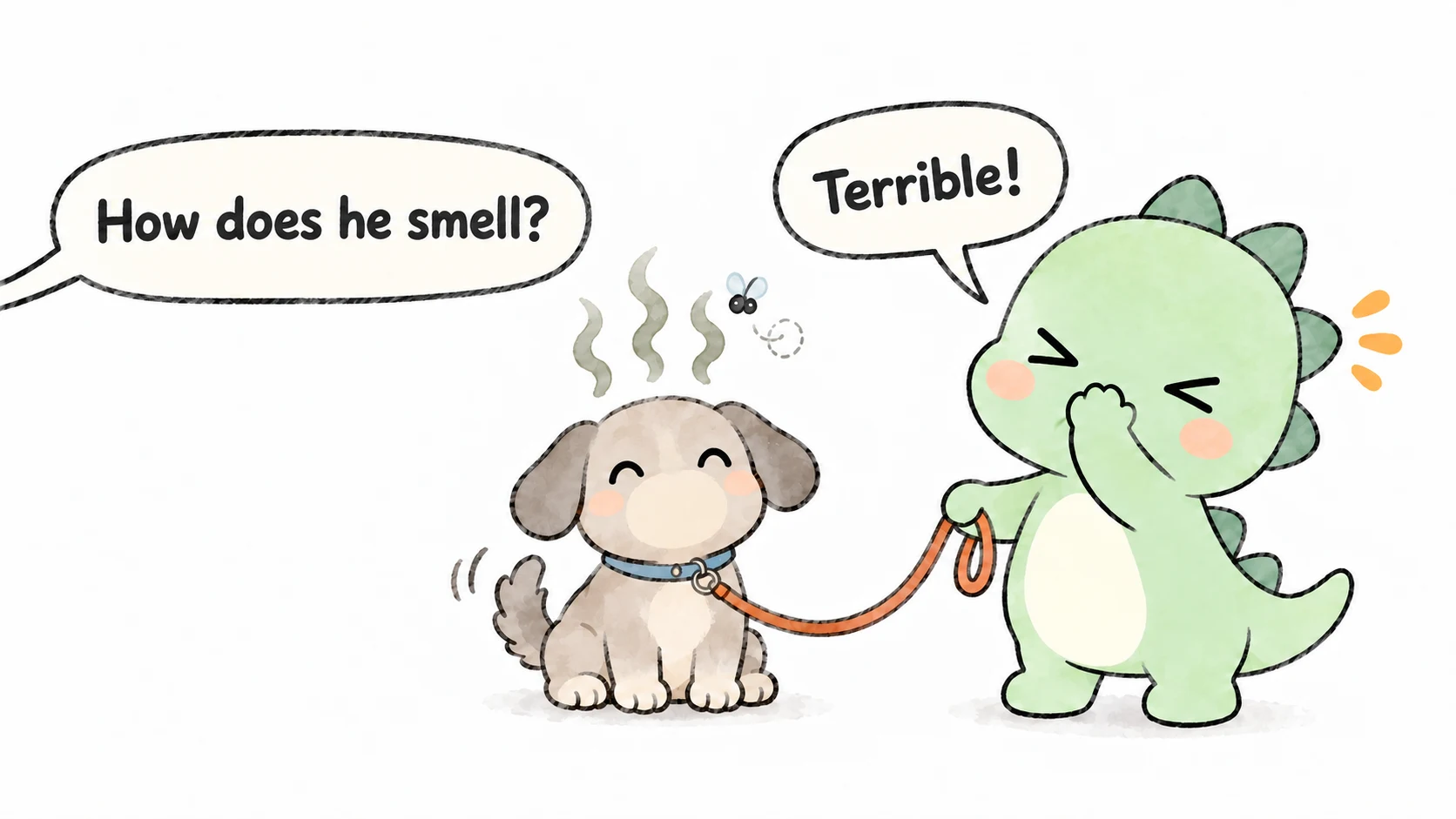
There's an old English joke that lives entirely between those two columns:
"My dog has no nose."
"How does he smell?"
"Terrible!"
The question comes from the right-hand column: with no nose, how does he smell anything? The answer quietly switches to the left-hand column: what does he smell like? Awful. One smell, two jobs, and the switch happens inside a single exchange.
Several linking verbs beyond the senses moonlight too:
| Linking (describes the subject) | Action (does something) |
|---|---|
| The leaves turned red. | Everyone turned quickly toward the exit. |
| The tool proved useful. | The test proved the theory. |
| Please stay calm. | We stayed at the Harbor Hotel. |
| The figures appear accurate. | The courier appeared suddenly at the dock. |
Why is look so tricky? Because it started out as an action
Look up look in the Online Etymology Dictionary and its first meaning is an action. Old English lōcian meant "use the eyes for seeing, gaze", and it usually went with on — the at in look at only begins in the 14th century. The sense "have a certain appearance" isn't recorded until around 1400, and look like arrives in the mid-15th century.
In other words, look was "examining" things for several hundred years before it started "appearing". Amara's looked carefully at is using the oldest job the word has.
Plenty of languages put up a signpost here: one word for using your eyes, and a different word, or an extra ending, for "seems to be". English doesn't. Both jobs share a single look, and the only way to tell them apart is what comes after it. That's why "look means appear, so it takes an adjective" is such an easy rule to learn and such an easy rule to over-apply: it covers only one of look's two jobs.
How does the TOEIC test it? Both meanings of look in the same conversation
The official TOEIC Listening and Reading sample test that ETS publishes is full of both kinds.
Part 3, Questions 38–40. A man with an Australian accent uses both meanings back to back:
Have you two taken a look at the progress they've made upstairs on the office expansion? It looks great!
In taken a look at the progress, look is a noun: take a look at is just a roomier way of saying look at, so the meaning is still the action (have you gone and checked?). In It looks great, look is the linking verb: a description. Two sentences, two meanings, separated by a question mark.
Part 3, Questions 41–43: I just looked at the catalog a few minutes ago. An action.
Part 4, Questions 77–79, an excerpt from a meeting: They seem much more focused on cutting their costs … — seem plus the adjective focused. A little later: Please take a minute to look at this contract with me. An action. And Question 79 asks, appropriately, What are the listeners asked to look at?
Part 7, Questions 196–200. A customer emails to complain that the wrong paint arrived, and adds: the others looked too green on my walls. A linking verb with the adjective green.
Reading Part 5 tests it head-on with word-form questions: four forms of the same word, and the blank's position decides which one fits. Question 101 of the sample test:
Customer reviews indicate that many modern mobile devices are often unnecessarily ------- .
(A) complication (B) complicates (C) complicate (D) complicated
The blank follows are, the most basic linking verb of all, so it needs an adjective describing the devices: complicated, answer (D). The trap is unnecessarily. With an adverb already sitting right before the blank, it's tempting to think the sentence is describing an action. In fact unnecessarily modifies the adjective after it (needlessly complicated), and "unnecessarily complicated" as a whole is the description tied back to the devices.
Try it: five questions
The first four come from Handy 990's grammar practice, the last from its Part 5 bank:
- The flight sat on the runway for four hours. The passengers grew ___ at the gate. (restless / restlessly)
- The nurse examined the swelling around the joint. She felt ___ along the top of the ankle. (careful / carefully)
- We tested the scheduling tool for a month. It proved ___ during the peak season. (useful / usefully)
- We had waited for the shipment since noon. The courier appeared ___ at the loading dock. (sudden / suddenly)
- Employees become ___ for the retirement plan after one full year of service. (eligible / eligibly)
Answers:
- restless. Swap in became: the passengers became restless. It describes the passengers.
- carefully. The nurse is touching, and what follows is a place, along the top of the ankle, not a description. This is the same trap as Amara's question.
- useful. Swap in was: the tool was useful.
- suddenly. This appear means "show up", an action. The courier isn't a sudden person; he just turned up suddenly.
- eligible. Become is a resulting copula: the employees become eligible.
Can a linking verb take a noun? Look the part, seem a waste
The second half of the reader's report said look "only takes a noun if you add like." That's mostly right, with exceptions.
Linking verbs like become, remain and stay take nouns all the time. He later became an inspector. Safety training remains a priority. They have stayed close friends.
Look and seem can take a noun directly too, just less often. Cambridge Dictionary's examples include He has started to look his age, and the idiom look the part (put him in a suit and he looks every inch a manager) is common. For seem, Cambridge gives Buying a new car seems a complete waste of money to me.
In ordinary use, though, the safest way to say someone resembles something is look like + noun: He looks like someone famous. With seem, seem to be + noun is the usual choice: She seems to be a capable manager.
Look like can also take a whole clause, but that's more informal: It looks like it's going to rain. The more formal versions are look as if and look as though.
Every rule comes with exceptions
Well is sometimes an adjective. You look well! means you look healthy; well is an adjective here, not an adverb. Compare The door looks good: good is about appearance, well is about health.
Feel bad or feel badly? Even the dictionaries disagree. By the rule, feel is a linking verb, so I feel bad about missing your call. Merriam-Webster accepts feel badly as standard; the Government of Canada's Language Portal calls it simply wrong, adding that feel badly would literally mean having a poor sense of touch. On a test, nobody will mark you down for feel bad.
The be swap occasionally fails. Besides descriptions, be can also take places: swap The courier appeared suddenly at the dock for The courier was suddenly at the dock and it still sounds fine. When that happens, ask one more question: does the word describe the subject? The courier isn't "sudden", so it's suddenly.
Casual speech has adjectives where adverbs "should" be. Drive safe and go slow are everywhere in conversation. That's a different matter (an ordinary verb followed by an adjective-shaped adverb), and the written TOEIC doesn't test it.
Resulting copulas come in fixed pairs; learn them whole. Go wrong, go stale, fall silent, run dry, run low, come true. Nobody is walking, falling over or running in any of them.
The last word: a long day of looking
Back to Amara. She spent a long time on that invoice and looked carefully at every line item: an action, an adverb.
After a whole day of that, she'll probably look tired: a description, an adjective.
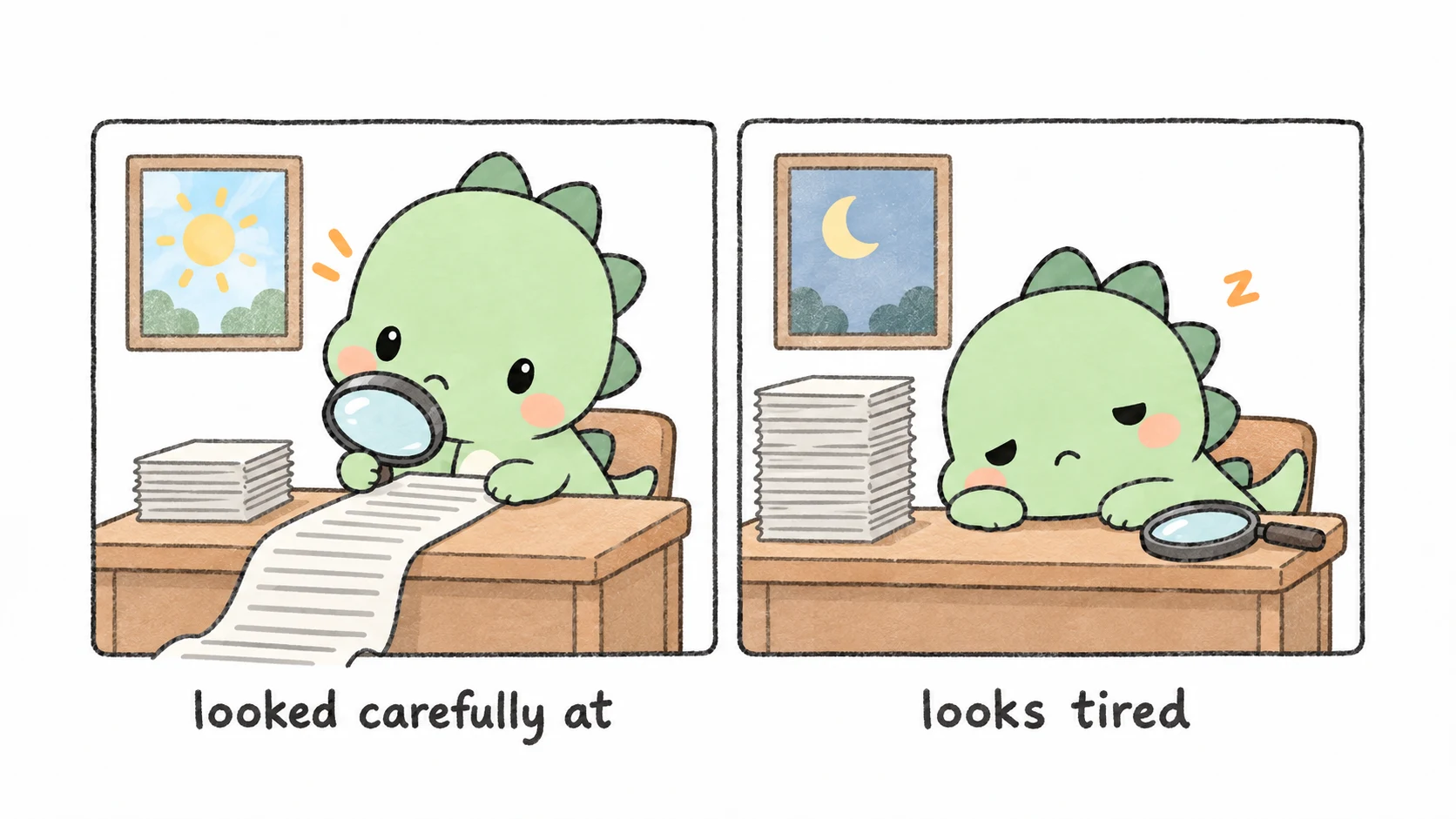
Same person, same look, same day. In the morning, look is what she does; in the evening, it's what everyone else sees. There's only one way to tell them apart: ask whether the word after look says how she's looking, or what she looks like.
In Handy 990, Grammar Practice → Verb Patterns → Linking Verbs has fifty questions, five of them the "looks like a linking verb, actually an action" trap from the top of this post. Chapter 2 of the Grammar book, Linking verbs, walks through the same "swap in is" test from the beginning, with a quiz at the end of each section. Elsewhere in this series, Bored or boring? covers a family of adjectives that often follow linking verbs, and Everyday English words that change meaning at the office is about a different "I thought I knew this word" trap.