
All articles · Published 2026-10-08
Why "look forward to seeing," not "to see"? English has two words spelled *to*
The to in "want to see" takes a plain verb; the to in "look forward to seeing" takes -ing. That isn't an exception. English has two words spelled to: an infinitive marker that is followed by a bare verb, and a preposition, the same kind of word as for and of, that takes a noun or an -ing form, not a bare verb. This piece starts from a reader's report, gives you a one-word test (can you put "it" after the to?), lists the common prepositional to's (be used to, be committed to, object to, with a view to and more), untangles "used to work" from "be used to working," explains why the two to's were a single word a thousand years ago, and ends with the places the test breaks down.
A reader's report: "look forward to Ving"
In September a reader flagged a Part 6 question. The comment was one line long:
look forward to Ving
The passage was a welcome letter to a new employee. Its first paragraph reads:
Welcome to the team! We are looking forward [1] you on Monday, June 2.
(A) to see (B) to seeing (C) seeing (D) see
The answer is (B) to seeing.
The reader's rule is exactly right: look forward to takes -ing. And the key follows that very rule. What makes the item sly is where the blank starts: straight after forward, so the to is inside it. (C) seeing gives you looking forward seeing you, with no to at all. (A) to see has the to but treats it as an infinitive. Only (B) gets both the to and the -ing.
Plenty of learners memorize "look forward to + -ing" at school. Fewer ask why. It's the same to, after all: I want to see you takes the plain verb, I look forward to seeing you takes -ing. Is English just being difficult?
No. The two to's are not the same word.
Why does to sometimes take a bare verb and sometimes -ing?
Modern English has two words that are spelled and pronounced exactly alike:
| The infinitive to | The preposition to | |
|---|---|---|
| What it is | An infinitive marker: it signals "a bare verb comes next" | A preposition, in the same family as for, of, about, in |
| What follows it | The bare form of a verb | A noun, a pronoun, or the -ing form of a verb |
| Example | I want to see you. | I'm going to Tokyo. / I look forward to seeing you. |
The infinitive to is a marker. It carries little meaning of its own; it just tells you a verb in its base form is coming. Want to go, decide to stay, plan to leave: all this kind.
The preposition to is a different animal. It's the to of go to Tokyo and give it to me, meaning roughly "toward." And English has a very steady rule: when a verb follows a preposition, it usually takes -ing (a handful of words such as but and except play by their own rules). Thank you for coming, tired of waiting, thinking about moving: -ing after for, of and about.
So look forward to seeing breaks no rule. It's that rule meeting a preposition that happens to look like an infinitive marker.
Cambridge's English Grammar Today puts it bluntly: the to in look forward to is a preposition, so it must be followed by a noun phrase or an -ing verb, not looking forward to go.
How do you tell them apart? Try putting it after the to
If the two to's look identical, how do you know which one you're facing?
Here is a quick test: keep the to, and put a noun after it, or simply it. If the sentence still stands, the to may well be a preposition. If it collapses, you are most likely looking at the infinitive marker.
| Try it | Result | So this to is |
|---|---|---|
| I look forward to it. | Works | A preposition → look forward to seeing you |
| I want to it. | Doesn't work | An infinitive marker → want to see you |
| She objects to the plan. | Works | A preposition → object to paying twice |
| She decided to the plan. | Doesn't work | An infinitive marker → decided to stay |
Cambridge's own example dialogue does the test for you: Are you excited about your trip to South America? — Yes, I'm looking forward to it. The fact that it fits is the clue that this to is a preposition.
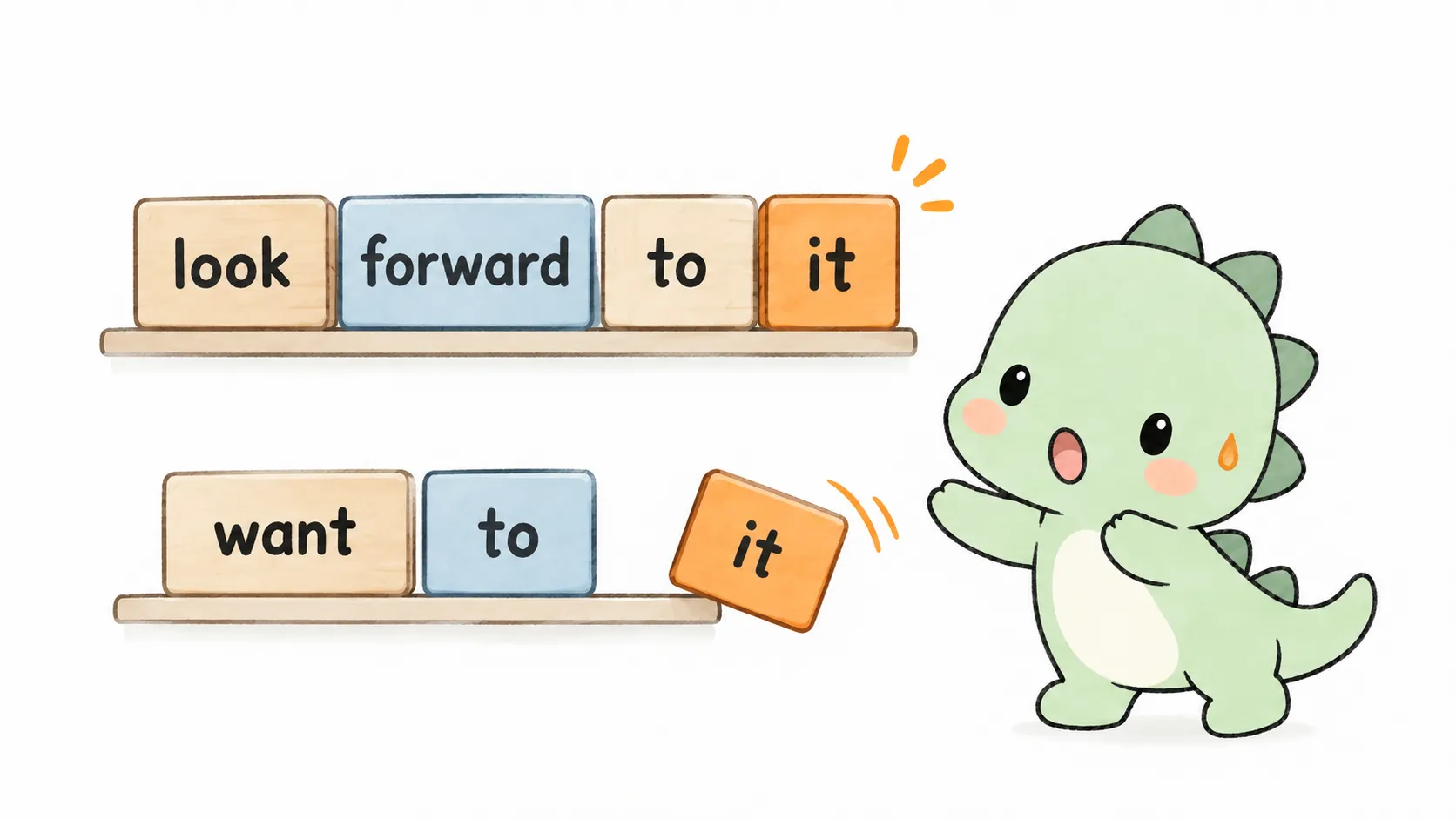
The test is handy, but it isn't foolproof. The caveats section near the end shows where it breaks.
Which to's are prepositions? The common ones
The to in each of these phrases is a preposition. The example sentences come from the Cambridge and Oxford learner's dictionaries:
| Phrase | Meaning | Example |
|---|---|---|
| look forward to | anticipate with pleasure | We're really looking forward to seeing you again. |
| be used to / get used to | be accustomed to | He was a salesman, so he was used to travelling up and down the country. |
| be accustomed to | be used to (more formal) | She was a person accustomed to having eight hours' sleep a night. |
| object to | oppose, protest against | I really object to being charged for parking. |
| be committed to | be pledged to | We are committed to improving services. |
| be dedicated to | give your time and energy to | The charity is dedicated to serving young people with special needs. |
| be devoted to | be deeply loyal to | Lucy is devoted to her cats. |
| contribute to | add to, help bring about | We hope everyone will contribute to the discussion. |
| in addition to | as well as | She's a fitness instructor in addition to being a full-time student. |
| when it comes to | as far as … is concerned | When it comes to getting things done, he's useless. |
| with a view to | with the aim of | Cambridge's headword is literally with a view to doing something |
| the key to | what makes … possible | Language is the key to understanding those around you. |
| admit to | confess | He admitted to feeling a bit tired. |
| be opposed to | disagree with | They're opposed to censorship. |
| get around to | finally find time for | I still haven't got around to fixing that tap. |
A few things to notice:
- Some of the examples are followed by a noun (her cats, censorship, the discussion), not an -ing form. That is what the preposition to takes: a noun or an -ing form, not a bare verb.
- In addition to is easy to write as in addition to be. It's in addition to being.
- The key to works the same way: the key to success, the key to understanding, not the key to understand.
The classic pair: used to work and be used to working
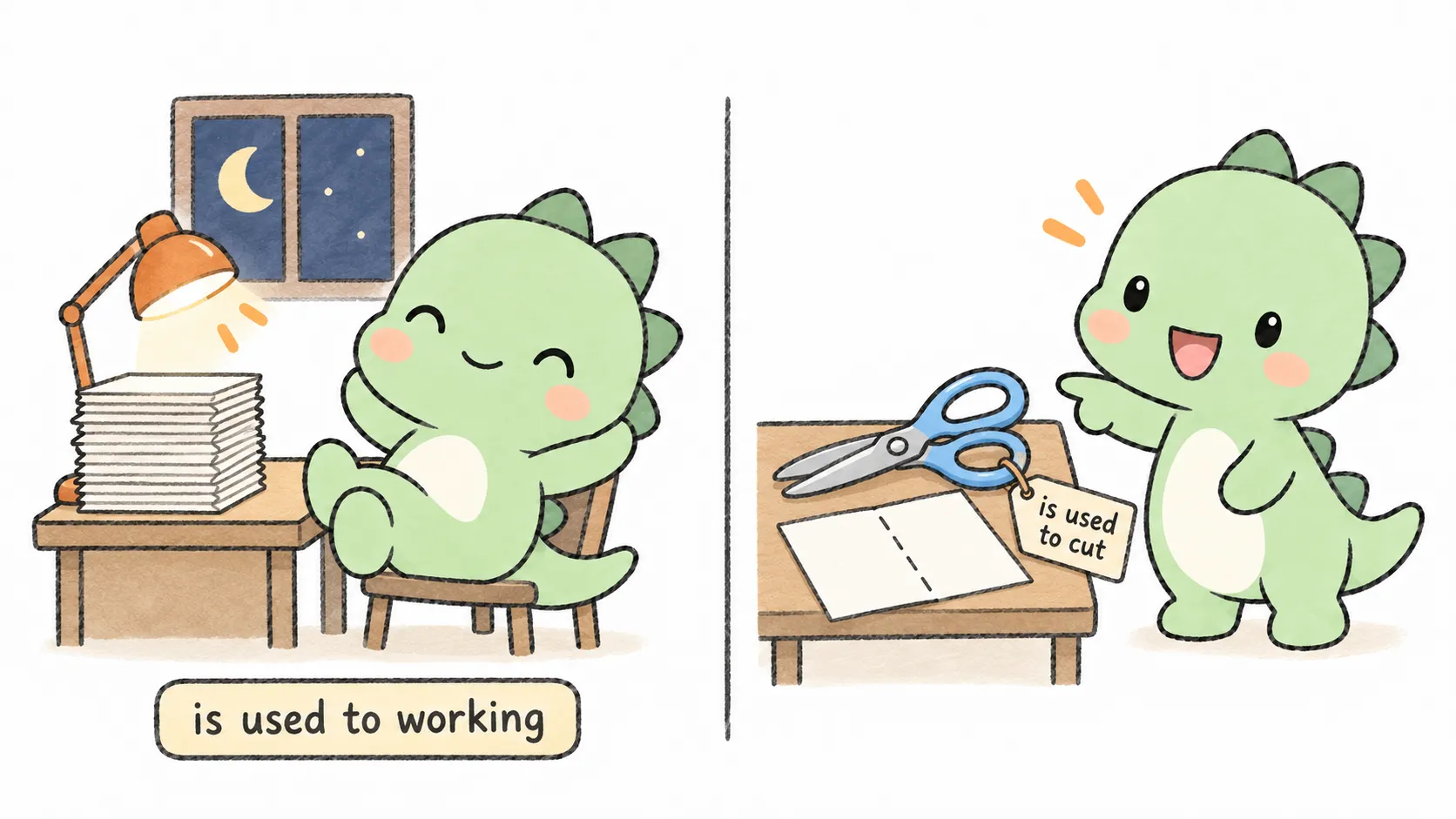
Of everything on that list, used to causes the most trouble, because it actually comes in three look-alike patterns:
| Sentence | Structure | Meaning |
|---|---|---|
| I used to work late. | used to + bare verb | I worked late regularly in the past (not any more) |
| I'm used to working late. | be used to + -ing | Working late is normal for me |
| This software is used to track orders. | be used + to-infinitive | This software is employed for tracking orders |
In the first sentence, used to is a fixed phrase meaning "regularly in the past, but no longer," followed by the bare verb. Cambridge warns that in this meaning you don't put be in front of it: not We are used to go.
In the second, used is an adjective meaning "accustomed," and the to after it is a preposition, so -ing follows. The it test agrees: I'm used to it works.
The third is the one people overlook. It's the passive of the verb use ("is employed"), and to track is an infinitive of purpose: what the software is used for. A Part 5 sentence in the Handy 990 question bank has exactly this shape: Numbing gel is used to minimize any discomfort during the procedure. That to is the infinitive marker, so it's minimize, not minimizing.
When there's a be in front, ask yourself whether the sentence is about a habit or a purpose. Habit: -ing after the to. Purpose: the bare verb.
The two to's used to be one word
After all that about how different the two to's are, here's the twist: a thousand years ago, they were the same word.
In Old English the infinitive was a single word with no to: "come" was cuman, "bear" was beran. But Old English also had a second infinitive, which Wiktionary's Old English conjugation tables still list, such as cumenne beside cuman. It followed tō, as in tō cumenne, and that tō was the preposition: "to, toward." The -enne ending marked a verb being used as a noun after a preposition (English Wikipedia's Split infinitive and Gerund articles both describe it this way; the latter's example is to berenne, the dative of beran).
In other words, a thousand years ago tō cumenne was built as "preposition to + a verb used as a noun."
By Middle English that form had merged with the ordinary infinitive (comen; to comen), and later the ending fell away altogether. With only the bare verb left behind it, to gradually came to be treated as a marker that simply flags "a verb comes next," rather than as a true preposition. Meanwhile the preposition kept doing its old job, as in go to Tokyo. One word, two jobs.
Today's -ing, for its part, doesn't come from -enne. It comes from the Old English -ing/-ung suffix that turned verbs into nouns. So look forward to seeing uses a newer tool to build something very like tō cumenne: the preposition to, followed by a verb used as a noun.
English's cousin German has the same double life: German zu can be a preposition, as in zu Hause ("at home"), or an infinitive marker, as in zu sehen ("to be seen").
Your language won't warn you
For many learners there is no warning sign anywhere near this trap, for a simple reason: in plenty of languages, the verb never changes form.
In Chinese, the verb in "I want to see you" and "I look forward to seeing you" is the same 見 (jiàn). Vietnamese works the same way: gặp ("meet") stays gặp whether you want to meet someone or look forward to meeting them. Nothing in a translation into either language will tell you, "careful, this to is not the to in the last sentence."
Languages that do change their verbs don't necessarily help either. Japanese turns a verb into a noun with の or こと in both cases: 行くことにした ("decided to go") and 会うのを楽しみにしている ("look forward to meeting"). The marker is there, but it's the same marker for both English to's.
That's why memorizing the phrases works: look forward to, be used to, be committed to give you no clue from the translation, so the clue has to come from the English itself. Learn the common phrases as whole units, and keep the it test as a backup.
How does the TOEIC test it?
In business English, look forward to turns up a lot at the end of letters. Cambridge notes that formal letters and e-mails often close with it: I look forward to hearing from you soon.
In the Part 6 and 7 passages of the Handy 990 question bank, look forward to appears 61 times across 60 question sets. What follows is mostly an -ing form: welcoming 19 times, seeing 10 times, then hearing, meeting, hosting, helping and others, along with noun phrases starting your, a or the, and it. Not once a bare verb.
The questions that actually test it are mainly in Part 6. Besides the one above, the bank has We look forward to [4] you there with the options seen / seeing / see / sees (answer: seeing), and another that keys welcoming. Amusingly, the same set of Part 6 questions also tests the other to: Ms. Fong plans to hire eight additional staff members and expects [3] them over the summer, where the answer is to train. One question about the preposition to, one about the infinitive to, and they look identical.
In fairness: in ETS's public TOEIC Listening and Reading sample test, to appears 140 times (counting the directions), never once followed by -ing, and no question tests this point. One sample test is too small to show how often the real exam uses it, and the Handy 990 Part 5 bank currently has no question dedicated to it either. So it's a point worth knowing and worth getting right when it comes up, not a question type you'll meet on every test.
This is English, so the it test breaks too
A few things to be clear about:
- Some words have both to's. You can agree to the plan (preposition) and agree to pay (infinitive). The it test passes, but with a verb it's the bare form, not agree to paying. Likewise be entitled to: entitled to a discount, but entitled to ask for references. And due to: due to computer problems ("because of"), but due to take place next week ("scheduled to"). With words like these, the it test only shows that the to can be a preposition, not that it is one this time.
- Some phrases allow both patterns. The Oxford learner's dictionary lists both She admitted to having stolen the car and She admitted having driven the car without insurance: admit works with or without to, and when the to is there, a verb after it takes -ing. The noun commitment is more flexible still: Cambridge has both a commitment to play for a full season and the commitment of car manufacturers to improving dealer profitability.
- -ing doesn't mean "in progress." The seeing in looking forward to seeing you isn't a progressive. It's a gerund, doing a noun's job.
- No list is complete. The table above covers the common ones. When you meet a phrase you don't know, try the it test, then check a dictionary.
Conclusion: same face, two jobs
Next time you see to, don't reach for the bare verb on reflex.
It might be the infinitive marker, whose only job is to announce a verb: want to see, decide to stay, expects to train. Or it might be a real preposition, sitting at the same table as for, of and about: look forward to seeing, be used to working, in addition to being.
A thousand years ago they were one word. Today they share a face and do two different jobs. The quickest way to tell them apart: put it after the to, and see whether it stands.
Chapter 23 of the Grammar book in Handy 990, "The verb after the verb," covers the same idea in its third section, "The to that is not a to," as one person turning up in two uniforms, with a section check at the end. Among the Part 5 and 6 grammar rules, Rule 7 (the infinitive to takes the base form) and Rule 8 (after a preposition, including the to in look forward to: V-ing) sit side by side. In the same series, Bored or boring? covers a different -ing, and Can you end a sentence with a preposition? covers a school rule about prepositions.