
All articles · Published 2026-09-25
British vs. American English vocabulary: the British first floor is one flight up, a lift is an elevator, and tabling a proposal can start an argument
The last piece in this series was about spelling — theatre and theater. This one is about something harder: the same thing called by entirely different words on each side of the Atlantic. An elevator is a lift, an apartment is a flat, a line is a queue, two weeks is a fortnight, and a résumé is a CV. The one most likely to send you the wrong way is the floor: a British first floor is one flight above street level. And then there are the sneakier words that both sides use with different meanings — one of which started a real argument between British and American staff officers during the Second World War.
The Australian in the TOEIC sample test says "ride"
The official TOEIC Listening and Reading sample test published by ETS comes with a full listening script, and every line is labeled with the speaker's accent: W-Am is an American woman, W-Br a British woman, M-Au an Australian man, M-Cn a Canadian man.
In question 9, the American woman asks, "Martin, are you driving to the client meeting?" The Australian man's correct response is (A):
Oh, would you like a ride?
An Australian in a Sydney office would be more likely to say Want a lift? In Britain and Australia, a lift is both a free ride in someone's car and the thing that carries you between floors. "Ride" is the American word.
This isn't a complaint about ETS. We read the whole sample script: the British woman talks about a fax machine, a laptop, a monitor and a seminar; the Australian man talks about a warranty, a coupon and the front desk. Not one of those words is British- or Australian-only. On the evidence of this one sample, the TOEIC varies the accent, not the vocabulary.
A real international workplace is less considerate. A colleague at the London office will tell you to take the lift to the first floor, a Sydney landlord will advertise a flat, and a notice in Singapore will ask you to queue. Our own question bank uses both sets on purpose — "fortnight" alone appears more than a hundred times. So this piece sorts out the most common pairs, starting with the one most likely to go wrong: the floor.
Which floor is the British first floor?
Start with this table:
| Where you are | American | British |
|---|---|---|
| Two flights up | third floor | second floor |
| One flight up | second floor | first floor |
| Street level | first floor | ground floor |
| One level down | basement | basement (or lower ground floor) |
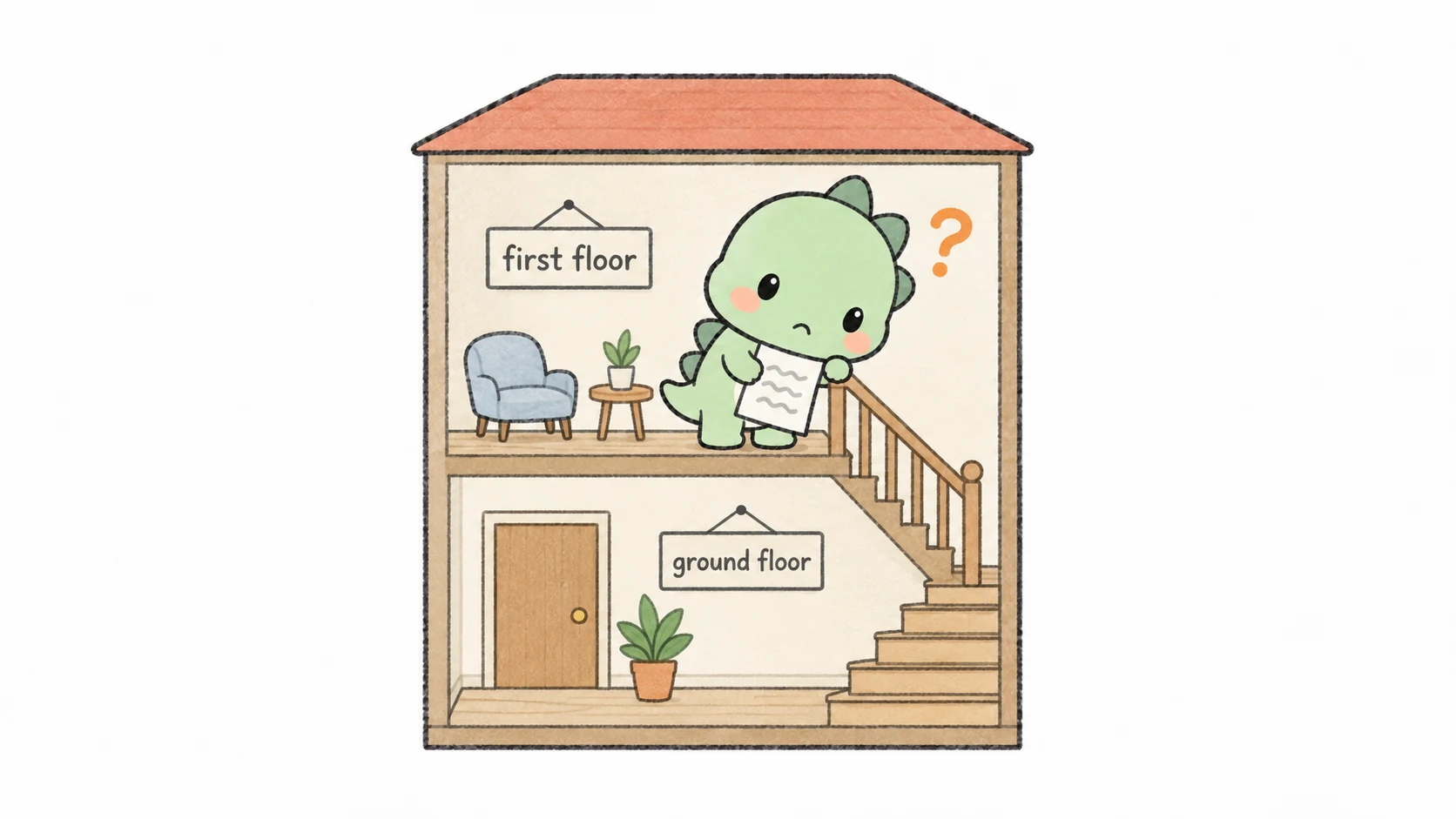
Walk into a British building and the level under your feet is the ground floor. The first floor is one flight up. The lift buttons usually read G, 1, 2 — and the 1 takes you to what an American would call the second floor. American elevators tend to show L (for lobby) or 1 instead.
Who counts which way? Britain, Ireland, most of continental Europe, Australia, New Zealand and Hong Kong use the British system. The United States, English-speaking Canada, and most of East Asia — including mainland China, Japan, South Korea and Taiwan — call street level the first floor. If you grew up in East Asia, you already count the American way — so in a building that counts the British way, the first floor is one flight higher than you expect.
Both systems make sense; they just start counting from different places. The American system counts the levels you can stand on, so the one at street level is naturally the first. The British system counts the levels built on top of the ground, so the ground itself doesn't count, and the first floor is the first one stacked above it. It's the same split as a baby's age: in traditional East Asian age reckoning a newborn is already one; in the Western system she is zero until her first birthday. America counts like the first, Britain like the second.
The floor even hides inside a word. The British flat comes from Scottish flat, "a floor or storey of a house" (recorded in 1801), and before that from Old English flett, "floor; dwelling." A flat is, literally, one floor.
What to do about it on the TOEIC
Listening Parts 3 and 4 regularly ask which floor a meeting has moved to or where the new office is, and some questions come with a floor directory as the graphic. When a British or Australian speaker says "first floor," the safest strategy is to listen for relative position rather than the number: upstairs, downstairs, just above reception, one floor up. "Ground floor" is never a problem — it has only one meaning. The trouble is "first floor."
The only conversation about floors in the sample test (questions 38 to 40, with an Australian man, an American woman and a Canadian man) never gives a floor number at all; it says "upstairs" and "on that floor." In our question bank, a British speaker says "I need it on the ground floor," and a Canadian speaker says "The lobby is on the first floor." In each speaker's own country, both sentences mean street level.
(The British spell the building sense storey and Americans spell it story; it's in the "doesn't even look like the same word" table of British vs. American spelling.)
Lift, flat, queue, fortnight, CV: five pairs you meet every day
Lift / elevator
Lift in the sense of "elevator" is first recorded in 1851; in the sense of "a free ride in a vehicle" it goes back to 1712 (Online Etymology Dictionary). So a British colleague offering you a lift might mean a car or an elevator — the context settles it. Americans ride the elevator and give each other rides.
The passenger elevator only became common in the mid-nineteenth century, more than seventy years after American independence. Each side named a new invention on its own, which is why the words are completely different. That is one of the main sources of British–American vocabulary differences: the things that arrived after the split are the things whose names split.
Flat / apartment
As above, a flat is "one floor." The British do say apartment, but it tends to be used for newer, more upmarket or short-let holiday properties; most people live in flats. When a Part 7 rental ad offers a two-bedroom flat, it is a two-bedroom apartment, and nothing about it is level.
Queue / line
Queue is French for "tail." One of the earliest records of it meaning a line of waiting people is Carlyle's The French Revolution (1837), which reports that the Paris bakers' shops "have got their Queues, or Tails." The French were doing the waiting; the British borrowed the word.
It is pronounced /kjuː/, exactly like the letter Q. Five letters, and only the first one does any work — the other four are just waiting in line.
Americans wait in line or stand in line. But don't assume Americans never say "queue": the print queue and the support queue come up in American offices every day. Americans don't queue, but their work does.
Fortnight / two weeks
Fortnight is a contraction of Old English fēowertīene niht, "fourteen nights." The early Germanic peoples counted time in nights rather than days — the Roman historian Tacitus noted it in his Germania — and in English that habit survives only in fortnight.
Americans understand the word but rarely use it; they say "two weeks" — one of the answer options for questions 71 to 73 in the sample test is "(D) In two weeks." British fortnightly also has an advantage: dictionaries give American biweekly two meanings, "every two weeks" and "twice a week," while fortnightly only means every two weeks. On a staff rota, that difference is worth a lot.
CV / résumé
In Britain you apply for a job with a CV (curriculum vitae, Latin for "the course of life"). In the United States you send a résumé (from French résumer, "to sum up"; the "summary of work history" sense dates from the 1940s).
In the US, the two are not synonyms. An American résumé is usually one or two carefully chosen pages. An American CV is the full record used in academia and medicine — every publication, every course taught — and ten pages is nothing unusual. Send a CV for an ordinary American job and the reader may think you are applying to be a professor.
In English the two accents on résumé are often dropped, which leaves resume — spelled the same as the verb meaning "to continue." Please send your resume is about a job application; The meeting will resume at 2 p.m. means the meeting will carry on. They are pronounced differently, too: the document is /ˈrɛzəmeɪ/, the verb /rɪˈzuːm/.

The sneakier kind: words both sides use, with different meanings
With the words above, at least you stop and look them up when you don't know them. The dangerous ones are words both sides use with different meanings — the ones you think you already know.
Table: the word that set British and American officers arguing
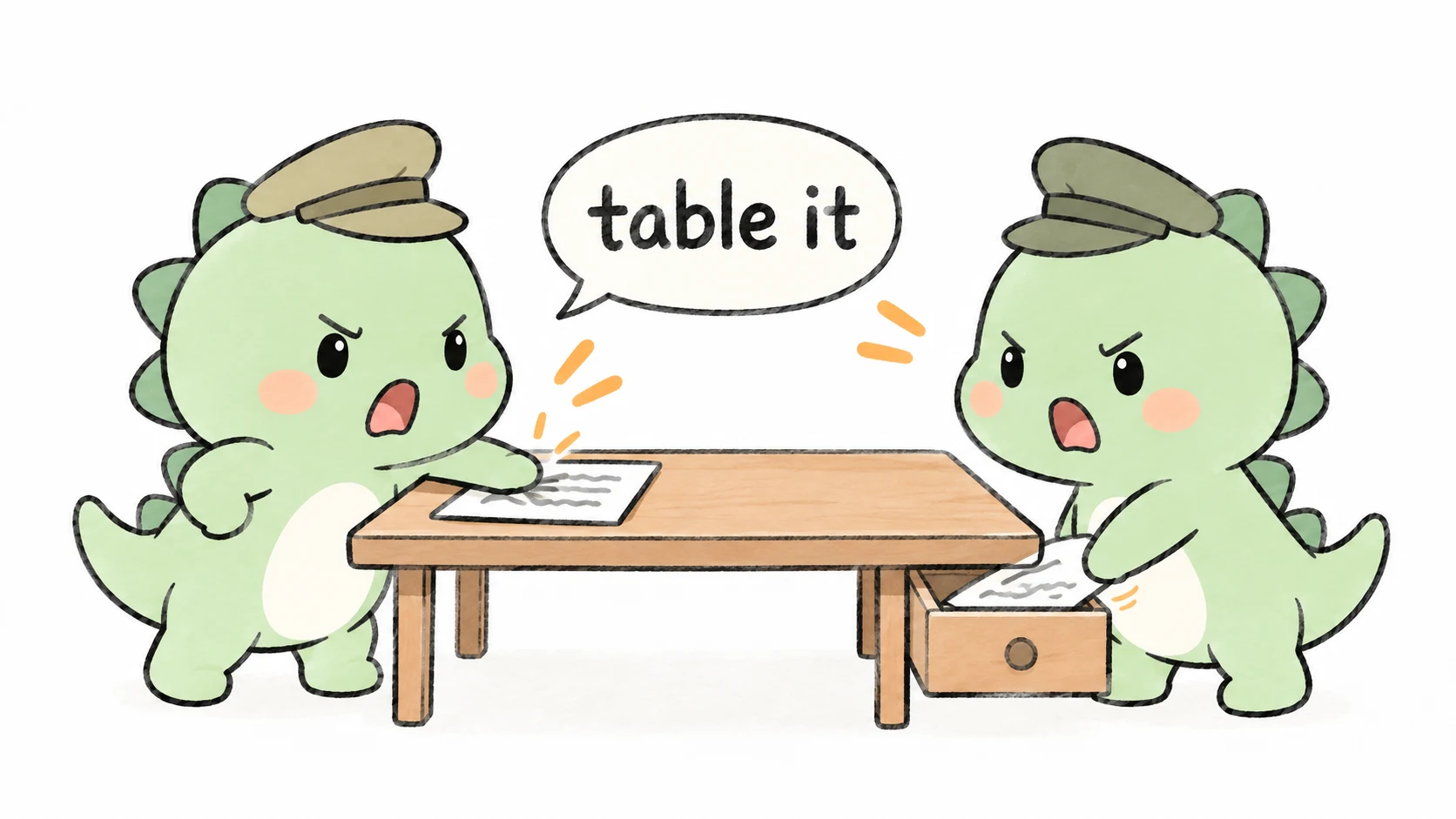
As Everyday English words that change meaning at the office explains, to table a proposal in Britain is to bring it up for discussion; in the US it is to shelve it — the opposite. This has caused real trouble.
In The Grand Alliance (1950), the third volume of his history of the Second World War, Winston Churchill recalls the early days of the combined British–American staff. The British prepared an urgent paper and told their American colleagues they wished to "table it" — to discuss it now. To the Americans, tabling a paper meant "putting it away in a drawer and forgetting it."
A long and, in Churchill's words, "even acrimonious" argument followed before both sides realized they agreed and wanted the same thing. Churchill calls it "an amusing incident." The people at the table probably weren't laughing.
Other words that can send you the wrong way
| Word | British | American | Where it goes wrong |
|---|---|---|---|
| first floor | one flight up | street level | Finding the meeting room |
| subway | pedestrian underpass | underground railway | Asking directions. London's metro is the Underground, or the Tube |
| pavement | sidewalk | road surface | "Stay on the pavement" means different places on each side |
| holiday | time off, a vacation | a public holiday; the year-end festive season | The sample test's question 76 has an option called "A holiday sale" — the American year-end sale |
| diary | appointment book, planner | private journal | A British colleague who says Let me check my diary is checking their schedule, not their secrets |
| quite good | fairly good (sometimes a polite "so-so") | very good | If a British manager calls your report quite good, hold the celebration |
| entrée | starter (Australia, France) | main course | Ordering dinner |
| pants | underwear | trousers | Think twice before complimenting a London colleague's pants |
Quite deserves a word more. In British English, quite before an adjective often means "fairly" or "reasonably," and the tone depends on stress and context; in American English it usually means "very." That's quite good is praise in New York and may be a shrug in London. The exam rarely tests shades of tone like this; a real job always does.
A TOEIC-oriented lookup table
Grouped by situation, American on the left and British on the right. Pairs in bold are the ones you are more likely to meet in TOEIC questions.
Travel and directions
| American | British |
|---|---|
| elevator | lift |
| subway | underground / the Tube (London) |
| parking lot | car park |
| round-trip ticket | return ticket |
| one-way ticket | single ticket |
| schedule | timetable |
| car rental | car hire |
| highway, freeway | motorway |
| gas, gas station | petrol, petrol station |
| sidewalk | pavement |
| give someone a ride | give someone a lift |
Home and daily life
| American | British |
|---|---|
| apartment | flat |
| first floor | ground floor |
| line | queue |
| cell phone | mobile (phone) |
| post | |
| zip code | postcode |
| trash, garbage | rubbish |
| drugstore, pharmacy | chemist, pharmacy |
Work and school
| American | British |
|---|---|
| résumé | CV |
| vacation | holiday |
| vacation days, PTO | annual leave |
| two weeks | fortnight |
| calendar (for appointments) | diary |
| semester | term |
Restaurants and shopping
| American | British |
|---|---|
| check (the bill) | bill |
| takeout | takeaway |
| appetizer | starter |
| fries | chips |
| chips | crisps |
| cookie | biscuit |
The last two rows are the trap of traps: American chips are British crisps, and British chips are American fries. Order fish and chips in London and you get fried fish with fries, not a bag of potato chips.
Why does one language have two sets of words?
In "The Canterville Ghost" (1887), Oscar Wilde wrote that "we have really everything in common with America nowadays, except, of course, language."
The version quoted more often — that Britain and America are two countries divided by a common language — is usually credited to George Bernard Shaw. But Quote Investigator traced it: the earliest attribution is a 1942 Christian Science Monitor article saying Shaw had said it, and no one has found the line in his writings or interviews. Wilde's version is there in black and white.
The differences come from two main sources.
New things got named separately. Elevators, underground railways, car parks, gasoline — all of these arrived after Britain and America had gone their separate ways, so each side named them independently. Lift and elevator, petrol and gas, underground and subway all came about this way.
One side kept a word the other dropped. American fall (for autumn) is often taken for an American simplification. In fact it is short for fall of the leaf; the Online Etymology Dictionary dates the "autumn" sense to the 1660s and notes it was once common in England. England moved to autumn, and America kept fall. As with the -ize spellings in the previous piece: American doesn't always mean newer.
So which set should you learn?
Same answer as for spelling: the TOEIC Listening and Reading test never asks you to write, so you don't have to choose — you only have to recognize both.
For listening, treat a British or Australian accent as a reminder, not an answer: it tells you a second meaning is possible, and the context decides which one is meant. Speakers borrow each other's words all the time — the Australian in question 9 said "ride" — and a building's floor numbers belong to the building, not to whoever is describing it. So when you hear "first floor," listen for relative position like "upstairs" or "above reception"; when you hear "table," work out whether the discussion is starting or being put off. For reading, when you meet flat, queue or fortnight, don't stop. They are neither typos nor rare words.
When you write your own emails and reports, pick one set and stay consistent. If you learned American English, keep using it. A message that says apartment in one paragraph and flat in the next reads as if two people wrote it.
As usual, this table comes with exceptions
The line is not clean. Canada spells centre and storey but numbers its floors the American way. Australia mostly follows Britain but has plenty of its own (the afternoon is "arvo," which the TOEIC is unlikely to test). And after decades of American films and television, the British understand — and sometimes say — movie, apartment and cookie. Every table above says "usually," not "always."
The sample test is only one test. When we say the TOEIC varies accents but not vocabulary, we mean the one sample ETS has published. The real test has hundreds of forms, and we have no data on them, so we can't promise you'll never meet flat or queue on test day. Recognizing them costs you nothing — that's the point.
Tone is the hardest thing to put in a table. Whether a British quite is praise or politeness depends on stress, setting and speaker. A table can tell you the difference exists; it can't make the call for you every time.
Accent Compare in Handy 990 plays the same sentence in American and British English, and Accent ID asks you to name the accent from a single clip — once you can tell a British speaker the moment they start, you'll remember that the other set of words may be in play. For the spelling half of the story, theatre and theater, read British vs. American spelling; for words that change meaning once you walk into the office, read Everyday English words that change meaning at the office.