
All articles · Published 2026-09-29
Discreet vs. discrete: the look-alike English words that spell-check can't catch and your ears can't hear
Discreet means careful; discrete means separate. They sound exactly alike and differ only by two swapped letters. This post starts from a reader's report: the two words were once a single Latin word that split around 1600. Then it takes six look-alike pairs that turn up in TOEIC reading — complement/compliment, stationary/stationery, principal/principle, affect/effect, personal/personnel, loose/lose — each with a way to remember it. And an honest finding: in the Part 5 questions of the official TOEIC sample test, not one item is built on a pair like these. They trip you up somewhere else.
A reader's report: "'carefully' should be discreetly"
On August 4, a user tapped the report button on a Part 5 question and left a single line:
discretely means "separately, individually"; "carefully" should be discreetly
This was the question:
Accurate record-keeping helps prevent costly ___ in the inventory.
(A) discreetness (B) discreet (C) discrepancies (D) discretely
The answer is (C) discrepancies — keep accurate records and your stock counts won't disagree with the books. The reader was pointing at the translation of option (D): "carefully" is what discreetly means; discretely means "separately, individually." The reader was right, and it has been fixed.
Which is exactly what this post is about: English has a set of words you can misspell without anyone noticing.
Why are these mistakes so hard to catch?
An ordinary typo gets a red underline. Type recieve and spell-check flags it at once.
But discreet and discrete are both real words. So are complement and compliment. Type "Personal Department" when you meant "Personnel Department" and Word won't say a thing — it checks that a word exists, not that it's the word you meant.
Worse, your ears don't help either. Half the pairs in this post are pronounced identically:
| The pair | Can you hear the difference? |
|---|---|
| discreet / discrete | No — both are /dɪˈskriːt/ |
| complement / compliment | No |
| stationary / stationery | No |
| principal / principle | No |
| affect / effect | Barely — in casual speech they often sound the same |
| personal / personnel | Yes — the stress moves |
| loose / lose | Yes — /s/ versus /z/ |
Spell-check won't catch them and your ears can't separate them, so the only thing telling them apart is a letter or two. That's why they keep getting mixed up — by native writers, and by translators.
Discreet and discrete: originally one word
These two look alike for a reason: they were the same word.
According to the Online Etymology Dictionary, both come from Latin discretus, the past participle of discernere, "to distinguish, to separate." It entered English in the late 14th century carrying two meanings at once: "separate," and "able to tell right from wrong, prudent." For a couple of centuries, writers spelled it either way.
The split came after about 1600. The spelling discreet became the everyday word for "careful, prudent"; the spelling discrete stayed on in philosophy, medicine, music and other fields that, in Etymonline's words, "remembered Latin and took some pains to show it," keeping the original sense of "separate, distinct."
So today the division of labor is:
- discreet (careful, tactful, low-key): a discreet inquiry, Please be discreet.
- discrete (separate, individually distinct): three discrete stages, discrete data
How to remember it: look at the two e's. In discreet they sit side by side, like two people whispering a secret — careful. In discrete a t stands between them — separate.
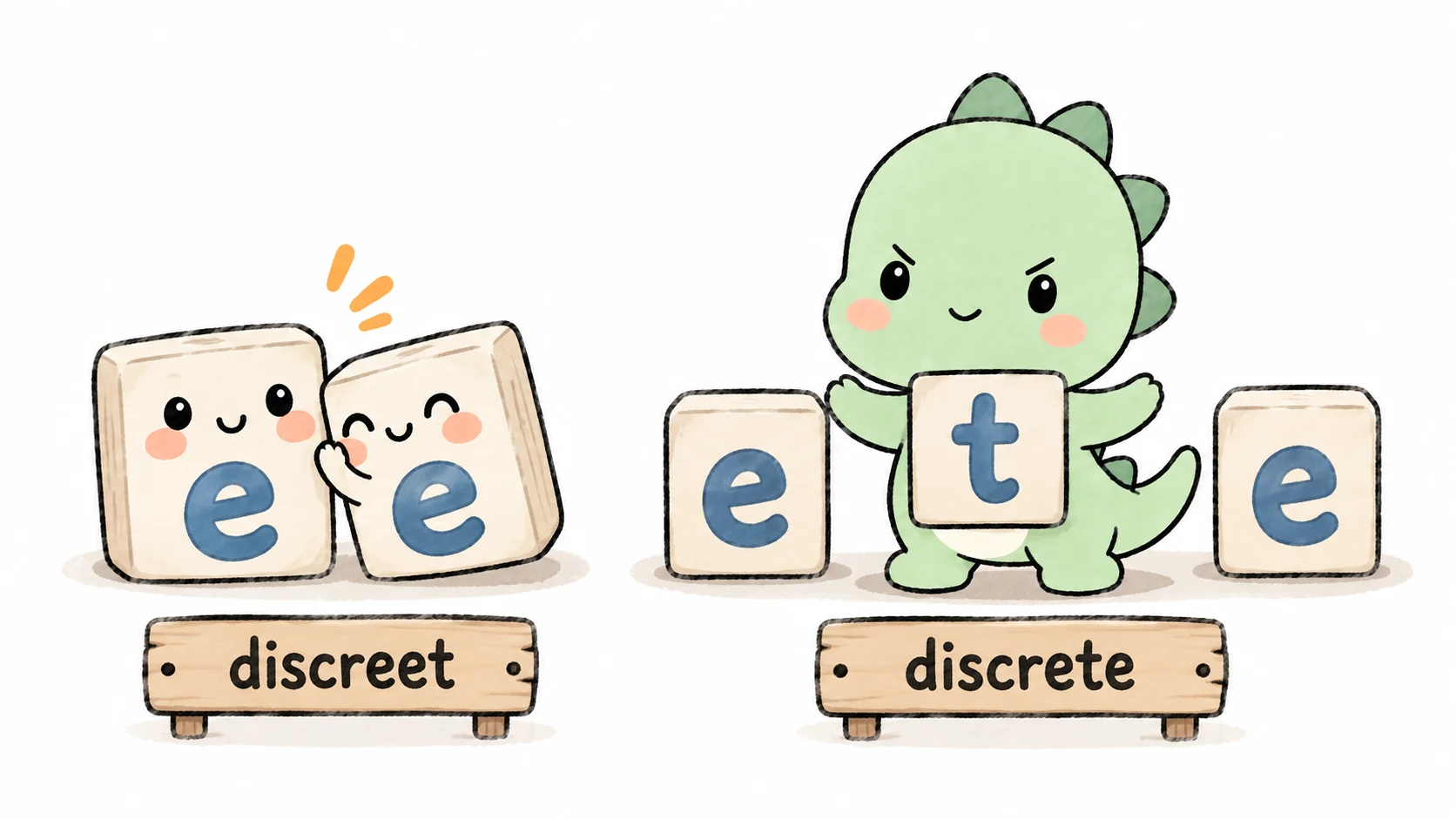
Their nouns went their own ways too. The noun for discreet is discretion (prudence, the freedom to decide — at your discretion means "as you see fit"); the noun for discrete is the rarer discreteness. Discretion is spelled more like discrete, but its meaning belongs to discreet. Even their divorce left some property unsorted.
Back to that question: (A) discreetness, (B) discreet and (D) discretely all belong to this one family. Only the correct answer, (C) discrepancies, is an outsider. It comes from a different Latin verb, discrepare, built on crepare, "to rattle, crack" — two figures that don't agree are two sounds out of tune. All four options start with the same four letters, disc. Whoever wrote that question knew exactly what they were doing.
Does the TOEIC actually test these?
Honest answer: rarely, in Part 5.
The official TOEIC Listening and Reading sample test that ETS publishes has five Part 5 questions. Two of them (101 and 103) are word-form questions — one root, options like complication, complicates, complicate, complicated. The other three test a pronoun, a connector and vocabulary. None of the five is a discreet-versus-discrete trap: two words that look alike but come from different families.
Five questions is far too few to say the real test never does this. So we also counted our own question bank: of 1,216 Part 5 questions, only 8 put both halves of a look-alike pair among the options (complement/compliment, affect/effect, advice/advise and so on) — under 1%.
So why learn them? Because they keep appearing in the reading material itself, and misreading one derails the whole sentence. Here is how often they occur in the English text of our Part 5–7 questions:
| Word | Occurrences in our reading questions | Its look-alike |
|---|---|---|
| complimentary (free of charge) | 55 | complementary (completing, matching): 2 |
| personnel (staff, the HR department) | 9 | personal (individual, private): 89 |
| stationery (writing paper, office supplies) | 11 | stationary (not moving): 1 |
Read complimentary breakfast as "a breakfast that goes well with something," or personnel as personal, and you can put your pencil down — the question is already lost.
And there's a more practical reason: sooner or later you'll write an email in English. Spell-check won't save you.
Six look-alike pairs that turn up on the TOEIC
complement / compliment
- complement: to complete, to go well with. The wine complements the dish.
- compliment: praise. She complimented his presentation.
What you'll meet most on the TOEIC are the adjectives, and their meanings are far apart: complimentary means "free of charge" (complimentary shuttle), complementary means "completing each other" (complementary skills). In hotel, airline and event English, complimentary almost always means you don't pay.
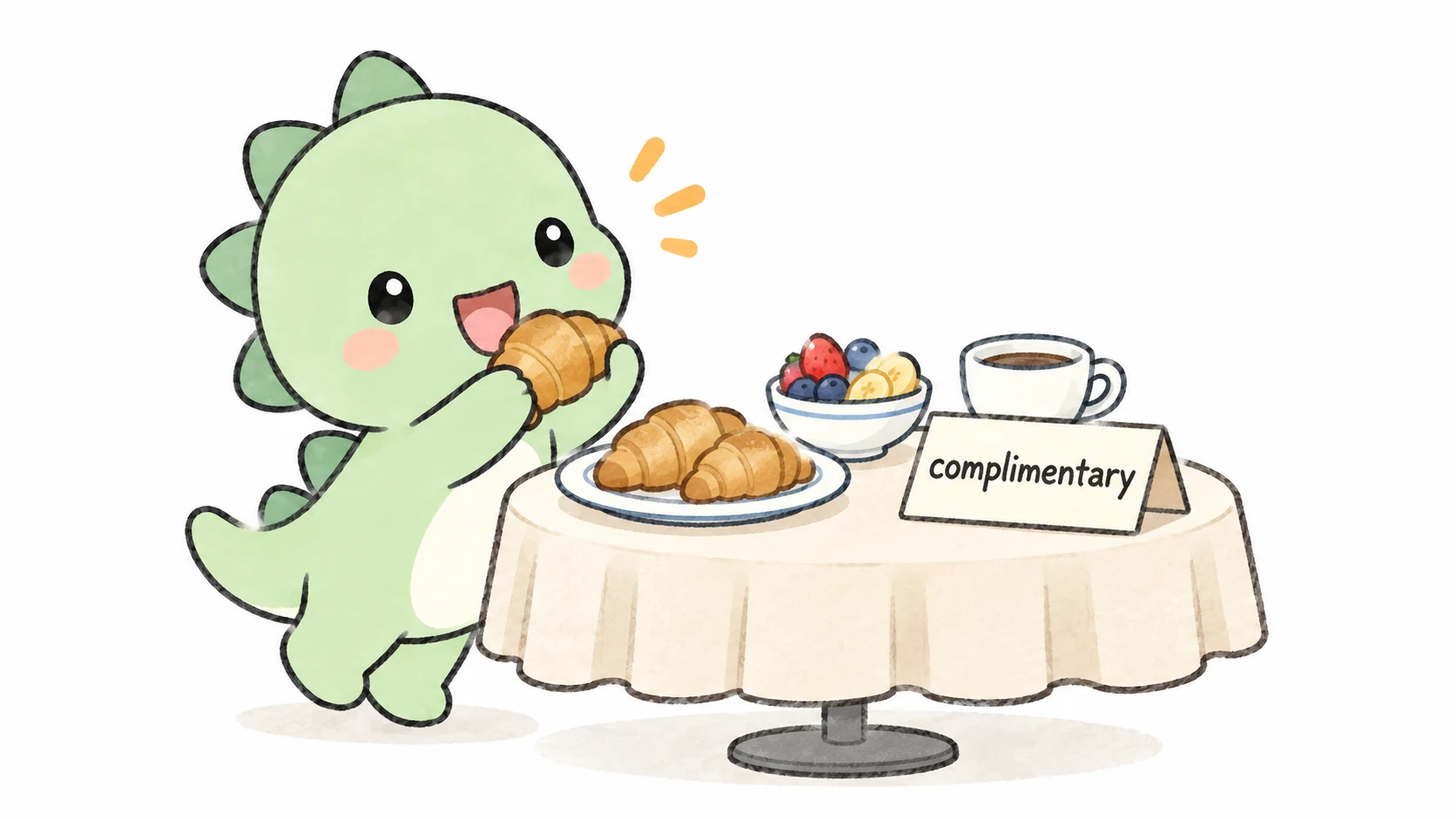
This pair, too, split from one word: both go back to Latin complementum, "that which fills up or completes." Etymonline records that in the 16th century complement could also mean "that which is added, not as necessary, but as ornamental," and in the 1610s the verb could even mean "to exchange courtesies." Between roughly 1650 and 1725 those senses passed to compliment, which had come back into English by way of French and Italian. A compliment, originally, was something extra added on.
How to remember it: complement shares its e with complete — it fills things up. Compliment has an I in it — I like compliments.
stationary / stationery
- stationary: not moving. The car was stationary.
- stationery: writing paper and office supplies. an order for office stationery
The story behind stationery is a good one. According to Etymonline, most medieval English merchants were roving peddlers; the few who sold from a fixed spot — a station — were often booksellers licensed by the universities. So those sellers were called stationers, and the paper, pens and envelopes they sold became stationery. The word for writing paper literally means "stuff from the guy who stays put."
How to remember it: the e in stationery is the e in envelope. The a in stationary is a parked car.

principal / principle
- principal: main (adjective); a head of school, a lead party, or the principal of a loan (noun). the principal reason, the loan principal
- principle: a rule or basic truth. a matter of principle
The sense to know for the TOEIC is principal as in money: in articles about loans and investments, principal and interest travel as a pair. Etymonline dates that "main sum of money" sense to the early 15th century.
How to remember it: principle ends in -le, like rule. The old classroom trick for the other one is "the principal is your pal" — a memory aid, not etymology.
affect / effect
- affect: a verb, to influence. The delay affected our schedule.
- effect: a noun, a result or influence. The new policy took effect in May.
The usual mnemonic is RAVEN: Remember Affect Verb, Effect Noun.
This pair has exceptions, covered in the caveats below. And the confusion is older than you'd think: Etymonline notes that effected has been used erroneously for affected since the early 15th century. Native speakers have been mixing these two up for six hundred years. You're in good company.
personal / personnel
- personal: individual, private. Stress on the first syllable: PER-so-nal.
- personnel: staff as a body; the HR department. Stress at the end: per-son-NEL.
Personnel was borrowed from French in 1837 as a military term, set against matériel (equipment and supplies): an army is made of people and things, and personnel is the people. That's why it's a collective noun — a whole group, never one person.
This pair and loose/lose below are the rare ones you can tell apart by ear — in Part 3 and 4 audio, a stress landing at the end, per-son-NEL, means the staff or the HR department.
How to remember it: personnel has the extra n, and its stress lands on that final -nel, French-style.
loose / lose
- loose (/luːs/): not tight. a loose screw
- lose (/luːz/): to fail to keep, or to be defeated. We can't afford to lose this client.
Native speakers get this one wrong constantly — "you're going to loose" is no rarity in online comments. The two are actually distant relatives: Etymonline traces both to the same Proto-Indo-European root *leu-, "to loosen, divide, cut apart," but lose comes down from Old English losian, while loose was borrowed from Old Norse lauss.
How to remember it: loose rhymes with goose and moose, with an /s/; lose sounds like whose and choose, with a /z/. Lose lost an o.
A few more
| This | That | One way to tell them apart |
|---|---|---|
| adapt (adjust, modify) | adopt (take up, take on) | to adopt a new policy is to start using it |
| advice (noun) | advise (verb) | noun with c, verb with s — the same split British English makes with practice/practise |
| precede (come before) | proceed (go on) | pre- means "before," pro- means "forward" |
| ensure (make certain) | insure (buy insurance) | insurers insure |
| council (a governing body) | counsel (advice; a lawyer) | a city council governs a city |
| moral (ethical) | morale (team spirit) | staff morale is how the team feels |
| desert (dry land) | dessert (sweet course) | dessert has two s's because you'll want seconds |
How to practice: part of speech first, meaning second, spelling last
Back to the question we started with. Four options that look alike — but you don't need to untangle every one of them first:
- Part of speech first. In costly ___, the blank follows an adjective, so it needs a noun. (B) discreet is an adjective and (D) discretely is an adverb — cross them out.
- Then meaning. That leaves discreetness (carefulness) and discrepancies (mismatches). "Prevent costly carefulness in the inventory" makes no sense.
- Spelling is only the final check.
Most look-alike traps work this way: they hide inside word-form questions and make you think you're being tested on spelling. Cut half the options by part of speech, decide the rest by meaning, and the shapes stop fooling you.
When reading passages, do the opposite: when you meet complimentary, personnel or stationery, slow down for half a second and make sure you know which one you're looking at.
The honest caveats
- The official sample test has only five Part 5 questions. "None of them is a look-alike trap" means exactly those five. ETS doesn't publish its item-writing rules, so we can't claim the real test never uses one.
- The counts come from our own question bank. 1,216 questions, 55 uses of complimentary — these are numbers from questions we wrote, not statistics from real TOEIC forms. They show that these words are common in TOEIC-style passages; they say nothing about how often the official test uses them.
- Mnemonics break. RAVEN fails twice: effect can also be a verb meaning "to bring about" (effect change), and affect is a noun in psychology, meaning outward emotional expression. On the TOEIC you'll usually meet the RAVEN side, but don't mark effect a change as a typo.
- Most mnemonics aren't etymology. "Two e's whispering" and "the principal is your pal" are pictures for memory; they have nothing to do with where the words came from. Only complement/complete happens to be true — those two really are family.
In Handy 990 you can long-press any word in a question to look it up — when you can't tell discrete from discreet, a long press settles it. If a question or translation looks wrong, tap Report a problem; you can follow its progress later under My reports in Settings. Elsewhere in this series, wind and wind covers a different kind of mix-up — words spelled the same but pronounced differently; Bored or boring? covers another pair that differs only in its ending and means the opposite; and Everyday English words that change meaning at the office collects familiar words like sheets and bars that mean something else at work.