
All articles · Published 2026-10-05
What is ASD-STE100? Simplified Technical English, the language of aircraft manuals: 875 words, one meaning each, no semicolons
In early October, X lit up with a tip from Andrej Karpathy: ask the AI to write in ASD-STE100, and what it writes gets much easier to read. ASD-STE100 is a simplified English designed for aircraft maintenance manuals: 875 approved words, one meaning per word, 20 words per sentence at most, and no -ing forms, perfect tenses, phrasal verbs or semicolons. To be clear up front: this post will not add a single point to your TOEIC score, but you may finish it with one more trick for talking to AI.
October 1: Karpathy tells everyone to read an aircraft manual
On October 1, 2026, Andrej Karpathy, a founding member of OpenAI, posted a few tips on X for making AI output easier to understand. The first: tell the model to write in ASD-STE100. Models know the rules well, he wrote, and the result is often "a lot more readable"; sometimes he softens the request and asks for only "80% of the way" to ASD-STE100.
Over the next few days the post went around X. Someone had already packaged the STE rules as an AI "skill" on GitHub, and it got dug up again; tech news followed with headlines about making AI write like an aircraft manual. For many people, this was the first time they had heard the name.
So let's get the bad news out of the way: this post will not help your TOEIC score. The TOEIC is not written in STE, and nobody in the exam room will ask you to answer in it. This is pure Language Notes. If you use AI tools such as ChatGPT or Claude, you will come away with a tool you can actually use; if you only want exam preparation, the other posts in this series are a better use of your time.
That said, ASD-STE100 was not invented for AI. It turns forty this year, and the readers it was built for are a lot like you: people who read English every day, though English is not their first language.
Why did aircraft maintenance need its own simplified English?
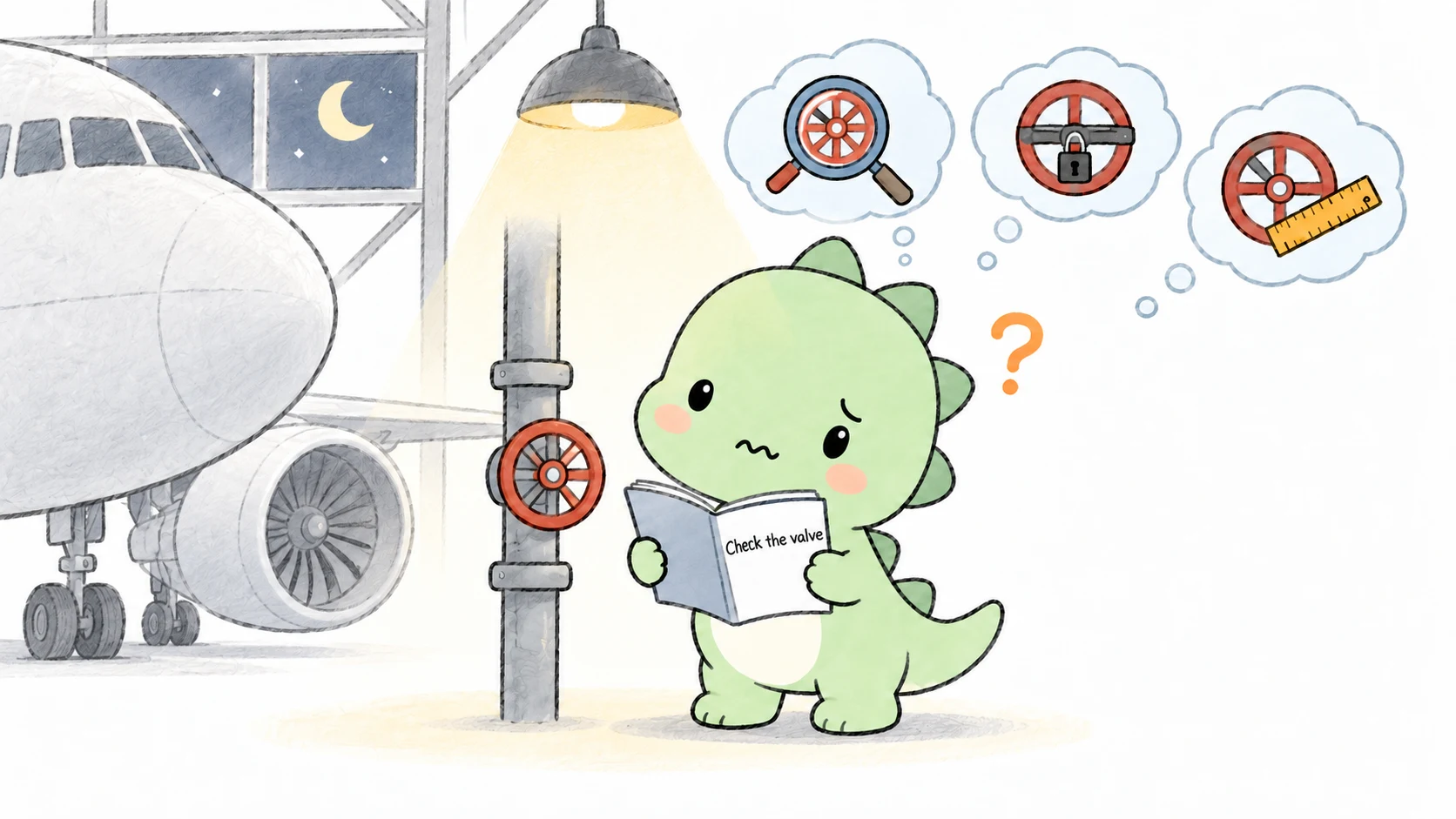
Picture a maintenance technician in a hangar in Bangkok, Seoul or Lisbon at three in the morning, holding an English manual. The manual says Check the valve. Does check mean "take a look at it"? "Make sure it is closed"? "Measure it"? A native speaker guesses right by feel. A second-language reader has to gamble. On an aircraft, a wrong gamble costs too much.
According to the general introduction to Issue 9 of ASD-STE100, in the late 1970s the Association of European Airlines (AEA) asked the European Association of Aerospace Industries (AECMA) to investigate the readability of civil aviation maintenance documents and find a way to simplify their language. AECMA brought in the Aerospace Industries Association of America (AIA). The two groups went through a large number of maintenance manuals and concluded that the industry did need a simplified English.
The timeline from there:
- June 30, 1983: the AECMA Simplified English Working Group is founded in Amsterdam.
- February 15, 1986: the first release of the AECMA Simplified English Guide.
- 1987: the Air Transport Association of America (ATA) writes the requirement to use STE into ATA100, its specification for technical publications. The name STE100 is a tribute to ATA100.
- 2005: renamed ASD-STE100 Simplified Technical English (AECMA had become part of today's ASD).
- January 15, 2025: Issue 9 is released, now formally a standard.
The whole specification is a free download from the official site, asd-ste100.org.
It was not the first simplified English either. The British writer C. K. Ogden proposed Basic English in 1930, with just 850 root words; in 1971 the American company Caterpillar introduced Caterpillar Fundamental English so that service staff around the world could read its machinery manuals. In his survey of controlled languages (2014, Computational Linguistics), Tobias Kuhn describes 100 English-based controlled languages; Basic English is the oldest of them and the most influential.
What does STE look like? 53 rules and 875 words
STE has two parts:
- Writing rules: 53 of them in Issue 9, in nine sections: words, multi-word nouns, verbs, sentences, procedural writing, descriptive writing, safety instructions, punctuation and word count, and writing practices.
- A dictionary: 875 approved words, plus 1,274 words that are not approved, each with the words to use instead.
875 words sounds like very few, but the count leaves out technical vocabulary. Words like screw, hydraulic pump and circuit breaker are "technical nouns", and along with the technical verbs approved in a company or industry, they can be used as they are. The 875 words are the frame around the nouns: the verbs, adjectives, prepositions and conjunctions.
Some of the most characteristic rules:
| Rule | What it says |
|---|---|
| Sentence length | Procedures: 20 words per sentence at most. Descriptions: 25 at most |
| Paragraph length | Descriptions: 6 sentences per paragraph at most, one topic only |
| One action per sentence | One instruction per sentence (unless the actions happen at the same time) |
| Imperative | Instructions are commands: Remove the cover. |
| Active voice | Always active; descriptions may use the passive only when you do not know who did the action |
| Tenses | Only the infinitive, the imperative, the simple present, simple past and simple future, and the past participle used as an adjective |
| -ing | Not allowed (unless it is part of a technical noun) |
| Phrasal verbs | Do not make your own phrasal verbs |
| Omissions and contractions | Do not leave words out, and do not use contractions such as don't and isn't |
| Semicolons | Not allowed |
| Spelling | American spelling by default, following Merriam-Webster |
If you have read our British vs. American spelling, the last rule may make you smile: a standard born in Europe chose American spelling.
One word, one meaning
The heart of STE is one rule: every approved word has one meaning and one part of speech.
In Everyday English words that change meaning at the office, we saw that the more common an English word is, the more meanings it tends to have. STE cuts those meanings down to one:
- fall can only mean "to move down by the force of gravity". The general introduction uses fall as its own example: it may not be used to mean "decrease".
- follow can only mean "to come after". For doing what instructions say, there is a different word: obey. One dictionary example puts the two side by side: OBEY THE PRECAUTIONS THAT FOLLOW. Follow handles order, obey handles compliance, and neither does the other's job.
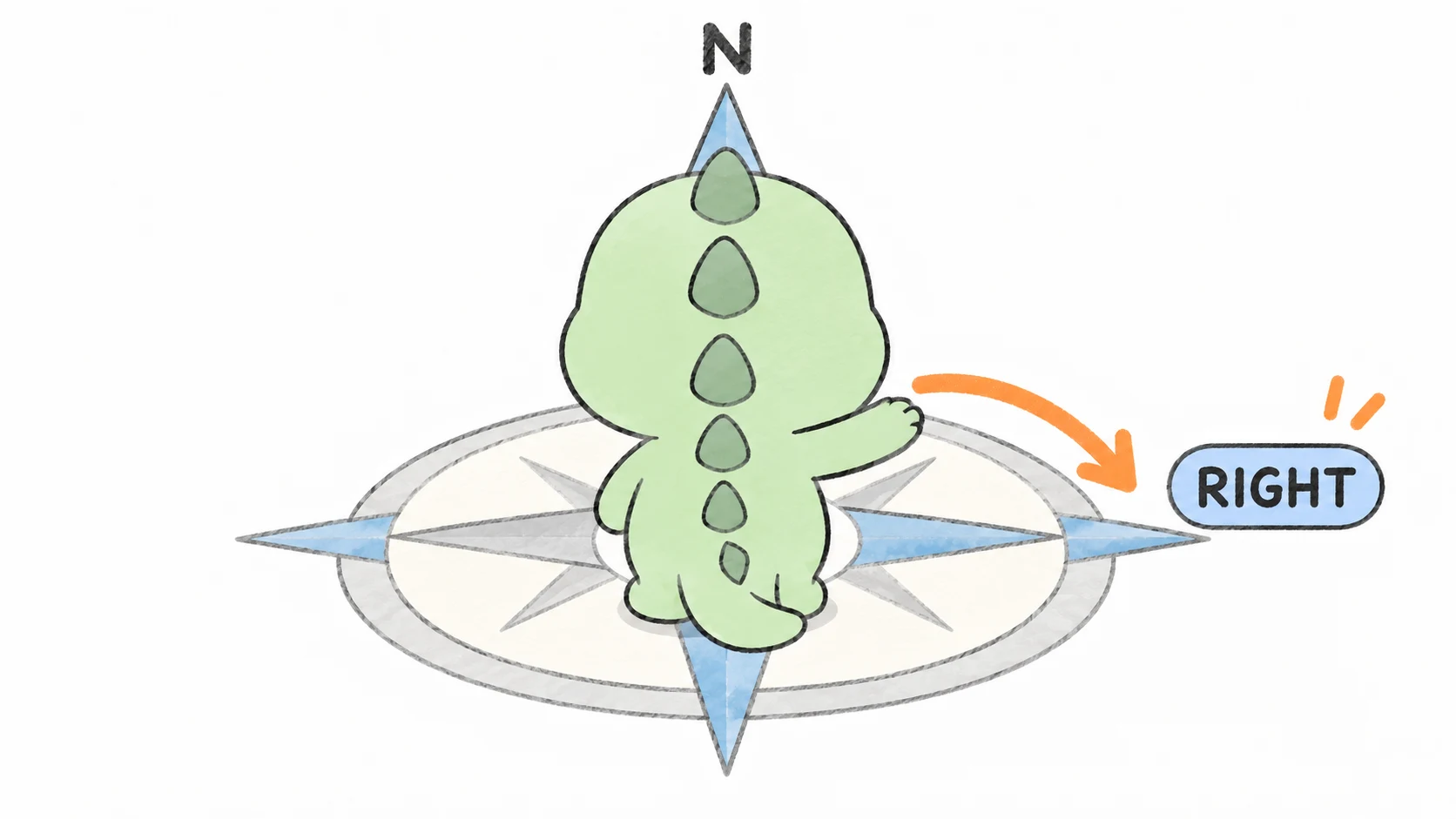
- right can only mean the side, never "correct". The dictionary defines it as On the east side when you look north. To give "right" just one meaning, STE defines it with a compass.
- check is approved only as a noun, never as a verb. You cannot write Check the valve; you write Do a check of the valve, or, depending on what you actually mean, make sure, measure or examine.
- by is approved only as a word for arithmetic: divide by two, increase by 10 degrees. For doing something with a tool, you write with.
Synonyms get the same treatment: only one survives. The general introduction's example: STE uses start, not begin, commence, initiate or originate.
The pairs below all come from the STE dictionary (its STE examples are printed in capitals; here they are in normal case). The bold marks what changed:
| Not STE | STE |
|---|---|
| When there is a fall in pressure, the indicator shows a leak. | When the pressure decreases, the indicator shows that there is a leak. |
| Obey the following precautions. | Obey the precautions that follow. |
| Check the casting for corrosion. | Examine the casting for corrosion. |
| Ensure that the correct seals are installed. | Make sure that the correct seals are installed. |
| Increase pressure until the flow begins again. | Increase the pressure until the flow starts again. |
| Attach both ends of the hose. | Attach the two ends of the hose. |
| Insert the sleeve into the opening. | Put the sleeve into the opening. |
| Call the ramp agent to remove the chocks. | Tell the ramp agent to remove the chocks. |
| Light L4 illuminates within 5 seconds. | Light L4 comes on in 5 seconds or less. |
| If you consider that the indication is not correct, do the test again. | If you think that the indication is not correct, do the test again. |
Why no -ing, no perfect tenses and no phrasal verbs?
These are the rules English learners feel most, because they are exactly the things school spends the most time on.
-ing. STE's explanation: the same -ing word can be part of a verb, an adjective or a noun, and it can build long chains of modifiers. Compare:
- The door is opening. Part of the verb.
- An opening door can be dangerous. An adjective.
- Opening a door can be dangerous. A noun.
A native speaker sorts these out at a glance; a second-language reader often has to stop and think. So STE does not allow them:
- ✗ When you are doing this procedure, obey all the safety precautions.
- ✓ When you do this procedure, obey all the safety precautions.
Of the adjective pairs in Bored or boring?, only half survive in STE: -ing adjectives like boring are not allowed; on the -ed side, a past participle can be an adjective, but only in a form the dictionary approves.
Perfect and progressive tenses. STE allows only the simple present, the simple past and the simple future:
- ✗ The technician has adjusted the linkage.
- ✓ The technician adjusted the linkage.
had adjusted and is adjusting are out too. Every worksheet you ever filled in on the present perfect is of no use in an aircraft manual.
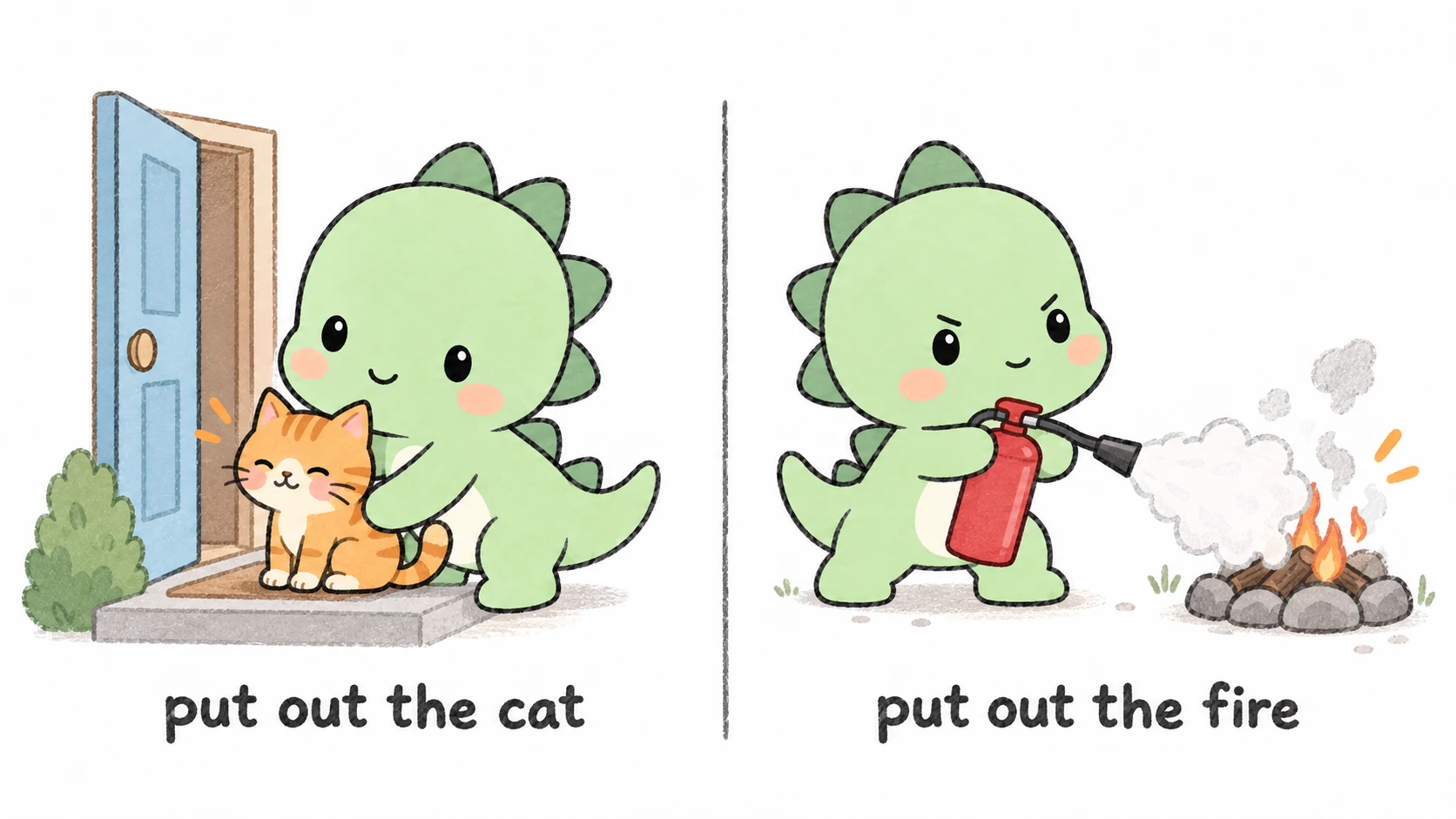
Phrasal verbs. STE's own example is easy to remember: Put out the cat means put the cat outside; Put out the fire means stop the fire. Put and out are both approved words, but together they grow a new meaning. The rule: do not combine approved words into phrasal verbs.
- ✗ After you put out the fire, close the valve on the fire extinguisher.
- ✓ After you extinguish the fire, close the valve on the fire extinguisher.
The same goes for fumes:
- ✗ This compound can give off poisonous fumes.
- ✓ This compound can release poisonous fumes.
Omissions. Drop the subject to save words, and the reader has to guess what is installed:
- ✗ If installed, remove the shims.
- ✓ If shims are installed, remove them.
Semicolons. The specification's reason is blunt: a semicolon lets you write very long sentences, and it is not easy to use correctly anyway. Wherever you want one, write two sentences:
- ✗ Examine the removed parts; replace the damaged ones.
- ✓ Examine the removed parts for damage. Replace the damaged part(s).
Does it work? What the research says
Two experiments on STE are cited again and again.
Shubert, Spyridakis, Holmback and Coney (1995, Journal of Technical Writing and Communication) compared aircraft maintenance procedures written in Simplified English and in ordinary English, with readers who were native and non-native speakers of English. Simplified English clearly improved comprehension, especially for the more complex documents.
Chervak, Drury and Ouellette (1996, Proceedings of the Human Factors and Ergonomics Society 40th Annual Meeting) took the experiment onto the maintenance floor: 175 practising aircraft maintenance technicians read 16 workcards covering two levels of difficulty, Simplified English or not, and two layouts. Simplified English clearly improved comprehension, and the gain came mostly where things were hardest: the difficult workcards, and the technicians whose first language was not English. The change of layout showed no effect.
In other words, for native speakers and simple documents, STE helps less; it helps most exactly where English is easiest to misread.
Rewriting the official TOEIC sample test in STE
This part is just for fun; it is not a test-taking technique. What happens if you hold a TOEIC paper up to the STE rules? We tried it on ETS's official TOEIC Listening and Reading sample test. Each pair shows the original first and the STE version below it.
The Part 5 directions. These already look a lot like STE: commands, one action per sentence, Then to mark the order. But they still break three rules:
- ✗ A word or phrase is missing in each of the sentences below. Four answer choices are given below each sentence. Select the best answer to complete the sentence. Then mark the letter (A), (B), (C), or (D) on your answer sheet.
- ✓ In each of the sentences that follow, a word or a phrase is missing. Below each sentence, there are four answers. Select the best answer to complete the sentence. Then put a mark on the letter (A), (B), (C), or (D) on your answer sheet.
In STE, below is approved only as a preposition (below each sentence is fine), not as an adverb after a noun; choice is not an approved word; and mark is approved only as a noun, not as a verb.
The line above every question set. Sentences of the refer to the following type appear 15 times in the sample test:
- ✗ Questions 161-164 refer to the following information.
- ✓ Questions 161-164 are about the information that follows.
Following is an -ing adjective that is not approved; the approved meanings of refer are of the "tell the reader where to find information" kind, and do not include "be related to".
A Part 7 notice (questions 161–164). Mooringtown Library invites community groups to use the notice board by its entrance. Three sentences from the notice:
- ✗ Notices must be approved in advance at the library's front desk and must meet the following requirements.
- ✓ Before you put a notice on the board, get approval at the library's front desk. Your notice must agree with the conditions that follow.
A passive, an unapproved meet and an unapproved following. The dictionary's replacements for meet are engage and touch, as when a part clicks into place or touches another, which is mechanical business.
- ✗ Any notices that do not meet these requirements will not be considered and will be discarded.
- ✓ If your notice does not agree with these conditions, we will not think about it. We will discard it.
Discard is approved, but the dictionary says to replace consider with think. Swap them mechanically and this is what you get: we will not "consider" your notice becomes we will not "think about" your notice. The STE version sounds rather more hurtful.
- ✗ Within one business day, you will receive a call confirming that your notice has been added to the board.
- ✓ In one business day or less, we will use the telephone to tell you that your notice is on the board.
Within is not approved, confirming is an -ing form, and has been added is a present perfect passive. And as we saw, by is only for arithmetic, so "by telephone" is not allowed either.
The rewrites come out a little longer and a little clunkier. But every word has one meaning, and every sentence does one thing.
Why does STE make AI easier to read?
Back to that post in early October. The usual faults of AI-written English are long sentences, piles of modifiers, and the same thing called by several different names, which is exactly what STE regulates, rule by rule. The STE rules are short and concrete, models have read them and can follow them, so "write it in STE" turns out to be a very cheap prompt.
There is some irony here: a standard designed for maintenance technicians who are not native speakers of English is now, forty years later, used by engineers around the world to make sense of AI. But it also shows something: English that is easy for second-language readers is easy for everyone.
Issue 9's general introduction makes a related point: once the words and sentence types are controlled, text written in STE is much easier for neural machine translation and large language models to translate.
How do you use STE when talking to AI?
This is the part of the post you can actually use. Three ways, starting with the least effort:
- Ask the AI to answer in STE. This is Karpathy's tip. Add one line after your question: Write your answer in ASD-STE100 Simplified Technical English, or, like him, soften it: Write about 80% of the way to ASD-STE100. You get shorter sentences, fewer modifiers, and one name for one thing from start to finish.
- Ask the AI to rewrite hard English in STE. When a passage defeats you (a contract, a manual, an English news story), ask the AI to rewrite it in the style of ASD-STE100. The result will not be real STE, but it will usually split long sentences, put the missing subjects back, and replace phrasal verbs with single verbs. Compared with asking it to "explain this passage", you get a clearer view of what the original actually says.
-
Write your own English prompts the STE way. This one has no research behind it; it is the same idea used in the other direction: one thing per sentence, commands, and one name for one thing throughout. For example:
- ✗ Could you maybe look over this and tidy it up a bit if possible?
- ✓ Read this e-mail. Find the errors in it. Correct the errors. Do not change the information in the e-mail.
The first has two phrasal verbs and a pile of polite padding; in the second, every word is an approved STE word (e-mail counts as a technical noun), and each sentence asks for one thing.
If English is not your first language, there is a bonus: you do not need long sentences to sound natural. The aerospace industry writes its most important documents in plain English like this on purpose.
The caveats, as usual
- STE is not an English textbook. The standard says so itself: its general introduction asks "Can STE be used to teach a writer English?" and answers no. It adds that writing STE correctly takes a high level of fluency in English.
- This post will not help you on the TOEIC. The TOEIC is not written in STE; its reading section is full of the following, present perfects and phrasal verbs, and you still have to learn them. Worse, STE's one-word-one-meaning rule can hurt you in the exam: in STE, follow cannot mean "obey", but on the TOEIC follow the instructions means exactly that. When you take the test, forget the STE dictionary.
- Our rewrites are not certified STE. We checked every word against the Issue 9 dictionary, but we treated nouns such as notice, board and answer sheet as technical nouns, which STE allows. Real STE writers are trained and use checking tools.
- Karpathy's "80% of the way to ASD-STE100" is not STE to begin with. Ask an AI to write in STE and you get English with an STE flavor, not documentation that meets the standard.
- The research is from the 1990s. Both experiments used the AECMA Simplified English of the time, and the participants were maintenance technicians and students, not TOEIC candidates.
Conclusion: even "right" starts from north
The most memorable entry in the STE dictionary is the definition of right: on the east side when you look north.
Not because the people who wrote the standard did not know what right means, but because they knew it means too much (the side, correct, a right, right away), and the person holding the manual at three in the morning needs only one of them.
Forty years later, the same idea is being applied to AI. AI's problem with English runs the other way: it wants to say everything, and its sentences keep getting longer. The next time it hands you a long, winding block of English, add one line after your question, Write in ASD-STE100, and make it talk like a maintenance manual at three in the morning.
Long-press any word in a Handy 990 question to look it up; the dictionary lists every meaning together, and the meanings STE cuts are exactly the ones the TOEIC tests. The phrasal verbs STE bans are taught in groups in Phrase Families: give up, give in and give away side by side. In the same series, Everyday English words that change meaning at the office is about words with many meanings, and Can you end a sentence with a preposition? is about another kind of rule: the ones native writers break every day.